

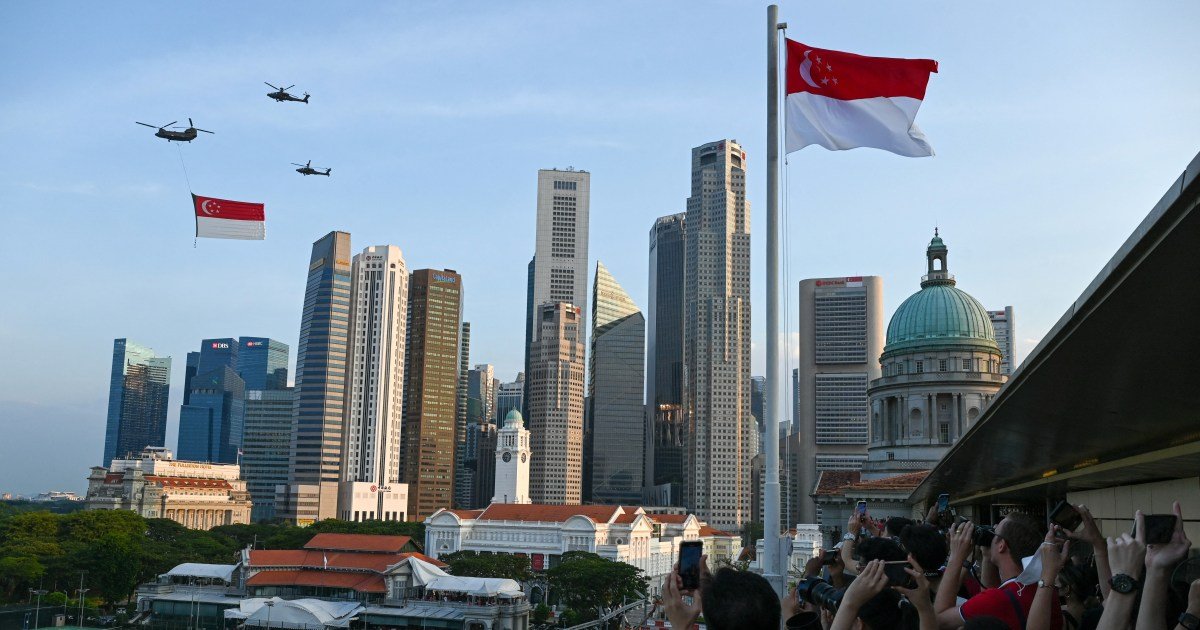
Singapore – As Singapore’s Diamond Jubilee celebrations draw to a close on Saturday night, a huge fireworks display will illuminate the city’s extraordinary skyline.
The numerous skyscrapers and futuristic buildings stand as a tribute to the country’s remarkable development after separating from Malaysia in 1965.
This tiny Southeast Asian state, with a population of just over six million people, has one of the highest rates of wealth per capita in the world. Its advanced economy also attracts workers from across the globe.
The financial hub is famed for its stability, high standard of living, forward-thinking approach and infamous for its centralised style of governance.
While Singapore will bask in some success this weekend, once the flags are taken down and the SG60 merchandise is removed from the shelves, the island-nation will get back to work and begin contemplating its future.
Plans are already in motion to continue Singapore’s growth, with its most famous landmark – Marina Bay Sands – set to house a new fourth tower of hotel rooms in 2029, while a 15,000-seat indoor arena will also be built at the site.
Changi international airport, which was ranked this year as the world’s best for the 13th time, will also gain a fifth terminal by the mid-2030s.
Residents of the “Lion City” clearly have plenty to look forward to, but the road ahead may also contain some potholes.
Al Jazeera has been taking a look at some of the challenges that Singapore could face in the next 60 years and how they might be tackled.
Singapore’s iconic Merlion statue with the business district in the background in 2019 [File: Vincent Thian/AP Photo]
Climate change
As a low-lying island, sitting just north of the equator, Singapore is particularly vulnerable to the threat of a changing climate. The country’s former prime minister, Lee Hsien Loong, once described it as a matter of “life and death”.
Rising seas and increased rainfall could lead to flooding, with extreme weather events set to be a more common occurrence.
While the city-state has so far dodged the kind of weather disruption that plagues many of its neighbours, the government is preparing for the worst.
Rising sea levels are of particular concern, with alarming estimates that the waters around Singapore could rise by more than a metre (3.2ft) by 2100.
To counter the threat, plans are being considered to build three artificial islands off the country’s east coast. These areas of reclaimed land would be linked by tidal gates and sit higher than the mainland, acting as a barrier.
Benjamin Horton, former director of the Earth Observatory of Singapore, said the country could come to a standstill if catastrophic rain were to combine with a high tide.
“If it flooded a lot of the infrastructure in Singapore, closing down MRTs [mass rapid transit], shutting down emergency routes, flooding a power station and the electricity went down – Singapore would be crippled,” Horton said.
The already-sweltering Southeast Asian financial hub will also have to cope with even hotter conditions.
Pedestrians shield from the sun with an umbrella as they walk in front of the parliament building in Singapore in May 2025 [File: Vincent Thian/AP Photo]
A 2024 government study found that the daily average temperature could rise by up to 5 degrees Celsius (9 degrees Fahrenheit) by the end of the century.
Horton, who is now dean of the School of Energy and Environment at City University of Hong Kong, said this could impact the country’s economic productivity.
“Singapore is always developing and is reliant on immigrant labour that works outside during the day. Climate change is going to impact that significantly,” he said.
Yet, Singapore, Horton said, has “the potential to be the lead in how you adapt to climate change and to be the leader in coastal protection”.
Demographic time bomb
Singapore’s population is ageing at a rapid rate.
By 2030, it’s estimated that almost one in four citizens will be aged 65 and above.
The life expectancy for a Singaporean born today is a little under 84 years, with residents benefitting from a high quality of life and a world-class healthcare system.
But this demographic shift is set to challenge the city-state over the next six decades.
An ageing population will inevitably require more investment in the medical sector, while the country’s workforce could face shortages of younger workers.
Older Singaporean women practice Tai Chi, a Chinese form of meditative exercise, in 2013 [File: Wong Maye-E/AP]
“The resulting strain will not only test the resilience of healthcare institutions but also place significant emotional, physical, and financial pressure on family caregivers,” said Chuan De Foo, a research fellow at the National University of Singapore’s (NUS) Saw Swee Hock School of Public Health.
While the authorities are looking to expand and strengthen healthcare facilities, they are also urging citizens to make better lifestyle choices in order to stay healthier for longer. New marketing campaigns encourage regular health check-ups, allowing for early intervention, while new technology is also being utilised.
“AI-driven tools are being developed to support mental wellbeing, detect early signs of clinical deterioration and assist in diagnosis and disease management,” Foo told Al Jazeera.
Fewer babies
Alongside living longer, Singaporeans – like many advanced Asian economies – are also having fewer babies, adding to the country’s demographic woes.
The fertility rate, which measures the average number of children a woman is expected to have in her lifetime, fell below 1.0 for the first time in 2023 and shows little sign of increasing.
That figure is even lower than Japan’s fertility rate of 1.15. This week, Japan reported its 16th consecutive year of population decline, with nearly a million more deaths than births in 2024.
Kalpana Vignehsa, a senior research fellow at NUS’s Institute of Policy Studies think tank, said the Singapore government is “swimming against a cultural tide” in its efforts to reverse the decline in births.
“Now is the time for expansive action to make parenting less expensive, less stressful, and most importantly, a highly valued and communally supported activity,” said Vignehsa.
Children in Singapore pass by an OCBC bank branch in 2020 [File: Edgar Su/Reuters]
An unstable world
Singapore is renowned for its neutral approach to foreign policy, balancing strong ties with both China and the United States.
But as relations between the world’s two biggest superpowers become increasingly strained, the Lion City’s neutrality could be challenged.
Any pivot towards Washington or Beijing is likely to be subtle, said Alan Chong, senior fellow at the S Rajaratnam School of International Studies.
He said that this situation occurred during the COVID pandemic, when Washington was not forthcoming with assistance for Asian economies.
“Almost all of Southeast Asia, including Singapore, tilted towards Beijing for economic support without announcing it,” said Chong.
US President Donald Trump’s punitive tariff policy has also caused consternation in the Southeast Asian business hub, which relies heavily on global trade.
Despite the threat from Washington’s increasingly protectionist policies, Chong believes that Singapore is prepared to weather the storm after signing a trade pact in 2020.
The Regional Comprehensive Economic Partnership was agreed between 15 mainly Southeast Asian countries, plus major North Asian economies including China, Japan and South Korea.
“It’s a huge insurance against any comprehensive global trade shutdown,” said Chong.
Stability at home
While the international outlook appears increasingly troubled, Singapore’s domestic political scene is set for more stability over the coming years.
The ruling People’s Action Party (PAP) has been in power since the country was formed and shows no signs of losing control.
In May’s election, the PAP, led by new Prime Minister Lawrence Wong, won all but 10 seats in parliament with just over 65 percent of the vote.
While the country’s leaders are likely to stay the same in the near-term, Teo Kay Key, research fellow at the Institute of Policy Studies Social Lab, said younger Singaporeans will soon want a different style of politics, one that is more open and more participatory.
“They are more likely to favour discussions and exchange of views,” she said.
“There is also a growing trend where the preference is to conduct open discussions, with a more democratic exchange of ideas,” she added.
