

Astronomers have found nearly 6,000 exoplanets orbiting other stars—but for every confirmed detection, there are countless mere hints, inconclusive observations that could just as well be blips of cosmic noise or glitches in a telescope. Most are too tenuous to take seriously, but every so often, one of these candidate planets is too tantalizing and potentially transformative to ignore.
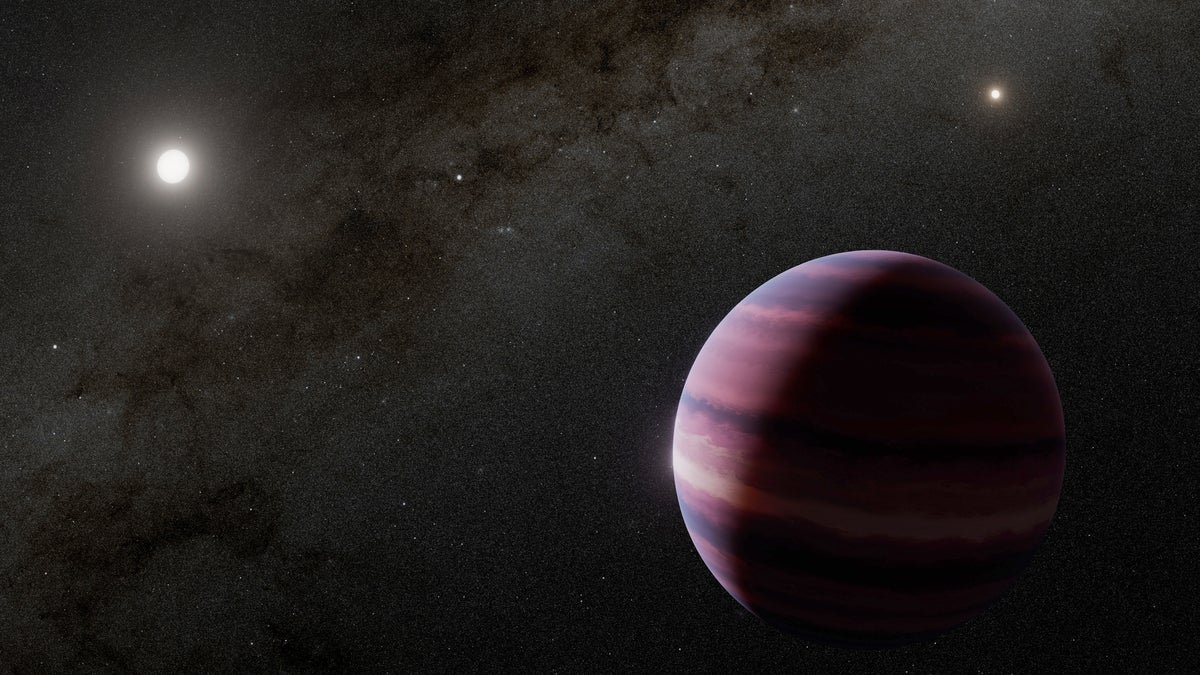
That’s certainly the case for one recently spotted by the James Webb Space Telescope (JWST) around a sunlike star called Alpha Centauri A, part of the nearest star system to Earth. If it is in fact a planet—and not instead a clump of dust or some instrumental aberration—the world would be a gas giant, akin to a warmer version of our own Saturn. It would orbit within Alpha Centauri A’s habitable zone, the starlight-bathed region where liquid water could persist on a planet’s surface, but the world itself would likely be lifeless, smothered beneath thick layers of gas. Any accompanying moons, however, could have better chances for harboring oceans—and perhaps even life.
Announced on August 7 in two papers accepted for publication in The Astrophysical Journal Letters, the candidate and its possibilities call to mind worlds from science fiction, such as the jungle moon of Pandora from James Cameron’s Avatar films—which, incidentally, orbits a gas giant called Polyphemos around, yes, Alpha Centauri A. But there’s still a chance the real-world JWST discovery proves to be a mirage.
On supporting science journalism
If you’re enjoying this article, consider supporting our award-winning journalism by subscribing. By purchasing a subscription you are helping to ensure the future of impactful stories about the discoveries and ideas shaping our world today.
“If it’s real, it’s amazing,” says Elisabeth Matthews, an exoplanet-focused astrophysicist at the Max Planck Institute for Astronomy in Heidelberg, Germany. “It’s a really exciting candidate—quite an intriguing candidate,” she says. “The authors work hard to make a case for why this, frankly, small and faint blob of light is believable, but I think there are still some open questions that need to be answered to really be 100 percent sure.”
The finding has been nearly a decade in the making, says Charles Beichman, an astronomer at NASA’s Jet Propulsion Laboratory and the California Institute of Technology and a co-author on the two new papers. In 2017, nearly half a decade before JWST would launch, he sent an email to scientists positing that the telescope’s giant 6.5-meter mirror paired with its Mid-Infrared Instrument (MIRI) might be able to see planets orbiting Alpha Centauri A. “When you stop laughing, let’s think about doing this project,” Beichman told them.
It was a bold suggestion, particularly when JWST was still on the ground, he admits. “Webb was never really meant to look at a star that’s this bright, moving this fast, and located, as Alpha Centauri is, right in the middle of the galactic plane where there’s thousands of stars,” Beichman says.
Despite those obstacles, the appeal was irresistible. Alpha Centauri A is about the same size and age as our sun, and with its two companions, the slightly smaller Alpha Centauri B and the tiny red dwarf star Proxima Centauri, comprises the nearest stellar system to our own—just about four and a half light-years away. Because the Centauri system is spitting distance from us astronomically speaking, it’s a bright, perennially popular target for scientists who may not be able to conduct similar observations on dimmer, more distant stars.
This is especially true for direct imaging, the technical term for when astronomers actually manage to take an exoplanet’s picture. Most exoplanetary discoveries instead arise through far more indirect means, such as the dip in a star’s light caused by a world passing between its sun and our telescope, or the tiny wobbling of a star caused by an orbiting planet’s gravitational tug. Only in rare cases can astronomers truly see an alien world; typically a planet needs to be very big and bright—as well as rather far from its sun—to offer any hope for astronomers to glimpse it against the overwhelming glare of its star.
But because Alpha Centauri A is cosmically close, Beichman and his colleagues thought that they could use JWST’s stunning power to accomplish the feat for even a planet orbiting relatively close to the star, within just a few times the distance between Earth and our sun. “Alpha Centauri just lets us cheat because it’s closer than everybody else,” Beichman says.
Although proximity makes for easier studies, this is counterbalanced against the system’s vexing complexity. Alpha Centauri A is the brightest star of the three, but its stellar companion Alpha Centauri B is still quite bright—and quite close, crowding in to a telescope’s field of view. Although JWST is equipped with a coronagraph—a masking tool to block out the glare from one star—it can’t do much to curtail this second, planet-obscuring source of light.
Three views of the Alpha Centauri star system. The first two images show the star system as seen by the Digitized Sky Survey (DSS) and by NASA’s Hubble Space Telescope. The third image shows August 2024 data from the James Webb Space Telescope’s Mid-Infrared Instrument (MIRI), in which light from Alpha Centauri A is blocked out to reveal the candidate planet (S1) identified by astronomers in newly published research.
Science: NASA, ESA, CSA, STScI, DSS, A. Sanghi (Caltech), C. Beichman (JPL), D. Mawet (Caltech); Image Processing: J. DePasquale (STScI)
For Aniket Sanghi, a Ph.D. student in astrophysics at the California Institute of Technology and a co-author on the two new papers, that difficulty only made the task more alluring. “I was looking for the next challenging object to work on, and Alpha Centauri A turned out to be one of the most challenging objects,” Sanghi says.
Faced with the brightness of not one but two stars overpowering JWST’s exoplanet-hunting optics, the researchers turned to a surprising strategy: enlisting yet another star. They found a particularly non-descript star that they could use as a stand-in. By observing this other star centered on and blocked by the coronagraph and then off-center unmasked, the researchers were able to model how its light flowed through JWST’s optics, creating a template by which Alpha Centauri B’s light could then be subtracted out from the precious images of Alpha Centauri A.
And when the researchers tackled the feat in August 2024, they found exactly what they hoped for: a faint blob of light nestled near the blocked-out Alpha Centauri A. “As a direct imager, you’re always confounded by artifacts,” Sanghi says. “You’re very skeptical of anything you see. But this one just popped out so clearly.”
Sanghi and his colleagues tried to undermine their own data, striving to explain how the blob could be stray light within JWST’s optics or a background object in the sky, but nothing quite stuck.
Then they incorporated more data, by performing two more JWST surveys of Alpha Centauri A in February and April of 2025, neither of which spotted a sign of the would-be planet. They also reexamined a puzzling 2019 study of Alpha Centauri A from a ground-based telescope that, while constituting the first hint of a directly imaged planet there, never quite solidified into a confirmed world.
If all that sounds counterintuitive, it should: two non-detections and two inconclusive ones do not a planetary discovery make. But the researchers found that by piecing together the four observations a single, plausible world could emerge: a cool, Jupiter-sized (but Saturn-mass) planet, looping around the star every 1.5 to 2.5 Earth years on an elongated, elliptical orbit.
The 2019 and 2024 observations caught the planet next to the star, the hypothesis goes, while the 2025 observations were unlucky enough to miss the planet while it was out of sight, in front of or behind the star.
Without a more conclusive sighting, it’s far too soon to declare a new planet, but experts not involved with the new research say it’s still both an enormously exciting planet candidate and an extraordinarily ambitious observation to attempt with JWST.
“All data, whether it’s a detection or not, tells you something,” says Emily Rickman, a European Space Agency astronomer at the Space Telescope Science Institute in Baltimore, which operates JWST. “Even if this ultimately is a non-detection and [the planet candidate] is something else, I think it’s a really important paper in understanding the true capabilities that JWST’s MIRI can push to, and I think that’s just as important.”
But for now, everyone just wants more data. Beichman and Sanghi say that if the 2019 and 2024 observations do indeed represent the same object, JWST will have another good opportunity to spot it in August of 2026. The researchers hope to win time on the observatory to make the attempt.
And NASA’s next astrophysical observatory, the Nancy Grace Roman Space Telescope, is ready to launch late next year and poised to mimic JWST’s observations of Alpha Centauri A. Roman is a pipsqueak compared to JWST, with a much smaller starlight-gathering mirror, but also includes a far more sophisticated coronagraph custom-built to tease out the presence of large exoplanets around some nearby stars.
In the meantime, researchers are left with quite an intriguing picture of a would-be planet orbiting a star of almost the same size and age as our sun.
“Our solar system is a very quiescent, nicely structured system,” says Jason Wang, an astronomer at Northwestern University who works on direct imaging. “There’s all the small planets closer in, all the big planets further out, we’re almost all on circular orbits—it’s very nice and peaceful.”
But if the hypothesized candidate planet is genuine, Alpha Centauri A hasn’t had a similar history—not with a gas-giant world running ramshackle through the star’s habitable zone.
“Giant planets are the big movers and shakers of the planetary system, so if you have an eccentric giant planet, that doesn’t bode well for the survival of terrestrial planets,” Wang says. A planet like the one the researchers propose should have scattered any promising terrestrial worlds out and away from Alpha Centauri A’s habitable zone. But, just maybe, the gas giant could possess moons, some of which in principle could be warm enough to sustain liquid water.
However the mystery of these observations pans out, scientists say JWST’s glimpse of our next-door solar system is worth celebrating, Matthews says. “Even just the boldness of going after this target and all of the work they’ve done to make observations that are possible at this system is really cool.”
