

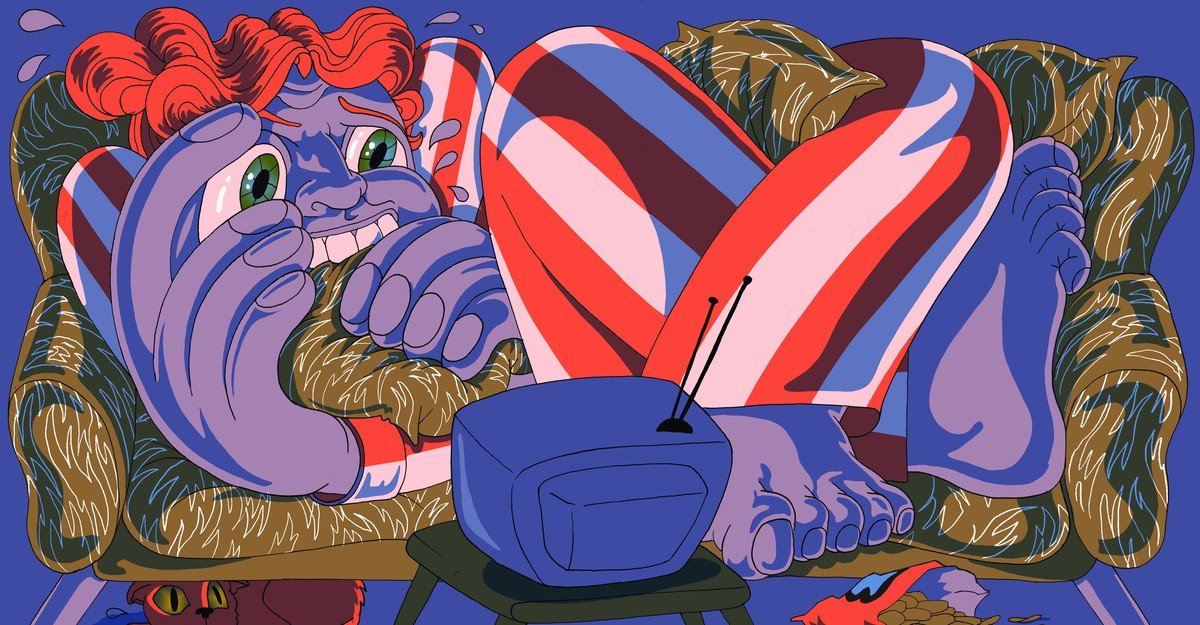
The Bear didn’t wait long to stress out its viewers. “Review,” the seventh episode of the dramedy’s first season, is one of the most anxiety-inducing viewing experiences in recent TV history. In it, the employees at the sandwich shop in which the show originally takes place lose their cool after a food critic’s praise directs a deluge of customers their way. But the crew’s panic quickly permeates off-screen too. “Review” seems designed to elevate a viewer’s blood pressure in tandem with that of its characters: Over the course of 20 minutes unfolding in real time, arguments arise, accidents happen, and several chefs quit their job. The episode exemplifies The Bear’s ethos as a whole; four seasons in, the show remains defined by ticking clocks and barely controlled chaos. As my colleague Sophie Gilbert wrote, it’s “horrifically stressful” to watch.
Yet that unrelenting feeling of stress has resonated with viewers, enough for The Bear to break streaming records over the course of its run. And lately, it’s not the only series channeling the pressures audiences may be feeling in real life: The Pitt, a word-of-mouth hit that uses each hour-long installment to follow the minute-to-minute events of one shift inside an emergency room, operates like a close cousin of The Bear when it comes to drumming up unease. The Pitt scored a bevy of Emmy nominations earlier this month, as did The Bear and shows such as Severance and Adolescence, which also use single-take, unbroken sequences to nerve-wracking effect. Even this year’s most-nominated comedy series, The Studio, in which each scene is meant to look like one continuous shot, encourages more nail-biting than laughing as it tracks the trials of a harried Hollywood executive. These programs go beyond merely dialing up the intensity of what’s happening on-screen; they submerge viewers in visceral, in-the-moment tension. The experience of watching them may be stressful as a result—but it is also apparently satisfying at the same time. They seem to be scratching an itch: for realism, and for an acknowledgment that day-to-day concerns can feel extraordinarily high-stakes.
Waning, it seems, are the days of the Emmys being dominated by television predicated on escapism and spectacle: Comfort shows such as Ted Lasso and historical epics such as Shōgun are currently off the air; sumptuous dramas such as The Crown have ended. Meanwhile, there seems to be less appetite for excessive violence. (Yellowjackets and Squid Game, former nominees known for their high body counts, were completely shut out of the Emmys this year.) Instead, a slate of series concerned with more mundane types of stress has emerged, using hyperrealistic filmmaking techniques to capture anxiety in a way that feels intimate.
The human brain—more specifically, the way it’s wired to enjoy jitters—is partly responsible for how well these shows have been received by viewers. “Our body doesn’t always know the difference between a heart-rate increase associated with watching The Bear versus going for a walk,” Wendy Berry Mendes, a psychology professor at Yale, told me. People have always sought excitement by being spectators; doing so causes, as Mendes put it, “vicarious stress”—a fight-or-flight response that feels good because it involves zero risk. Watching a horror movie can produce the effect, though Mendes pointed out in an email that horror tends to unfold at a more extreme pace, causing reactions infrequently experienced by audiences. (Think of how jump scares can dramatically startle viewers.) The intense shows holding viewers’ attention these days, meanwhile, can conjure a sense of ongoing anxiety. “Certainly, that unremitting pressure” in The Bear, Mendes wrote, “is something more common than running from a zombie.”
Research has also shown that witnessing a loved one overcome a tough task is more stressful than seeing a stranger do so. Television shows that unfold in real time can feel like they collapse the fourth wall; combined with techniques such as extreme close-ups, it’s possible they can produce a strong level of empathy for some viewers. “Our minds create what is real and what isn’t real to our stress systems,” Jeremy Jamieson, a psychology professor at the University of Rochester, told me. When a viewer engages intimately with the material, he added, “they could be having essentially a stress response when they’re not actually doing anything stressful.”
This form of immersive storytelling is nothing new. Take 24, a regular presence at the Emmys in the 2000s that, each season and across 24 hour-long episodes, chronicled the events of a single day in the life of an improbably skilled government agent. The scenarios were likely unimaginable to viewers, and their over-the-top—if anxiety-inducing—nature made them compelling. More mundane trials are faced by average-Joe protagonists such as The Pitt’s Robby (played by Noah Wyle), a senior attending physician, and Carmy (Jeremy Allen White), the executive chef on The Bear. Their arcs are prosaic compared with the high-stakes journey of 24’s Jack Bauer: Robby just wants to get through a tough shift in the ER, and Carmy is chasing a dream of turning his brother’s failing sandwich shop into a fine-dining establishment. “They’re sincere characters, grounded in caring about what they’re doing and caring about the people around them,” Nicholas Natalicchio, a professor of cinema and television studies at Drexel University, told me. Even Matt (Seth Rogen), The Studio’s protagonist, is defined more by his struggle to stop people-pleasing than by his noteworthy occupation as the head of a major company.
The emphasis on emotional responses rather than pulse-quickening plot twists also enhances how much these ensembles resemble actual people. As Robby, Carmy, and their co-workers encounter problems on the job—running out of money to purchase equipment, trying and failing to manage a supervisor’s ego—they begin to seem like a viewer’s own colleagues. (Although The Bear doesn’t always track its story in real time like The Pitt does, it continues to place its characters under the threat of deadlines, frequently showing a countdown clock sitting in the kitchen.) Such recognizable stress helps their stories resonate further. “We all aspire to have that kind of excellence in our work lives,” Yvonne Leach, a professor of cinema and television studies at Drexel, told me. It can be cathartic, as a result, to see hardworking characters struggle realistically—to, as she put it, “see the toll that it takes.”
Besides, Leach added, the recent need for escapist television—the popularity of which grew during the coronavirus pandemic—may be abating. Her students in a class on TV storytelling have recently been voicing how much they want to “see things that are real,” she told me. Natalicchio agreed, adding over email that undergraduate students today have grown up with anxiety as a constant in their life, especially when it comes to entering the workforce. They’ve come of age amid economic turmoil and near-constant disruption to many industries, which may contribute to their interest in shows about challenging workplaces. “That’s not to say there wasn’t stress before, but I think never before has it been a steady hum in the background like it is now,” Natalicchio said. “I think, for many viewers, seeing shows like The Studio or The Bear is cathartic. They can, to a certain extent, relate to it and process their own stress.”
The characters on these shows may fall apart emotionally, but they do make it past their hardest times one way or another. In the case of The Pitt and The Bear, even the worst days yield victories: Robby and his team save plenty of patients, and the employees at Carmy’s restaurant always make it through dinner service. In characters like them, Jamieson said, “you have a role model for resilience.” Such characters are both flawed and capable; they’re who we want to root for and maybe even who we hope to emulate. “We tend to be drawn to people who are competent and warm,” Mendes explained. When both of those qualities are present, it creates, she said, “magic”—the kind that offers a reassurance that other anxiety-inducing shows don’t. The realism of shows like The Pitt and The Bear may remind viewers that simply making it through the day can be an uphill battle. But these shows also embrace the idea that such days don’t last forever.
