

Japan needs to admit that long-running efforts to address gender inequality in higher education aren’t working, experts say, with antidiversity sentiment spreading from the U.S. and threatening to gain traction.
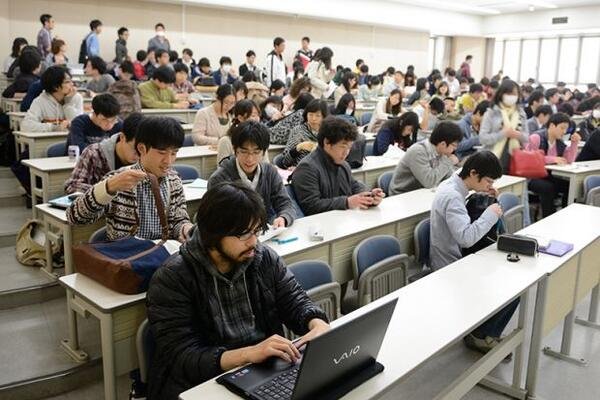
Despite government policies spanning nearly two decades, women remain severely underrepresented across Japanese universities, particularly in science, technology, engineering and mathematics fields.
As of 2022, women made up just 26.7 percent of faculty nationwide and fewer than half of all students, with even starker disparities in senior academic roles and male-dominated disciplines.
Sayaka Oki, a professor at the University of Tokyo, described the situation as “terrible.”
“Gender equality doesn’t really exist here,” she added.
As of 2022, only 11 percent of professors at Oki’s university were female, with particularly low representation in engineering. In undergraduate programs in physics and engineering, women typically make up only about 15 percent of the student population.
“The gender imbalance starts at the student level and gets worse in higher positions,” she said. The university has launched repeated initiatives that have attempted to address the problem and has reported that it has “steadily increased the number of women in faculty positions.”
Since 2006, Japan’s government has implemented a “goal and timetable” policy aimed at increasing women researchers in natural sciences, setting numerical hiring targets every five years.
However, these targets have remained largely unchanged because the proportion of women earning doctoral degrees—the main feeder for research roles—has not significantly increased.
Ginko Kawano, professor of gender equality at Kyushu University, said that, “after nearly two decades, the policy has not produced significant results, and it appears we are now at a turning point in terms of policy design.”
Kawano noted recent government encouragement for universities to adopt admission quotas for women in STEM to improve applicant numbers.
Yet “while this sends a positive message that women are welcome in these disciplines, it is unlikely to serve as a fundamental solution to the underlying issues,” she said.
She also acknowledged strong opposition from students and faculty: “Institutions that choose to introduce this system should clearly explain the reasoning behind it.
“At the same time, it is crucial for university faculty to have access to the information and knowledge necessary to evaluate the merits and drawbacks of such quotas.
“For example, they should be aware of the historical exclusion of women from science, and recognize the persistent bias that suggest[s] women are not suited for STEM fields—biases that continue to shape the choices women feel able to make,” Kawano said.
Adding to the complexity is a political environment increasingly wary of diversity initiatives.
Kawano warned that antidiversity sentiment similar to that in the U.S. could gain traction in Japan, although opposition to gender equality policies has existed independently for years.
Akiyoshi Yonezawa, professor of higher education in the Global Strategy Office at Tohoku University, highlighted demographic pressures pushing universities toward diversity.
“Since around 1990, the number of 18-year-olds has continuously declined and is expected to continue until at least 2040,” he said.
In response, women and international students have been framed as essential for sustaining Japan’s knowledge economy.
Yonezawa criticized how diversity initiatives in Japan are often framed: “DEI initiatives in Japanese universities and society tend to be promoted as a ‘catch-up’ Western mindset rather than intrinsic value formation through daily experience. This makes DEI activities in Japan’s higher education fragile in the long term when faced with controversy.”
Institutional barriers also persist. Oki described how her university’s collegial governance system complicates efforts to implement top-down diversity policies and secure funding, which often comes with centralized control conditions.
“To access the fund, we’re required to adopt a more top-down management style,” she said. “That’s difficult because our university traditionally follows a collegial governance model.”
Oki agreed that there was a risk that international developments had made the situation potentially more difficult—particularly in the U.S., where things like the ban on affirmative action had made colleagues “more cautious about what might happen here.”
