

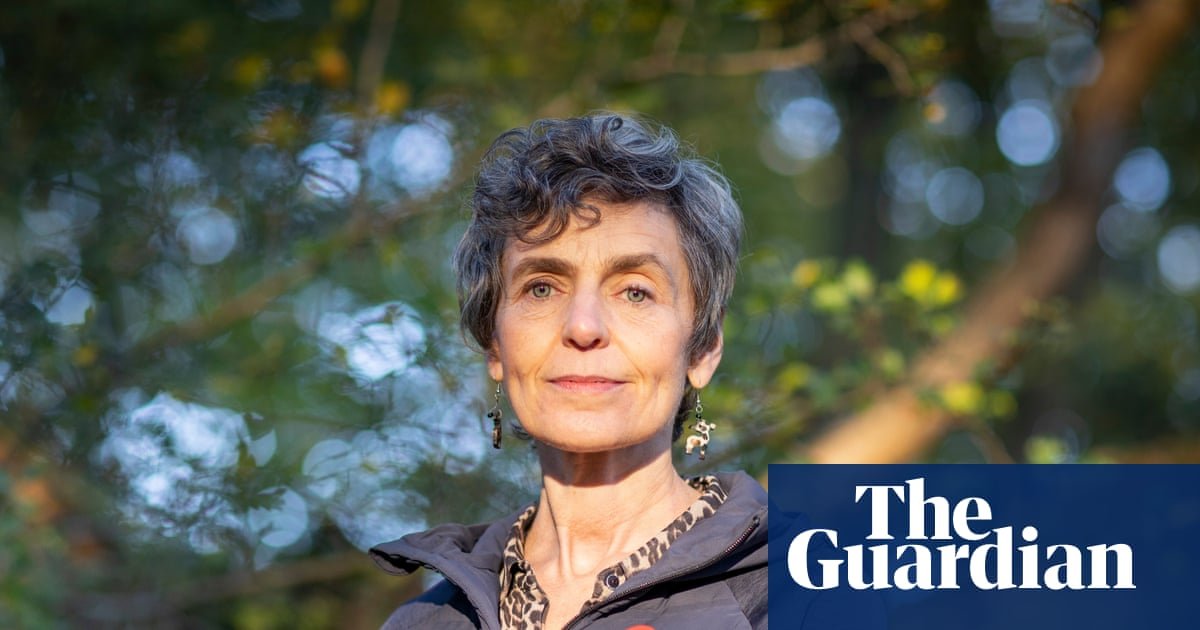
Louise Lancaster, 59, was one of a group of Just Stop Oil activists given the longest-ever UK sentences for peaceful protest for planning disruption on the M25 in November 2022. This year, she wrote a diary for the Guardian, detailing her first six months behind bars. Here, written before her release on 8 April and after her sentence was reduced on appeal, she reflects on her final months of incarceration.
January
At the start of the year, I turned a corner and encountered a new emotional landscape. Transfer to open prison and the sentence appeal were on the horizon. Change, out of my control, was brewing.
Open prison, a surveilled environment without bars or locks, intended as a stepping stone to community reintegration, is a goal for many in closed prison. But, heart-wrenchingly, it is only a pipe dream for the more troubled inmates – those who struggle to adhere to the strict behavioural rules, so often due to fragile mental health, complex psychological or neurodivergent needs, which there is scant provision to cater for.
Every day, I try to engage with Tina, whose internal distress can result in loud, anguished outbursts in the night and repetitive calls for help. She regularly finds herself punished for these, with downgraded conditions, locked in her cell for days without TV, phone or association time with others. Prison is no fit place for Tina.
This morning, I call my daughter, Verity, but first pick up a message she left a few days before. I would have loved to have phoned her at the time, to share and support. I feel a pang of guilt and the chasm between us. Today is her birthday.
It is also the day Cressie, Lucia (her co-defendants Lucia Whittaker De Abreu and Cressida Gethin) and I are assembled in HMP Send’s video room for our appeal hearing.
Two foot-thick tomes of court papers weigh down the table. Next to them, a cup of delicious flapjacks Lucia had made, that happily we are allowed to share. The legal arguments went on for two days and we strained to hear, but we are sustained by the knowledge that thousands gather outside the court, to peacefully and insistently make their support known. And we’re uplifted to see (co-defendants) Daniel (Shaw), Roger (Hallam) and appellants from the other three trial groups, via the video-link system, on the screen. The verdict will take four to eight weeks. We are not holding our breath.
February
News in the UK and abroad is getting grimmer by the day. Surreal stuff. Trump’s tornadoes of turmoil, world temperatures tipping 1.75C above pre-industrial levels, 35% of Los Angeles engulfed by wildfires, and Storm Éowyn, listed as a real danger to life in the UK, is ripping the covers off polytunnels where I work in the prison gardens.
I and those working with me there are also being scattered, reassigned to different work or education. This can happen without warning. It’s very unsettling for the many neurodivergent people who make up nearly half the prison population. Appealing against the moves is futile.
I have just been put on a 12-week education course, which I’m already qualified for and which I will never complete, as I move prison in three weeks. Given how much information the prison system amasses on us, it is such a waste that inmates’ time is not more intelligently managed. There is little follow-through after courses, aside from links established by altruistic staff, with outside trusts and employers that boost the hopes and dreams of a few.
A demonstration outside Southwark crown court, London, as fellow activists are sentenced in July 2024. Photograph: Vuk Valcic/Zuma/Rex/Shutterstock
Pre-empting the move to open prison, I prepare cards and little gifts for all I’ve built relationships with here. I feel sheepish letting Ava know. As a foreign national, she is barred from open prison, despite attending every course asked of her over the many years and giving much to the prison community.
Today is grey and drizzly. Cressie and I cross the exercise yard with our plastic boxes to collect lunch. An officer spots us and cheerily announces we are moving to East Sutton Park open prison tomorrow. We exchange puzzled looks. We are the lucky ones. Mina, a fellow transferee, only finds out in the morning.
Every time you move prisons, all your possessions must be checked out, one by one. In reception, we dutifully pick items out of our plastic bags, which get placed in new, sealed ones. We are surprised to discover that we will travel by car rather than prison vans, aptly named sweat boxes. This seems weird.
Stranger still is the environment we arrive at – a manor house and grounds akin to the ones I used to visit with my parents on a day out as a kid, with functional interiors reminiscent of outward-bound centres I stayed at in school groups. The communal rooms are beautiful and filled with books. Food is a step up. There’s a well-run gym, relaxed, supportive staff and the shared bedrooms have barless garden views, which cheer up the same prison furniture. Sadly, the mattresses are even poorer – within a week, Lucia’s back is in chronic pain.
Although beautiful, the house has many steps – a nightmare for less mobile prisoners, and all work programmes require a level of physical fitness some just don’t have. Prison causes deterioration of health for many inmates. Those who struggle are either assigned work that exacerbates their condition or are paid a third of the meagre wage if they cannot work as hard as other people. The individual needs of those brought here can surely be better considered and provided for.
March
Protesters hold portraits of Louise Lancaster and Cressida Gethin during a vigil in Cambridge in December 2024. Photograph: Martin Pope/Sopa/Rex/Shutterstock
Meals at East Sutton Park are communal events. We eat with prison friends from HMP Send. These are releases on temporary licence (RoTLs), a common topic of discussion. As with enhancements and open prison, they are a privilege and largely favour those who already possess the skills to access work in the community. RoTLs generally include the day release, work outside the prison and gradually increasing numbers of nights at home. With only two female open prisons in the UK, many people are far from home. Newly proposed guidelines are set to reduce financial support for travel for those on RoTL, which could limit access for poorer inmates and exacerbate discrimination.
Over lunch, news reached us that HMP Send may be the one women’s prison James Timpson plans to close to trial out alternative forms of “punishment and rehabilitation”. Send may convert into one of the 14 new male prisons the government insists on building. We all share our concerns for those left behind. Some will move to alternate, non-custodial community provision, therapy centres or drug and alcohol rehabilitation. It’s definitely reform on the right trajectory – but others will surely be transferred. Send is one of the better closed prisons. What will be their fate?
Today, our fate has been decided. Cressie, Lucia and I walk in the unseasonably warm sun to the video room, where our lawyers will inform us of the verdict of our appeal. It is almost shocking to receive a reduction in sentence when 10 other appellants do not. We take time to process the new reality. As well as pleasure, a range of emotions and thoughts spring to mind. Not insignificantly, the unpredictable danger of curfew tag error, triggering recall to prison; harsh licence conditions regarding participation in events and internet use; and restrictions that will prevent us contacting each other and so many others.
But when I phone my family to break the news, they are already celebrating the year off of my sentence and that I could be released on curfew tag within weeks. Our sentences are still manifestly excessive, of course. The real injustice is not their length but that citizens engaging in nonviolent civil resistance are incarcerated by a legal system that outlaws consideration of the deep wrongs that compel their action.
The 1,000 people who sat silently on the road and stayed there for 90 minutes, despite pressure from the police to move, are in my view the catalysts for the reduction in sentences. My thanks goes out to them; we must never underestimate the power of such collective action.
That night I reread Martin Luther King Jr’s letter from a Birmingham jail. I quote: “Injustice anywhere is a threat to justice everywhere. We are caught in an inescapable network of mutuality, tied in a single garment of destiny. Whatever affects one directly, affects all indirectly.”
In these rapidly shifting sands of global instability, compassion and care are being stripped away. Injustice is increasing. We cannot let this happen.
The names of inmates Tina, Ava and Mina have been changed to protect their identities.
Additional reporting by Matthew Taylor
