

When Ashley Robinson and her mother took DNA tests 10 years ago and began meeting long lost cousins, they stumbled across a surprising family history that changed their lives. Robinson’s lineage traced back to the 272 West Africans who were enslaved by Jesuits and sold to plantation owners in the southern US in 1838. The sale of the enslaved Africans helped fund Georgetown University, the oldest Jesuit higher education institution in the US, and served as collateral to the now defunct Citizens Bank of New Orleans, whose assets were later folded into JPMorgan Chase.
Robinson dived into researching her lineage after having her first child at 21 years old, and soon enrolled in an organization called the GU272 Descendants Association, which hosts genealogical workshops and connects people whose ancestors were sold by Georgetown University. While national discussions around reparations for the descendants of enslaved Africans have largely stalled, Robinson’s uncovering of her family’s history met an unlikely resolution. During her senior year in undergraduate school, she received a scholarship funded by the successors of her family’s enslavers.
“I remember praying after I finished the [scholarship] application,” Robinson said. As a 29-year-old mother of three, Robinson considered taking a break from school due to financial constraints. “It was perfect timing, because the scholarship came about, and that’s sailing me through the end of my degree.” The $10,000 from the nonprofit Descendants Truth & Reconciliation Foundation has helped minimize the federal student loans that Robinson needs to complete her computer science degree at University of Maryland Global Campus by the end of the year.
For Robinson, the scholarship has meant that she “will be able to finish school without taking food from the table or having to figure out what we’re going to do next”.
Ashley Robinson, a descendant of Jesuit slaveholding, left, was awarded a $10,000 grant from the Descendants Truth & Reconciliation Foundation to help complete her computer science degree at the University of Maryland Global Campus. Photograph: Ashley Robinson
Based in Baton Rouge, Louisiana, The Descendants Truth & Reconciliation Foundation is a partnership between the descendants of West Africans enslaved by Jesuits and the church’s successors, aimed to address the wrongs of the past by focusing on three pillars: education, honoring elders and addressing systemic racism. The descendants partnered with the Thurgood Marshall College Fund to issue post-secondary educational scholarships for descendants of Jesuit enslavement at institutions of their choice. Since the fall of 2024, the foundation has awarded more than $170,000 in scholarships to 25 students across 20 schools, with students being eligible to renew scholarships every year.
As Donald Trump’s administration has targeted diversity, equity and inclusion efforts at the federal level by cancelling grant programs that benefit people of color, the foundation has successfully championed reparations in the private sector. “We’re looking to fill the gap where these institutions are somewhat hesitant or unsure how they’re going to be able to support those communities,” the foundation’s president and CEO, Monique Trusclair Maddox said. Bishops reckoning with their church’s history of slavery in the UK are also looking to the foundation’s truth and reconciliation efforts.
“Teaching this history through Jesuit institutions, allowing dialogue to come in places that wouldn’t otherwise be afforded is something that hasn’t been done in the past,” Trusclair Maddox said. “We believe that that whole approach to changing how people look at racism and how people look at marginalized communities is something that will last for a long time.”
‘Possibility for a greater America’
The Society of Jesus, also known as the Jesuits, were slaveowners until the mid-1800s, relying on forced labor to expand their mission throughout North America. When Georgetown University faced financial difficulties, the Jesuits sold more than 272 enslaved people from five tobacco plantations in Maryland to Louisiana plantation owners to help pay off the school’s debts. More than 100 of the enslaved people were sold to other owners, or remained in Maryland by escaping or by having spouses on nearby plantations. The sale that generated the current-day equivalent of $3.3m tore apart families and communities, and in turn, helped form the Georgetown University that’s known today.
The board of trustees of the Descendants Truth & Reconciliation Foundation, which consists of descendants, Jesuits, as well as representatives from former slaveholding institutions and business and philanthropic organizations. Photograph: The Descendants Truth & Reconciliation Foundation
Georgetown and the church’s sordid past was largely forgotten until a descendant uncovered it while researching her genealogy in 2004. Over several years, genealogists dug up additional research on the enslaved people, as descendants formed their own groups to learn more about their ancestors. Then starting from August 2018 to the fall of 2019, about 15 representatives altogether from the Society of Jesus, Georgetown University and the descendants gathered together over multiple joint meetings with a facilitator and truth and racial healing practitioner hosted by the Kellogg Foundation.
Through their difficult conversations, they created a memorandum of understanding that created the scaffolding for the foundation and laid out the Jesuits’ commitments. When Father Timothy Kesicki, a Jesuit priest and chair of the Descendants Truth & Reconciliation Trust learned about the descendants, he said that it transformed his understanding of history: “I almost had a 180 degree turn on it, because suddenly it wasn’t a past story. It was a living memory, and it begged for a response.”
The year-long conversations that unfolded between the Jesuits and descendants were raw and full of challenging emotions. “The whole thing was painful for everybody. This is a historic trauma. It was very hard for Jesuits. It’s very easy to be trapped by shame and fear and a prevailing sentiment out there that says: ‘Why are you digging up the past?’” said Kesicki. “We were understanding the truth differently than our preconceived notions, there was a power and a beauty to it also.”
After tracing her own family history back to those who were enslaved by the Jesuits in 2016, Trusclair Maddox attended an apology ceremony at Georgetown University where she met other descendants of Jesuit enslavement the following year. She soon joined as a board member of GU272, before taking over the helm of the Descendants Truth & Reconciliation Foundation in 2024.
The Jesuits agreed to commit the first $100m to the foundation, and so far have contributed more than $45m, some of which came from the sale of former plantation land. Georgetown University also committed $10m to the trust. Half of the funding is designed to provide educational scholarships and home modifications for elderly descendants, and the other half of their dollars will go toward projects devoted to racial healing. The first racial healing grant funded an art display in New Orleans on Juneteenth. The exhibit will go to the Essence Festival in New Orleans, and Cleveland, Ohio. The foundation is also considering creating a grant for victims of fires in California, which would be open to all.
Along with the educational pillar, the foundation also helps seniors by hiring occupational therapists to do an assessment of the safety needs in their home, and then a remodeler installs features such as grab bars and railings. The foundation is now piloting its program in descendant homes in Louisiana, Texas, Mississippi and Ohio, with plans to grow nationally.
A partial list of the enslaved Africans transported from the port of Alexandria, Virginia, to New Orleans, Louisiana on the ship called Katherine Jackson in 1838. Photograph: The Descendants Truth & Reconciliation Foundation
In spite of the anti-DEI rhetoric nationally, Trusclair Maddox said that support from individual donors has increased by 10% in recent months, and they’ve also received donations from more anonymous donors. Benefactors have shared with the foundation that their work is needed now more than ever.
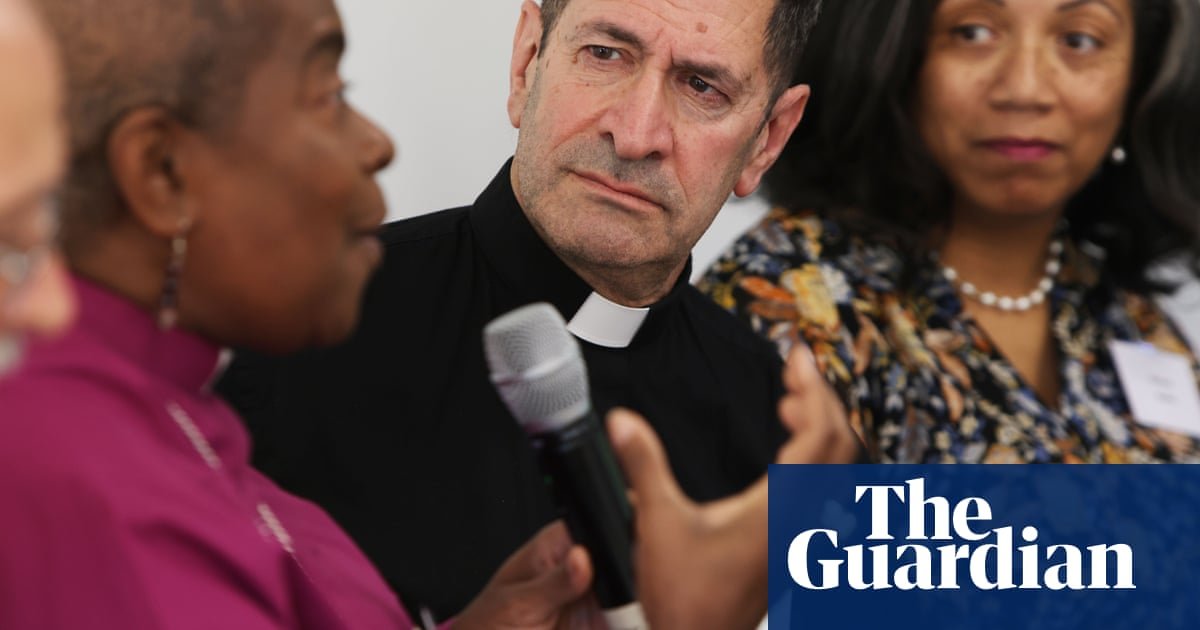
The program is also being used as a model for truth and reconciliation throughout the world. Last September, Kesicki and Trusclair Maddox presented their programs to the College of Bishops in Oxford, who were grappling with their own history of slavery in England. After the presentation, the College of Bishops sent a video expressing gratitude about what they learned over the two days. “We’re transforming their church,” Trusclair Maddox said, “not just what we’re doing here in the US.”
The foundation is also working to educate young Jesuits and descendants on their shared history and to instil in them a respect for their collective future. Starting in late June, about 15 people – a combination of Jesuits and descendants – from throughout the nation will discuss racial healing in-person in Baton Rouge, Louisiana, and through Zoom throughout the summer. A descendant will lead discussions on race relations and teach about the history of the Jesuits and enslavement, as well as Jim Crow policies.
Trusclair Maddox foresees the foundation helping future generations reckon with the past in perpetuity. “The heirs of enslavers and the descendants of those who were enslaved have come together, not from a litigious perspective, but from a moral perspective, and joined hands and hearts together to walk this path. As painful as it may be together, we believe that shows some hope,” Trusclair Maddox said. “There is a possibility for a greater America. There’s a possibility for people to not live in fear.”
