

Mira Rojanasakul revisited her home state of West Virginia to report on its recovering rivers. Photography and video by Kristian Thacker.
June 25, 2025
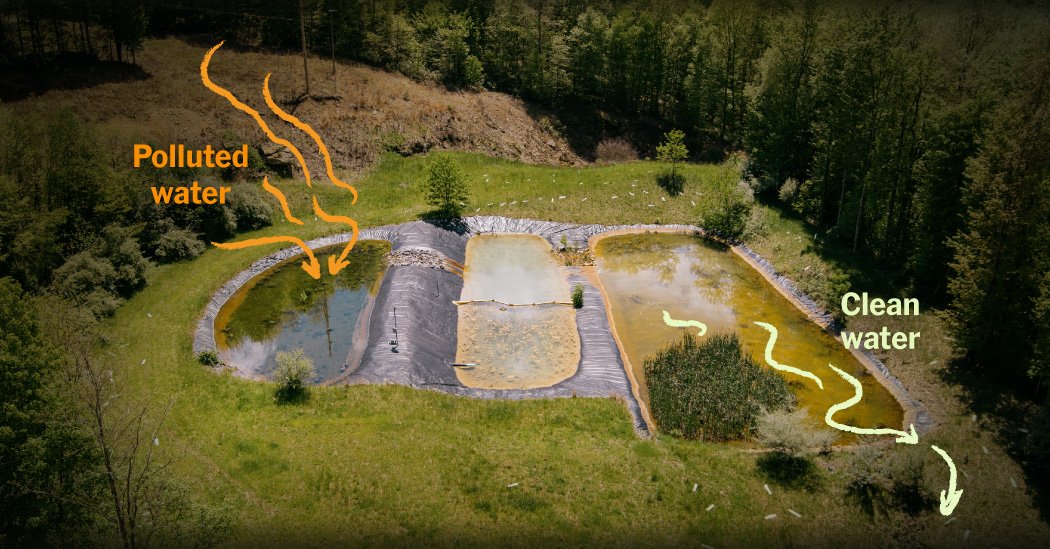
This low-tech system, built less than 10 years ago, is transforming life along the water. Fish and sensitive species like salamanders and frogs are returning to Deckers Creek, which for decades flowed rust-orange and lifeless from iron and other pollution.
It’s one of dozens of cleanup sites being installed across West Virginia, helping the state make progress on a global environmental issue: waterways poisoned from coal mining.
Brian Hurley, executive director of Friends of Deckers Creek, the nonprofit group that built and manages this site.
Ponds where heavy metals settle out.
A few miles downstream, a new, higher-tech version of this cleanup process is yielding an unexpected bonus: “Rare earth” elements, essential for clean energy technologies and military equipment, are being recovered from the pollution.
To mine and extract those elements from scratch is expensive, but “here you’re getting it for free,” said Paul Ziemkiewicz, director of West Virginia University’s Water Research Institute.
And in restoring mountain streams and rivers, these sites are also bringing hope of an economic revival, free from the environmental harm caused by mining and logging.
Cleaning up coal
A billion years of tectonic drama shaped West Virginia’s rolling hills, secluded hollows and renowned whitewater rapids. It also laid down enormous seams of coal that would sustain generations of mining, fueling America’s exceptional growth.
Coal isn’t all that was unearthed.
Pyrite, or “fool’s gold,” is found in particularly high concentrations in northern Appalachia. Coal mines perforating these hills expose pyrite to oxygen and water to make sulfuric acid, which then dissolves heavy metals as it seeps through the surrounding rock. The toxic brew, called acid mine drainage, can spoil groundwater and coat stream beds with rust, killing aquatic life.
Left untreated, this process goes on indefinitely.
Before a 1977 landmark federal law, companies could simply mine coal and move on with the profits, leaving behind polluted waterways and other environmental damage.
Even after the government started requiring restoration of the landscape after mining, companies found ways around the rules. Mine owners have transferred their permits or declared bankruptcy, offloading the cost of cleanup onto the state. And with the industry in decline, the tax on coal production that pays for cleanup of abandoned mines could also be in jeopardy.
Source: Department of the Interior Abandoned Mine Land Inventory System.
Mine reclamation has also historically been more focused on land: moving mountains back into place after surface mining or filling in hollowed-out spaces underground to prevent collapse. Water and biodiversity concerns often went unaddressed, even though acidic runoff can corrode pipes and threaten drinking water for many residents of rural West Virginia who rely on backyard wells.
Nonprofit groups, dozens of which have sprung up across West Virginia, stepped in to fill in gaps where official policies fell short.
While federal and state officials guide projects, and though researchers have developed new approaches to water cleanup, the nonprofits are often the boots on the ground. They monitor sprawling watersheds and build relationships within communities, even talking private landowners into opening up their backyards for cleanup work.
They can also apply for federal grants to help pay for water testing and treatment.
Kelley Flaherty, executive director of Save the Tygart Watershed Association.
Treated water runs over rocks stained by acid mine runoff.
Just over the ridgeline from Deckers Creek, Kelley Flaherty, the executive director of Save the Tygart Watershed Association, monitors more than a thousand square miles of coal country that drain into the Tygart Valley River.
Coal’s past and present influence is visible across this domain, where the industry remains a major employer. In Grafton, W.Va., a stately rail station that bustled with passengers during coal’s roaring years now sits empty. But outside of town, trucks thunder by on their way to and from the 6,000-acre Leer Mine Complex, where underground excavation has caused the land above to sink and has driven residents out of their homes with life-threatening methane leaks. Core Natural Resources, owner and operator of the mine, did not respond to a request for comment.
“When we think about West Virginia, we think coal mining, or timber — that’s the only economic avenue,” said Dr. Flaherty. The goal is to make people aware of the intrinsic value of the river as well as its economic value, she said.
The Tygart Valley River has begun a remarkable transformation, thanks to a decade-long initiative to try a more proactive approach to cleanup — one that researchers believe will treat water more reliably and efficiently in the long run.
Passive systems, like the one at Deckers Creek, direct water through limestone or wetlands to reduce acidity and heavy metals. They’re often favored by nonprofits for their lower costs, though over time, sludge can coat the stone and reduce their performance.
Another approach to cleaning up water involves mixing powdered lime, an alkaline, directly into the stream. This is effective at reducing acidity, though not at removing metals from the water, as they eventually settle in ponds or areas further downstream. The lime also has to be replaced as often as every few weeks.
Along the Three Fork Creek in the Tygart Valley River watershed, the state has installed several silos, which deliver a steady supply of lime. The strategy is working: Once one of the most polluted tributaries to the Tygart, Three Fork Creek now supports an array of aquatic life and recreation on the water.
Acid mine runoff stains the streambed orange before it meets a lime doser at Maple Run, which sits in the Tygart Valley River watershed.
A lime silo at Birds Creek.
An unexpected resource
The last few miles of Deckers Creek before it flows into the Monongahela River are where the greatest volume of pollution enters the stream. Abandoned since the 1950s, the Richard Mine discharges an average of 400 gallons per minute of toxic runoff.
Hidden in the polluted water is what could be a source of revenue for more cleanup: rare earth elements crucial for batteries, solar panels and other technologies.
The United States uses thousands of metric tons of rare earths a year — mostly imported from China, which suspended nearly all shipments in April amid President Trump’s trade war.
When the Energy Department sought proposals to investigate coal waste as a potential source for rare earths in 2015, researchers at West Virginia University decided to look at the metal-laden water pollution instead.
Paul Ziemkiewicz, director of West Virginia University’s Water Research Institute, overseeing a tank filled with a rare earth solution.
The Richard Mine treatment facility, a new site owned and operated by the state.
Separating rare earths from solids is expensive, and trying to open a new mine to do so could take years. “You’d have to grind it up, treat it with acids, all kinds of chemistry,” said Dr. Ziemkiewicz, whose team worked with Virginia Tech researchers and L3 Process Development, a chemical engineering firm, to develop a patented process for extracting rare earths from mine water pollution.
Acidic mine runoff is already doing much of the work, dissolving rare earths and other materials into a polluted mixture that requires cleanup, anyways.
If you’re going to develop a supply chain, “this is a good place to start,” he said.
Built and operated by the state, the temperature-controlled building and automated whirring at the new Richard Mine treatment facility stand in stark contrast to the quiet ponds further upstream on Deckers Creek. But the basic chemistry is the same.
The polluted water in this area is particularly rich in the more valuable “heavy” rare earths, compared to other sources in Butte, Montana and Mountain Pass, California. And the potential income could be enough to cover around a third of operating costs — or more, if prices remain elevated.
The site, the second in the state to also recover rare earths, cost $8.8 million to build, excluding land costs, and was paid for mostly by West Virginia’s reclamation fund and a federal grant. A pledge from a natural gas company could also help cover operating costs.
Cleanup of West Virginia’s abandoned mines has also been supported by $140 million annually from the 2021 Bipartisan Infrastructure Law, which is planned to continue until 2037. The Trump administration initially paused those payments but then resumed the funding.
“Light” rare earths recovered from coal pollution.
More valuable, “heavy” rare earths.
At the mouth of Deckers Creek, a short walk from downtown Morgantown, the stream’s rejuvenation is allowing bold new plans to take shape. A coalition of local residents is looking to build a park along the water with opportunities to fish, swim and traverse the waterway by foot, bike or boat.
Across the state, residents are hoping this transformation will bring in more visitors and jobs, too.
“Our rivers and our water might be our most valuable resource,” said Danny Twilley, assistant vice president of economic and community development at West Virginia University.
With several major cities within a few-hours’ drive, Dr. Twilley says the state is uniquely situated for growth in its outdoor recreation economy. New River Gorge, which received a national park designation in 2020, has seen a recent surge in visitors. Across the state, tourism income reached a record high last year.
Employment in the state’s outdoor recreation economy is starting to rival other industries, with 20,300 jobs in 2023 compared with 17,700 workers in mining and support activities that same year, according to federal estimates.
“Salt, timber, coal — they provide employment and economic opportunities for a long time, but they also tend to be industries that are a bit feast-or-famine,” said Dave Bassage, program coordinator at New River Conservancy and a founding member of Friends of the Cheat, one of the largest watershed organizations in the area.
“If we look to the future, coal is a much smaller part of the overall energy picture in the country and it’s unlikely to ever regain the same level that it once had.”
But people will always want to get outdoors, he said.
The mouth of Deckers Creek, before it flows into the Monongahela.
