

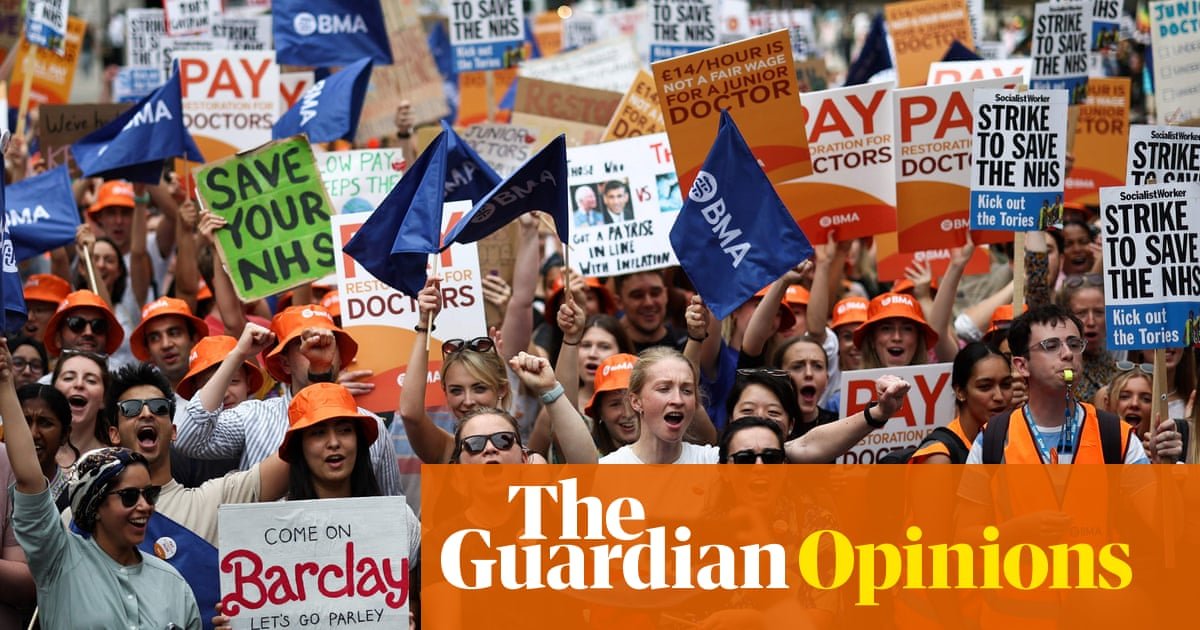
“Because you’re worth it,” goes the ad. But knowing who is worth what is even harder to determine than it was half a century ago. So as doctors vote in a strike ballot, how will the public weigh up their just reward?
Some 50,000 resident doctors – formerly known as junior doctors – are deciding whether to walk out again in England. Their year-and-a-half-long series of strikes ended with Wes Streeting agreeing a 22.3% pay rise over two years. Now their seniors, hospital consultants, are about to vote on striking to reclaim the 26% the British Medical Association (BMA) says their pay has fallen by since 2008.
The public backed striking doctors last year despite the 1.3m healthcare appointments lost, which cost the NHS £1.5bn. Beyond pay, that was a protest against a government that had stripped the NHS bare: public satisfaction with the health service was at a peak in 2010 but by last year it had fallen to its lowest since records began. There was a strong sense among staff and the public that this was about defending the state of the service.
Would doctors get that public backing now? YouGov finds 48% opposed to further strike action, with 39% of voters in favour. Times have changed: the NHS was the big gainer in this month’s spending review, with extra funding designed to cut waiting times and increase GP appointments, though it is still under intense strain. Senior medics, including the former president of the Royal College of General Practitioners, Clare Gerada, wrote a letter to the Guardian imploring doctors not to strike again. “The NHS is at a more perilous state than at any time in our careers,” they wrote. “A doctors’ strike would further diminish the ability of the NHS to deliver, and play into the hands of those who don’t believe in an NHS that is publicly funded and based on need not want.” Streeting has just awarded resident doctors an average pay rise of 5.4%, more than the rest of the NHS.
Here’s the issue: despite last year’s good post-strike rise, the BMA says resident doctors’ pay has fallen by 23% in real terms since 2008, and they intend to get it back, as do the teachers, whose pay has fallen behind like all the public sector. This is a poorer country, with growth practically stagnant, battered like the rest by world events but uniquely stricken by Brexit too. Public and private sector pay has fallen over the past few years, despite a slight uptick recently. This people know instinctively from how far their money doesn’t go: had pay kept growing at pre-financial crash rates, public pay would be 56% higher and the private sector would be 40% better off. These stark figures underlie deep social discontent and distrust of government. No wonder unions strive to bring back better times, calling the doctors’ pay offer “derisory” and “insulting”.
Well, is it? Full Fact’s reliable analysis shows foundation year doctors get a £38,831 basic salary while the most qualified resident doctors – 48% of them – get £73,992: the salient fact is many of these doctors will become consultants whose earnings escalate to more than £100,000 a year.
Is that a lot or not? What you think depends on what you earn, but very few understand where they stand on the scale. Keep focusing here on a string of numbers, because they are the way we live now. Median pay is £37,430, with half earning more and half earning less. When aggregated across a year, the minimum wage has just risen to £25,396.80. To enter the top 10% of earners you must have a salary of more than £65,000. Estimates vary, but about £180,000 is the threshold for entering the top 1%.
It may be no comfort to public sector employees that the prime minister’s salary has sharply fallen behind. His £172,153 pay, not quite within the top 1%, should be £305,770 had it kept up with inflation since 2009. Using the PM’s pay as a comparator – as anti-public-sector rightwingers do to castigate any public servants earning more – makes little sense: some headteachers running multi-academy trusts can reach £300,000, as can CEOs of large city councils.
Are those sums a lot? They are peanuts compared with private sector high-flyers. The opaquely funded TaxPayers’ Alliance has a “public sector rich list” that fails to make comparisons with private top pay. Six-figure earners in the public sphere, running a large school or hospital, have a far more complex task than company CEOs earning millions for single-performance indicators: the bottom line and the share price. New research from the High Pay Centre, funded by the Aberdeen Financial Fairness Trust, just reported that the median FTSE 100 CEO pay is 78 times greater than their median employee’s pay. Tesco’s CEO on £9.23m makes 431 times more than a median Tesco worker. It’s been six years since revealing these pay ratios became mandatory for large listed companies, but high hopes have been dashed because it has changed nothing: exposing gigantic inequality has not shamed boardrooms into reconsidering their values on pay.
“Fair pay” is a slippery concept. Fair pay agreements for every sector are government policy, starting experimentally with social care, for employers and unions to agree legally binding minimum rates and conditions affordable in their industry. They reflect the old wages councils devised by Winston Churchill to protect “sweated labour”, which were later abolished by Margaret Thatcher. When she disempowered unions, workers’ pay fell while the top pay, off the leash, shot up stratospherically, where it remains.
In the light of all that grotesque distortion of worth, doctors and other valued public servants deserve high rewards. But in the everyday world where growth and pay have long stagnated, people seeing resident doctors’ significant pay rise last July may resent them striking again, this time against an NHS at last struggling to its feet.
