

This is an edition of The Atlantic Daily, a newsletter that guides you through the biggest stories of the day, helps you discover new ideas, and recommends the best in culture. Sign up for it here.
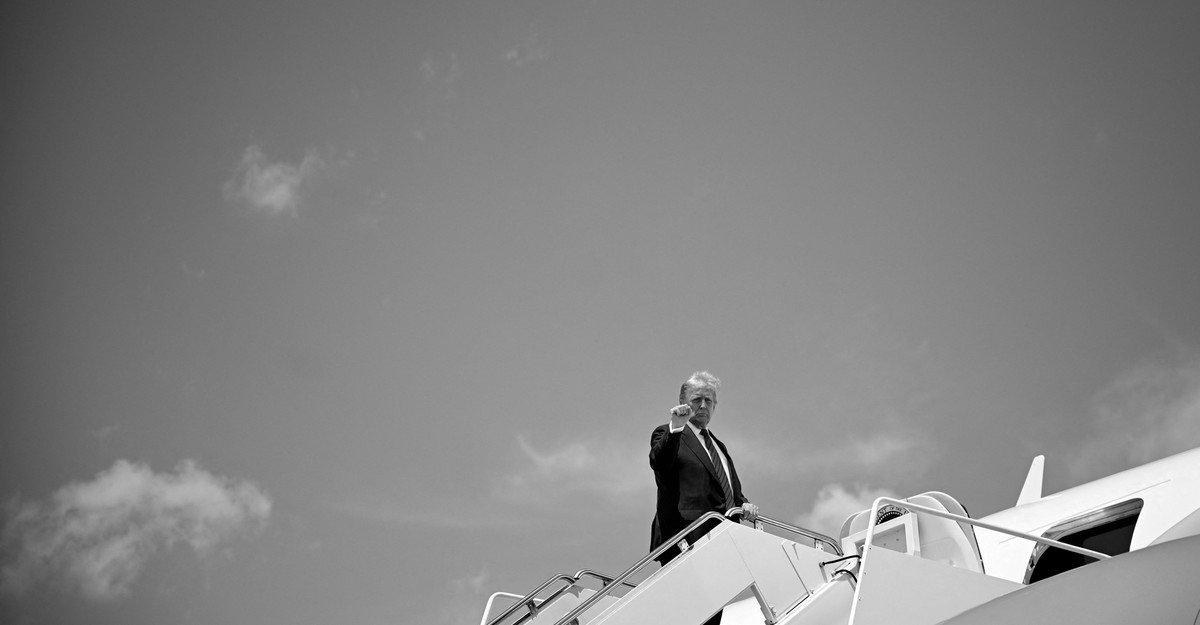
When Donald Trump raised the idea of toppling Iranian Supreme Leader Ali Khamenei yesterday, it wasn’t just the idea that was surprising. It was the particular phrase he used to describe it.
“It’s not politically correct to use the term, ‘Regime Change,’ but if the current Iranian Regime is unable to MAKE IRAN GREAT AGAIN, why wouldn’t there be a Regime change??? MIGA!!!” he posted yesterday on Truth Social.
The phrase became toxic for a reason. Two years ago, an essay in the Claremont Review of Books noted that regime change entered the popular lexicon in “the early days of the 9/11 wars, when the Bush (43) Administration argued that the security of America and of the entire world depended not merely on defeating hostile countries militarily but on changing their governments into ones more inherently peaceable and favorable to our interests.” Of course, regimes change all the time, but regime change came to mean “external, forcible transformation from ‘authoritarianism’ or ‘dictatorship.’”
This sounds very much like what Trump is discussing. Having switched from discouraging Israeli military strikes against Iran to joining them, he appears to now be toying with broader ambitions. (Trump offers few endorsements stronger than calling something “politically incorrect.”) But the writer of the Claremont Review essay, a prominent right-wing intellectual, warned about such projects. “We know how that worked out. Regimes were changed all right, but not into democracies,” he wrote. “And some of them—e.g., the one in Afghanistan—20 years later changed back to the same regime American firepower had overthrown in 2001.”
That writer was Michael Anton. Today he is the director of the policy-planning staff at the State Department (a bit of an oxymoron in this administration), and in April, the White House named him to lead the U.S. delegation at technical talks with Iran on a nuclear deal—negotiations that are presumably irrelevant for the time being.
Trump’s abrupt shift has thrown the MAGA right into acrimony. In truth, the president has never been a pacificist, as I wrote last week. During the 2016 GOP primary, Trump cannily grasped public anger at the Iraq War and turned it against his rivals. Thinkers such as Anton and politicians such as Vice President J. D. Vance then tried to retrofit a more complete ideology of retrenchment and restraint onto it, but Trump is an improviser, not an ideologue. No one should have been too surprised by the president’s order to bomb.
Still, his rhetorical embrace of regime change was stunning even to those who never bought into his identity as a dove, and certainly to some of his aides. Perhaps Anton was not surprised to see his view so cavalierly discarded; after all, he once likened backing Trump to playing Russian roulette. But Vance and Secretary of State Marco Rubio were unprepared for the change in rhetoric. Rubio solemnly told Fox Business that the U.S. is not at war with the country it just dropped hundreds of thousands of pounds of ordnance on. Vance, on Meet the Press, insisted, “Our view has been very clear that we don’t want a regime change. We do not want to protract this or build this out any more than it’s already been built out.” A few hours later, Trump contradicted him directly, in what would have been embarrassing for someone still capable of the emotion.
Vance’s views on foreign policy are deeply shaped by the Iraq War, in which he served. Now his boss is at risk of speedwalking that conflict one country to the east. The Iraq War was the product of months of preparation by the George W. Bush administration: military mobilization, avid though unsuccessful attempts to rally international support, an extended period of manufacturing consensus in Congress and in the American public. Yet despite that work, and as even proponents of regime change in Iran acknowledge, the Bush administration’s handling of the Iraq War was a disaster, perhaps the worst American foreign-policy blunder in history. The U.S. government had good war plans for getting rid of Saddam Hussein’s regime but had not effectively thought through what would happen after that.
Trump has done even less of that thinking, and leads a nation far more politically divided and warier of foreign intervention. Americans have long viewed Iran negatively: A Fox News poll before this weekend’s airstrikes found that roughly three-quarters of them view Iran as a “real security threat.” Still, another poll earlier this month found that most don’t want the U.S. to get involved in armed conflict there. A Pew Research Center poll in May even found that slightly more Americans think that the United States is its own “greatest threat” than that Iran is.
Trump’s flippant transformation of “Make America great again” into “Make Iran great again” exemplifies the hubris of the Iraq War project that he had promised to leave behind. Just as U.S. officials claimed that Iraq could be easily and quickly converted into an American-style democracy, Trump wants to export his catchphrase to Iran, where the implementation would be even hazier than it is here. Iran is a country of some 90 million people, not a dollhouse to be rearranged.
Can regime change work? The answer depends on how success is defined. In 1973, for example, the U.S. backed a coup in Chile, toppling the leftist leader Salvador Allende. It worked: Allende was killed and replaced by Augusto Pinochet, who created a stable, market-based, U.S.-friendly Chilean government. But doing that involved horrifying repression and the killing and disappearances of thousands of critics, leaving a black mark on the U.S. record.
In another case of regime change, the U.S. government helped topple Iranian leader Mohammed Mossadegh in 1953. This, too, was an immediate success. Mossadegh was removed, and the Washington-friendly Shah Mohammad Reza Pahlavi was restored to power. But the legacy of the moment stretched on much longer. The shah was also brutally repressive, and Iranians remembered the 1953 coup bitterly. In 1979, a revolution swept Iran, deposing Pahlavi and installing a virulently anti-American government. That regime still rules in Tehran—for now, at least.
Related:
Here are three new stories from The Atlantic:
Today’s News
- Iran launched strikes on a U.S. base in Qatar, which were intercepted by Qatar’s air-defense system, according to the Qatari government.
- The Supreme Court temporarily allowed the Trump administration to deport migrants to countries other than their own without giving them the chance to contest their removals.
- President Donald Trump called on “everyone” to “keep oil prices down” after America’s recent attack on Iranian nuclear sites sparked fear of higher oil prices.
Dispatches
Explore all of our newsletters here.
Evening Read
A fenced driveway leading to farmland belonging to the South African farmer Stefan van Huyssteen outside Senekal (Marco Longari / AFP / Getty)
Extreme Violence Without Genocide
By Graeme Wood
Signs of violent criminality are ubiquitous in South Africa. Electric fences and guard dogs protect homes containing something worth stealing. Reported rapes, carjackings, and armed robberies all occur far more frequently than in the United States. In Bloemfontein, one of the safer cities, I asked a hotel clerk for directions to a coffee shop, and she said it was “just across the road,” not more than 500 feet away. When I headed out on foot, she stopped me and said that for my safety, “I would prefer that you drive.”
Read the full article.
More From The Atlantic
Culture Break
Illustration by The Atlantic. Sources: Sony
Play. In Death Stranding 2, people play as an unlikely hero: a courier who trips over rocks and experiences sunburn. It’s the Amazonification of everything, now as a video game, Simon Parkin writes.
Disconnect. Franklin Schneider has never owned a smartphone. And, based on the amount of social and libidinal energy that phones seem to have sucked from the world, he’s not sure he ever wants to.
Play our daily crossword.
Stephanie Bai contributed to this newsletter.
When you buy a book using a link in this newsletter, we receive a commission. Thank you for supporting The Atlantic.
