

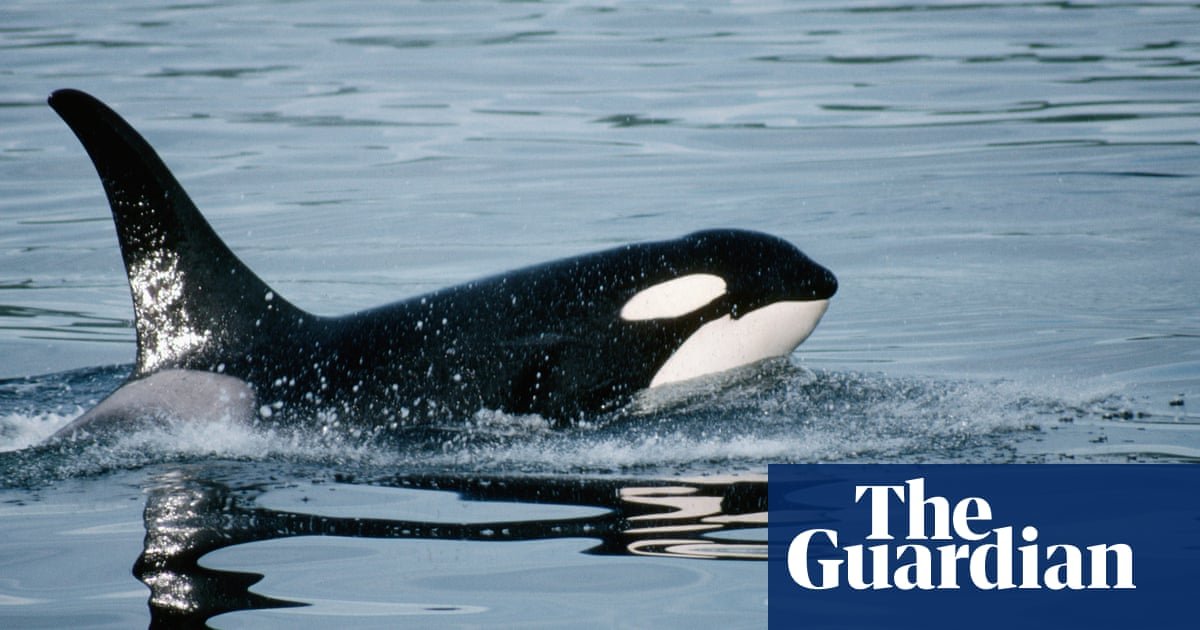
Killer whales have been observed mutually grooming each other with a type of seaweed, the first known instance of a marine animal using tools in a way that was previously thought to be the preserve of primates such as humans.
A group of killer whales, which are also known as orcas, have been biting off short sections of bull kelp and then rolling these stems between their bodies, possibly to remove dead skin or parasites. The behavior is the first such documented mutual grooming in marine animals and is outlined in a new scientific paper.
The discovery was made in a contained group of 73 killer whales that live in the southern part of the Salish Sea, a section of the Pacific Ocean hugging the coast of Washington state in the US and Canada’s British Columbia.
Researchers were surprised to see a whale remove a 2ft section of bull kelp, balance it on its nose and then approach another whale to wedge the kelp between their bodies and rub it between them. At first, the scientists thought this was a quirky one-off but then noticed this was a widespread behavior within the group, according to the paper, published in journal Current Biology.
Whale with kelp in its mouth. Photograph: Center for Whale Research, NMFS NOAA Permit 27038
“We started keeping an eye out for the behavior and realized this was a common, frequent behavior, which was a very exciting moment,” said Michael Weiss, research director at the Center for Whale Research and the study’s lead author.
“We realized we had stumbled across a newly described behavior, which is remarkable. You don’t even think it is a possibility to find something new like this when you’re observing whales.”
Cetaceans such as whales have been previously seen with kelp draped over their bodies, a practice known as “kelping”. The behavior witnessed for the first time last year and published in the new study, however, differs because the kelp is selected, trimmed and manipulated between two whales working together.
The “allokelping” occurred between all whales within the pod, but particularly between those closely related, of a similar age and involving those with lots of dead skin. This has led researchers to posit that the grooming practice is done to remove dead skin, help the whales stay free of parasites and foster the sort of social bonds that a select group of other animals, such as humans, get from interacting in this way.
“In primates, including humans, touch moderates stress and helps to build relationships,” said Darren Croft, a researcher at the University of Exeter and executive director of the Center for Whale Research. “We know killer whales often make contact with other members of their group, touching with their bodies and fins, but using kelp like this might enhance this experience.
Orcas in the southern resident killer whale endangered J Pod play in the Salish Sea at sunset. Photograph: Richard Ellis/Alamy
“It might also be important for skin health. Whales and dolphins have a variety of strategies to help them slough dead skin, and this may be yet another adaptation for this purpose.”
Killer whales, despite their name, are the largest members of the dolphin family and can reach up to 33ft (10 metres) long and weigh as much as 22,000 pounds (10,000kg). Known to be an intelligent apex predator found in all of the world’s oceans, killer whales have been seen working cooperatively when hunting but until now it wasn’t known that they use tools in this way.
The deployment of tools is seen elsewhere in the animal world, most famously with chimpanzees using sticks to retrieve termites from a mound. Elephants, tamarins and crows have also been seen using tools in some way, although few creatures, other than humans, are known to use tools in the sort of mutually beneficial way documented in the Salish Sea killer whales.
“It doesn’t surprise me that they have these intricate social interactions because we know they develop deep bonds between each other, that they are very smart and they figure out problems in their environment,” said Weiss.
A more surprising aspect of the discovery, Weiss said, was how long it took. The Salish Sea killer whales have been studied for the past 50 years, with the kelp usage only spotted last year. “These are probably the most monitored marine mammals in the world,” said Weiss.
“It really shows that these whales have so much to teach us and that we are still just scratching the surface of their lives and behavior. There is probably a lot of other such behavior we are just waiting to stumble upon, in this and other marine species.”
A breakthrough in better understanding the whales’ lives came through the use of cameras on drones, which allowed researchers to observe them more closely. By flying and zooming in on the pod as it swam together, researchers could make out the short strands of kelp and how they were being pressed up and moved between the whales.
The study’s discoveries were “amazing” and raised the question of other instances of cetacean tool use, said Monika Wieland Shields, director of the Orca Behavior Institute, who was not involved in the research.
“Thus far, there is still a pretty small sample size of allokelping, but if, as the authors suggest, this behavior relates to social skin care, it’s probably been ubiquitous for some time,” she said. “This research demonstrates the new behavioral, cultural and social insights that can come from relatively new techniques like drone observation.”
Distinct groups of whales have been known to share certain traits, such as their songs containing regional “accents” in different parts of the ocean around the world. Researchers said they were keen to find out if kelp grooming practices are unique to this group of killer whales or are found elsewhere, too.
Even though this grooming practice has only just been discovered, it is under threat. The group of 73 whales do not interbreed with other killer whale populations and Weiss said the outlook was “very bleak” as the group slowly declines. The whales feed primarily on chinook, or “king”, salmon which have suffered steep population drops due to overfishing, the climate crisis and the destruction of spawning habitat by dams built on rivers.
The bull kelp itself, meanwhile, is menaced by global heating, which is causing oceans around the world to rapidly warm up. The kelp thrives in colder water and whole swaths of the algae are being wiped out in the Pacific north-west as conditions become increasingly hot.
“The killer whales are in danger and we are at risk of losing this unique behavior, too,” said Weiss. “If we lose them we may never see this behavior on the planet again. We don’t just lose 73 whales; we lose everything they have been doing for thousands and thousands of years.”
