

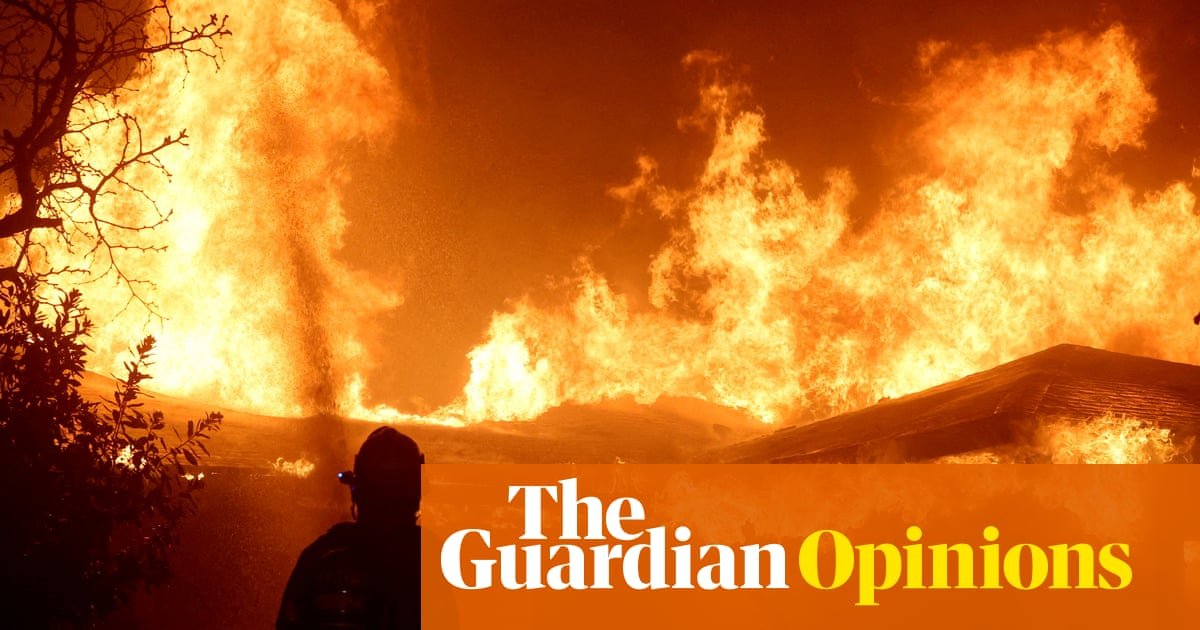
The heatwave that gripped much of the UK this week was the latest sweltering reminder that the climate emergency is already making daily life more volatile.
Many of the places most brutally exposed to out-of-kilter weather patterns and natural disasters are in the global south, and rightly demand solidarity from the wealthier countries responsible for most historical emissions. But the costs of the emergency are being felt everywhere.
Three nuggets from the last week alone: first, chocolate prices in the UK increased at a record annual rate of 18% rate last month, according to the Office for National Statistics (ONS), driven by repeated weather-related failures of the cocoa crop in west Africa.
Second, research by Bloomberg Intelligence calculated that an extraordinary $1tn was spent in the US last year on rebuilding and recovery after climate disasters such as wildfires and floods.
The analysis highlighted the benefits for companies specialising in repair and resilience (the DIY chain Home Depot gets a mention, for example, as does the cement-maker Heidelberg), but rightly pointed out that these are resources that have to be diverted from other purposes.
“Climate-related disasters are redistributing trillions of dollars in global spending away from the broader economy to pay for the costs of repairing the damage from the last fire, flood and storm and preparing for the next one,” as the authors put it.
And third, a deeply depressing paper by US academics, for the IZA Institute of Labor Economics, was highlighted by Ruth Curtice of the Resolution Foundation. It showed that wildfires, which are becoming increasingly prevalent, have a direct impact on jobs and earnings because the smoke affects the health of people many miles away from the centre of the blaze.
Researchers found that the impact over a typically smoky year knocks as much as 2%, or $125bn, off the total earnings of US workers – with older employees feeling the worst effects. That’s a health crisis and an economic challenge, too.
Even in wealthy countries, in other words, the climate emergency is absorbing an ever-expanding share of resources and causing repeated cost shocks.
For policymakers contemplating this “age of shifts and breaks”, as the ECB chief Christine Lagarde has called it, another fascinating piece of research published last week – not specifically about climate, but about cost shocks more generally – provided some worrying context.
Isabella Weber and her colleagues analysed transcripts of more than 100,000 “earnings calls” – the crucial meetings at which companies update their investors – from almost 5,000 US companies between 2007 and 2022, and cross-checked them against data on costs across the economy.
They found that during cost shocks – when everyone knows costs are going up – companies feel emboldened to push up prices and build their profit margins.
Scrutinising the language used on the calls, Weber et al suggest executives tend to calculate that they won’t lose market share, because rival companies will also raise prices, and assume the public will be more understanding than during normal times.
It’s not that CEOs put their heads together and cook up a top-secret plan to make bumper profits in the teeth of a crisis – instead, an economy-wide cost shock acts as what the authors call an “implicit coordination mechanism”.
This is what Weber and co call “sellers’ inflation” – driven not by the demands of workers for higher wages, which companies then pass on to consumers, but by opportunistic behaviour from bosses.
They don’t argue that this is necessarily the main driver of inflation during crises such as the Covid pandemic, but that this “markup increase” channel is significant – and makes managing inflation more complex.
“If, in the face of major supply shocks, firms do not absorb cost increases but instead perceive them as good news – as they facilitate price hikes and hence higher profits – this has important implications for price stability in a world of overlapping emergencies,” they warn.
skip past newsletter promotion
Sign up to Business Today
Get set for the working day – we’ll point you to all the business news and analysis you need every morning
Privacy Notice: Newsletters may contain info about charities, online ads, and content funded by outside parties. For more information see our Privacy Policy. We use Google reCaptcha to protect our website and the Google Privacy Policy and Terms of Service apply.
after newsletter promotion
Climate change is one such emergency – alongside burgeoning global conflicts, and the dismantling of long-established trading relationships. And as it hits food production in particular, it appears likely to continue presenting policymakers with cost shocks.
The main weapon of central banks – raising interest rates – is a very blunt one against this particular species of inflation.
Weber argues instead for a “toolbox approach” that includes building up “buffer stocks” of essential commodities (chocolate, sadly, seems unlikely to qualify), cracking down on companies taking unfair advantage of economic shocks, and in extremis, price controls.
Another recent plea for policymakers to think differently about climate-driven inflation came from a pair of researchers at the LSE’s Grantham Research Institute.
David Barmes and Luiz Awazu Pereira da Silva advocate “adaptive inflation targeting,” in what they call a “hot and volatile world”.
They argue that given the likelihood of increasingly frequent climate cost shocks, policymakers would be wise to tolerate, or “look through,” these short-term blips more willingly than they do at present.
They suggest politicians might also want to allow central banks to temporarily target a higher inflation rate at times of repeated shocks, and perhaps allow more leeway around the target, too.
Keeping rates high to squash climate-driven inflation has no impact on the underlying problem, Barmes and Pereira da Silva argue, and raises government borrowing costs, just as public investment in the green transition is urgently needed.
Anyone sweating through the weekend in a home built when 30C was a once-in-a-generation aberration may have pondered how out of step Britain’s infrastructure is with the changing climate. But our economic policymaking infrastructure, too, will surely need to adapt.
