

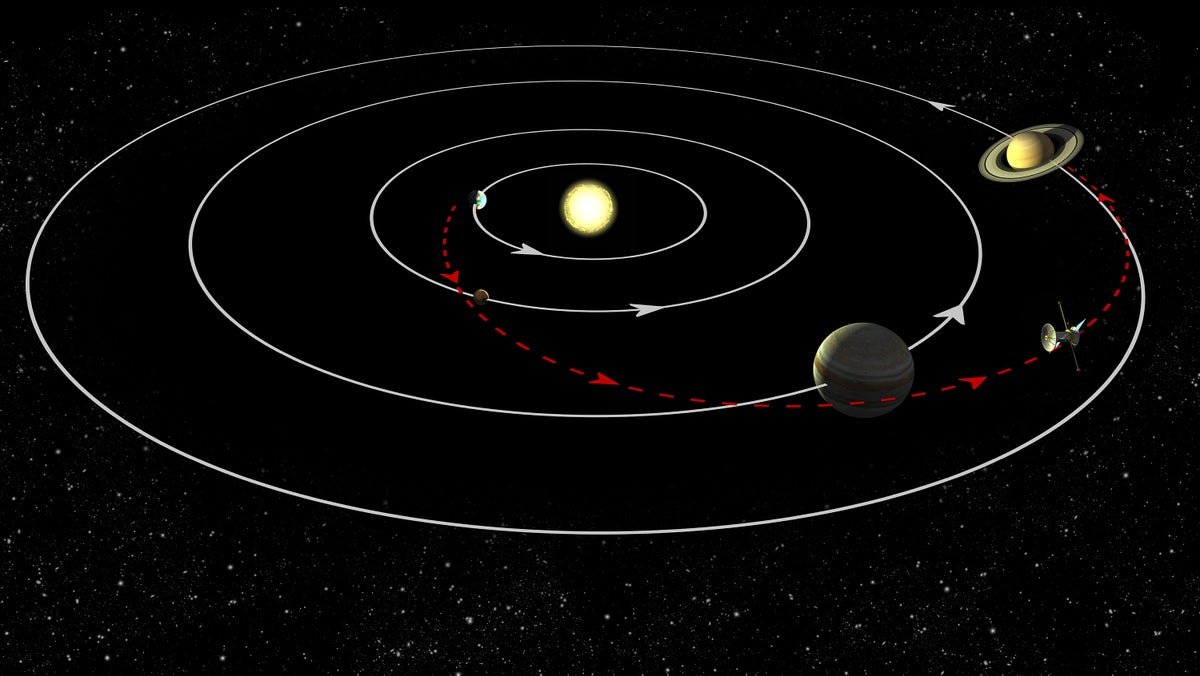
You’ve probably watched this sort of science-fiction scene more than once: some stalwart starship captain and their crew are fleeing from aliens/escaping a supernova /running out of fuel and are seemingly out of options, about to get eaten/vaporized/stuck. But then, just ahead, they spot a planet! So they head right for it, rockets blazing, then dive down and use its gravity to slingshot to safety. Hooray! Cue the triumphant music.
So it goes on the silver screen, at least. But does this maneuver work in real life?
Yes! Well, not so much the way it’s done in movies—but it is an actual thing. It’s widely known as a gravitational slingshot, though most scientists refer to it as a gravitational assist, and it’s an essential tool for most interplanetary missions.
On supporting science journalism
If you’re enjoying this article, consider supporting our award-winning journalism by subscribing. By purchasing a subscription you are helping to ensure the future of impactful stories about the discoveries and ideas shaping our world today.
The idea seems simple enough. As a spacecraft approaches a massive object, say, a planet, the gravity of the planet bends its trajectory, changing the spacecraft’s direction. But there’s more to it than that: the spacecraft can actually use the planet’s gravity to speed up or slow down after this maneuver, allowing easier voyages to the outer or inner planets, respectively.
While the trajectory-bending part seems obvious enough, that speed-up-or-slow-down part is pretty counterintuitive. It’s related to the symmetry of gravity.
If you hold a rubber ball some distance from the ground and drop it, the ball will accelerate as it falls, speeding up until impact. Then it bounces, moving upward and decelerating as it does so. It will eventually come to a stop, whereupon you can catch it or let it fall again. But either way, it can’t bounce any higher than the height from which you dropped it. It gained kinetic energy—the energy of motion—as it fell but then lost it once again postbounce as it slowed on its way back up. This action is symmetric, so at best (if you had a perfectly elastic ball and did this experiment in a vacuum), it would bounce to the same height from which you dropped it.
The same is true for a spacecraft approaching a planet. The world’s gravity will accelerate you as you fall in, you’ll whip around at closest approach (that’s the “slingshot” part), and then you’ll lose that extra velocity as you move away because the planet’s gravity is still pulling on you. As that gravitational grip slips away, the spacecraft will be moving relative to the planet at the same speed at which it initially approached.
So if all the bonus speed is lost on the way out, how can this maneuver be used to accelerate a spacecraft? The key is in the phrase “relative to the planet.” If you approach the planet at, say, 20 kilometers per second (km/s), you’ll leave with the same speed. But that’s your speed measured against the planet.
At that same time, crucially, the planet is also orbiting the sun. If you approach the planet from behind (that is, in the direction of its motion), then, as the planet’s gravity gives you a boost, it also, in a heliocentric sense, pulls you along, adding some of its orbital velocity to yours. That gives you a kick relative to the sun, speeding you up on your way to your destination. In essence, the spacecraft gets a net gain in speed by stealing a little bit of the planet’s orbital kinetic energy.
In turn, this means the planet actually slows a bit in its orbit around the sun—which sounds dangerous! But fear not: the planet slows in proportion to how much more massive it is than the spacecraft. Given a typical one-ton probe compared with a multisextillion-ton world, the planet doesn’t noticeably slow at all. You could launch a million probes at it and never be able to tell the difference in its orbital speed. A bacterium bouncing off you while you’re out walking would have a far larger effect on you.
The reason it’s worthwhile to go to the trouble of gravitational assists is that spacecraft are launched by rockets, which can only accelerate to some top speed. For our current rocketry, these speeds are so low and the interplanetary distances so great that even the fastest, most direct voyages take years (or even decades for destinations in the outer solar system). You can load the spacecraft with more fuel to burn to go faster, but there’s a limit to that, too. Fuel has mass, and you’d need to accelerate that extra mass, which takes more fuel, which has more mass. This catch-22 is described by what is called the rocket equation, and it means the amount of fuel you must add to move even slightly faster reaches prohibitive scales very quickly.
So shaving time off your voyage requires some other method—such as siphoning speed from a big, juicy planet along the way! For example, the Cassini probe to Saturn, which launched in 1997, was a huge spacecraft, the size of a school bus, and had a mass of 2.5 metric tons without fuel. (The addition of the fuel it needed to fulfill its mission at Saturn, along with the launch vehicle and other equipment, tipped the scales to 5.7 metric tons.) It would’ve taken practically forever to get to Saturn with the rockets we had then. So the mission planners took advantage of Jupiter, sending the spacecraft past it on a speed-boosting slingshot maneuver that shaved significant time off the journey. In fact, just to get out to Jupiter in the first place, Cassini also performed two fuel-saving flybys of Venus and one of Earth, stealing planetary orbital energy every time.
A gravitational assist works the other way, too. Earth orbits the sun at more than 30 km/s, so firing a probe at the sun or the inner planets is extremely hard because of all that sideways velocity. Instead mission planners prefer a more circuitous route. They launch the spacecraft with enough velocity in the opposite direction of Earth’s path around the sun to drop in front of, say, Venus, where it can then donate some of its orbital energy to the planet to drop toward the sun even more. BepiColombo, a joint European Space Agency and Japan Aerospace Exploration Agency mission to Mercury, did exactly this, passing Earth once and Venus twice to get in Mercury’s vicinity. Even then, it had to do a total of six gravity assists past Mercury to match the planet’s orbital speed around the sun. The last assist was in January 2025, and it will enter Mercury orbit in November 2026.
Gravitational assists are an emblematic example of why space travel is hard—it is exactly rocket science, after all. Gravity is the biggest culprit; just getting away from Earth in the first place is the largest part of the problem. It’s ironic, then, that gravity can make reaching most of the rest of the solar system so much easier.
