

Mysterious Link between Earth’s Magnetism and Oxygen Baffles Scientists
The strength of Earth’s magnetic field and the amount of oxygen in its atmosphere seem to be correlated—and scientists want to know why
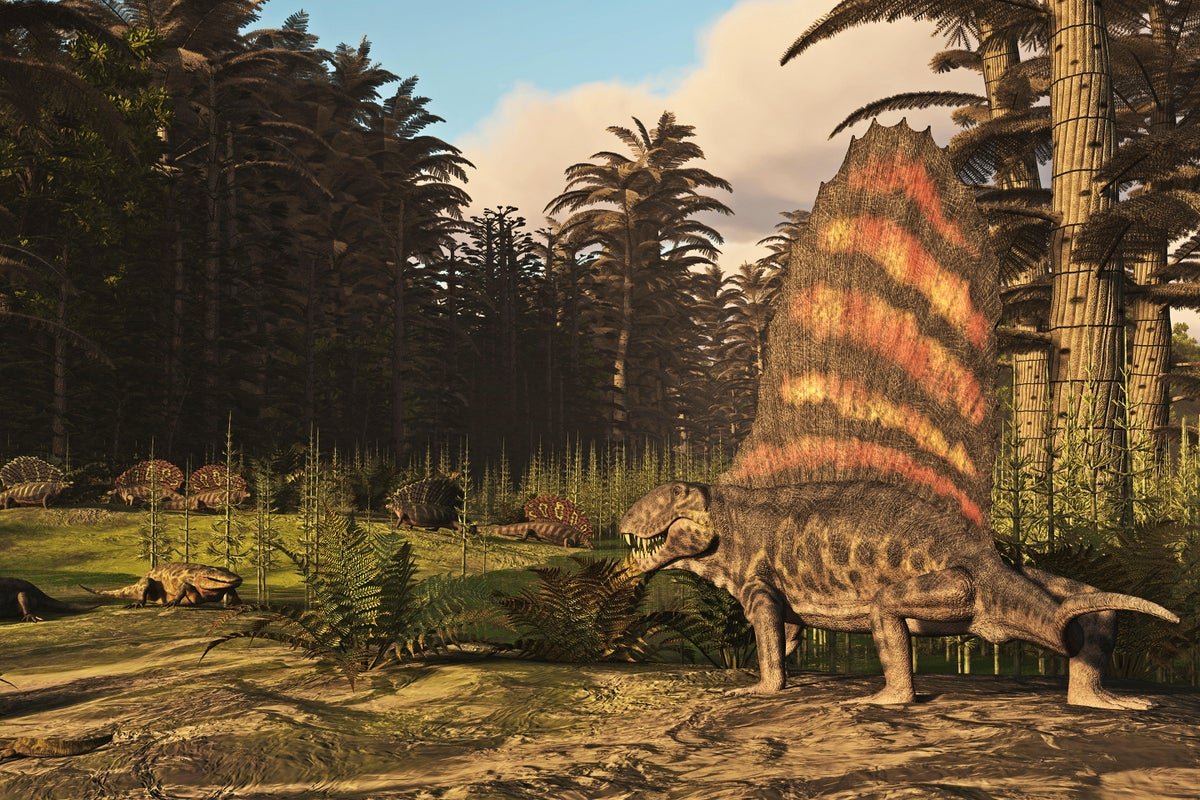
A group of Dimetrodon’s hunting in a Permian era environment.
Stocktrek Images, Inc./Alamy Stock Photo
The strength of Earth’s magnetic field seems to rise and fall hand-in-hand with the abundance of oxygen in its atmosphere, a study of geological records spanning the last half billion years has found.
Explaining the link could help to reveal fundamental trends in the evolution of life on Earth — and could show astronomers the most promising places to look for signs of complex life on other planets. But it is so far unclear whether Earth’s magnetism plays direct a role in keeping oxygen levels high — and sustaining animal life — or whether both are influenced by a third, unidentified mechanism.
Nature; Source: “Strong Link between Earth’s Oxygen Level and Geomagnetic Dipole Revealed since the Last 540 Million Years,” by Weija Kuang et al., in Science Advances, Vol. 11, No. 24; June 13, 2025
On supporting science journalism
If you’re enjoying this article, consider supporting our award-winning journalism by subscribing. By purchasing a subscription you are helping to ensure the future of impactful stories about the discoveries and ideas shaping our world today.
“We don’t really have a good explanation for it,” says Benjamin Mills, a biogeochemist at the University of Leeds, UK, and co-author of the study, published in Science Advances on 13 June. But the study suggests “some potential causes that are exciting and potentially testable”, says Aubrey Zerkle, a biogeochemist at the University of St Andrews, UK.
Knowing how Earth’s deep interior could influence the evolution of the atmosphere is “critical to understanding what makes our planet habitable”, says Richard Bono, a geophysicist at Florida State University in Tallahassee who has helped to compile long-term records of geomagnetism.
Geological clues
Oxygen is the main component of Earth’s crust and mantle. But molecular oxygen only began to slowly accumulate in the atmosphere after organisms that produce oxygen through photosynthesis began to evolve, around 2.5 billion years ago. And only in the current aeon, covering the last 540 million years or so, has it reached concentrations that are breathable by most animals.
There is no direct way to measure the composition of the atmosphere in the deep past, but geochemists can use indirect clues to reconstruct oxygen levels starting in the Cambrian period, which began around 540 million years ago. For example, oxygen concentration “has a strong relationship with how easy it is to start and maintain wildfires,” says Mills, and the frequency of large wildfires can be worked out by looking at ancient charcoal deposits, among other factors.
Geophysicists can also reconstruct how the strength and direction of the geomagnetic field has varied across even longer stretches of Earth’s history, by studying rocks produced by ancient volcanic eruptions. That’s because magnetic crystals that form in the solidifying lava align themselves with the field, acting like tiny compasses frozen in time.
To put these two long records side-by-side and compare them, Mills teamed up with geophysicists Weijia Kuang and Ravi Kopparapu, both at NASA Goddard Space Flight Center, Greenbelt, Maryland, and with exobiologist Joshua Krissansen-Totton at the University of Washington in Seattle. The authors found a strong correlation — both oxygen levels and geomagnetic intensity have increased over the past million years, and some of the major spikes or drops in both measures occur in the same geological eras (see ‘Long-term trends’).
Possible explanations
The paper discusses some possible reasons for the correlation. Earth’s magnetic field is known to have a protective effect on the upper atmosphere because it deflects solar wind, a stream of charged particles from the Sun that would otherwise cause oxygen and other gases to slowly escape into space. But the team calculated that the loss of oxygen caused by a drastic weakening of the field would still be small compared to the amounts generated by photosynthesis — or to those consumed by other organisms and by geological cycles in which elements are exchanged between the atmosphere, crust and the mantle.
“We don’t necessarily think that the magnetic field impacts cycling directly, but it may be a result of the same processes,” says Mills. Over hundreds of millions of years, tectonic motions have repeatedly formed supercontinents, and have subsequently broken them up — releasing vast amounts of nutrients that in turn spurred massive blooms of oxygen-producing algae in Earth’s oceans. Tectonics are driven by the slow churn of Earth’s mantle, the region between crust and core. This churning could also have impacted the liquid outer core, where the geomagnetic field is produced, says Kuang.
“If things like the spreading rate [of the oceanic crust] influence the magnetic field, the tectonic cycle could be driving oxygenation — but also the magnetic field,” Mills says.
Sanja Panovska, a geophysicist at the Helmholtz Centre for Geoscience in Potsdam, Germany, says that the study is convincing, but it introduces more questions than it answers. “The authors mention a lot of hypotheses, but they are not put to the test in this paper.”
Nevertheless, the discovery could feed into a long-standing debate on whether a strong magnetic field is essential for complex life to evolve on a planet. “It’s very expensive to observe exoplanets, and you need to choose which ones to observe,” says Mills. “What this kind of work would inform is the kind of places you’d look.”
This article is reproduced with permission and was first published on June 13, 2025.
