

A yellowish-green apple with a short brown stem, centered on a light blue background.
Math, Revealed
What an apple, a pentagram and a belly button have in common.
Each installment of “Math, Revealed” starts with an object, uncovers the math behind it and follows it to places you wouldn’t expect. Sign up here for the weekly Science Times newsletter for upcoming installments.
June 16, 2025
A yellowish-green apple with a short brown stem, centered on a light blue background.
Hiding inside every apple
A yellowish-green apple, seen from directly above, with its stem prominent, on a light blue background.
is a little bit of secret geometry.
A yellowish-green apple, cut in half to show its core and seeds arranged in a star shape, on a light blue background.
To reveal it, cut the apple sideways, straight through the core, like this:
A close-up of a halved apple’s core, showing five dark seeds in a star shape, on a light blue background.
There you’ll find five seeds in the shape of a star.
Five yellow pencils are arranged in a five-pointed star shape on a light blue background.
In its idealized form, this kind of five-pointed star is known as a pentagram.
In mathematics, the pentagram is a poster child for “self-similarity,” a symmetry that’s like worlds within worlds. The shape contains infinitely many smaller and smaller copies of itself, like nested Russian dolls.
A five-pointed star made of yellow pencils is centered on a light blue background. Five shorter black pencils appear one at a time connecting the points of the yellow star.
To see self-similarity in action, imagine connecting the star’s points with straight lines.
A five-pointed star is formed by yellow pencils with five black pencils connecting the points. The pentagram formed in the center of the star by its overlapping lines is highlighted in blue. All on a light blue background.
The newly created pentagon immediately calls attention to a smaller pentagon nestled inside itself.
A five-pointed star is formed by yellow pencils with five black pencils connecting the points. The pentagram formed in the center of the star by its overlapping lines is highlighted in blue. All on a light blue background.
A famous number known as the golden ratio describes the proportions of the smaller parts to the whole.
The parts add up: a blue segment and a yellow segment, laid end to end, are exactly as long as a black segment. Or: small plus medium equals large.
A five-pointed star is formed by yellow pencils with five black pencils connecting the points. Below the star formation, two additional pencils—one all black and one yellow and blue—are arranged horizontally.
Moreover, the parts are in the same proportion: medium is to small as large is to medium.
That common proportion defines the golden ratio, which is approximately 1.618.
Illustration of a red and grey skeletal dodecahedron on aged paper, hanging from a red pushpin, set against a blue background.
In 1509, an Italian mathematician named Luca Pacioli ascribed cosmic significance to the golden ratio in his book “On the Divine Proportion.”
The book included many illustrations by his friend Leonardo da Vinci, including this 3-D shape (a dodecahedron) made from identical pentagons.
Leonardo da Vinci’s “Vitruvian Man” illustration on aged paper, depicting a male figure in two overlaid stances with arms and legs apart, inscribed within a circle and a square. Pinned with a blue pushpin to a light blue background.
Years earlier, Leonardo had performed his own study of proportions, based on the theories of the ancient Roman architect Vitruvius.
This led him to draw an iconic image known as “Vitruvian Man.”
Did he hide the golden ratio in it?
Illustration of Leonardo da Vinci’s “Vitruvian Man” showing a single standing figure with outstretched arms touching the edges of a square, pinned to a blue background.
This much we know: With his arms spread wide, Vitruvian Man fits perfectly in a square — his wingspan equals his height.
Illustration of Leonardo da Vinci’s “Vitruvian Man” with arms and legs spread, inscribed in a circle, pinned to a blue background.
With arms and legs splayed, he also stands comfortably on the circumference of a circle, which his middle fingers extend to touch.
At the center of it all is his navel.
Illustration of Leonardo da Vinci’s “Vitruvian Man” with arms and legs spread, inscribed in a circle, pinned to a blue background.
Leonardo’s handwritten notes specify many of the man’s proportions as fractions of his height:
“From the hairline to the bottom of the chin is one-tenth of the height of the man.”
“From below the chin to the top of the head is one-eighth of the height of the man.”
And so on.
Leonardo da Vinci’s “Vitruvian Man” illustration on aged paper, depicting a male figure in two overlaid stances with arms and legs apart, inscribed within a circle and a square. Pinned with a blue pushpin to a light blue background.
Yet nowhere does Leonardo quantify the location of the man’s navel.
This omission seems surprising, given the navel’s centrality in his scheme.
Some commentators claim that Leonardo positioned the navel to divide the man’s height according to the golden ratio.
But Leonardo doesn’t mention the golden ratio, either in the drawing or in his notebooks.
Leonardo da Vinci’s famed “Vitruvian Man” illustration on aged paper, depicting a male figure in two overlaid stances with arms and legs apart, inscribed within a circle and a square. Pinned with a blue pushpin to a light blue background.
In fact, a 2015 analysis by the architect Vitor Murtinho found that the placement of the Vitruvian man’s navel does not quite comport with it.
The man’s height in the drawing is 181.5 millimeters and the height of the navel is 110 millimeters, for a ratio of 1.65 to 1.
That’s close to the golden ratio (1.618 to 1), but surely Leonardo could have come closer if he’d meant to.
A round, bright pink balloon with its tied end facing forward, centered on a light blue background.
Is it possible that Leonardo really thought 1.65 was the correct anatomical proportion for a well-shaped human being?
Zoomed into the same round, bright pink balloon with its tied end facing forward, centered on a light blue background.
And what, in fact, is the typical number? Presumably, it falls on a bell curve — or should we say belly button curve.
An inflated pink balloon fills the screen. The gathered, stretched latex of the balloon’s opening forms a textured knot in the center.
As for what’s most desirable, proponents of the golden ratio insist on a divine proportion. The ideal navel should divide the upper abdomen from the lower abdomen, not in half but in a ratio of 1.618 to 1.
A close-up of a white mannequin’s navel, an “innie,” on its smooth torso.
Indeed, a 2015 study published in the journal Aesthetic Plastic Surgery asked participants to select the most attractive navel position on digitally altered pictures of bikini models, and found that the golden ratio was ideal.
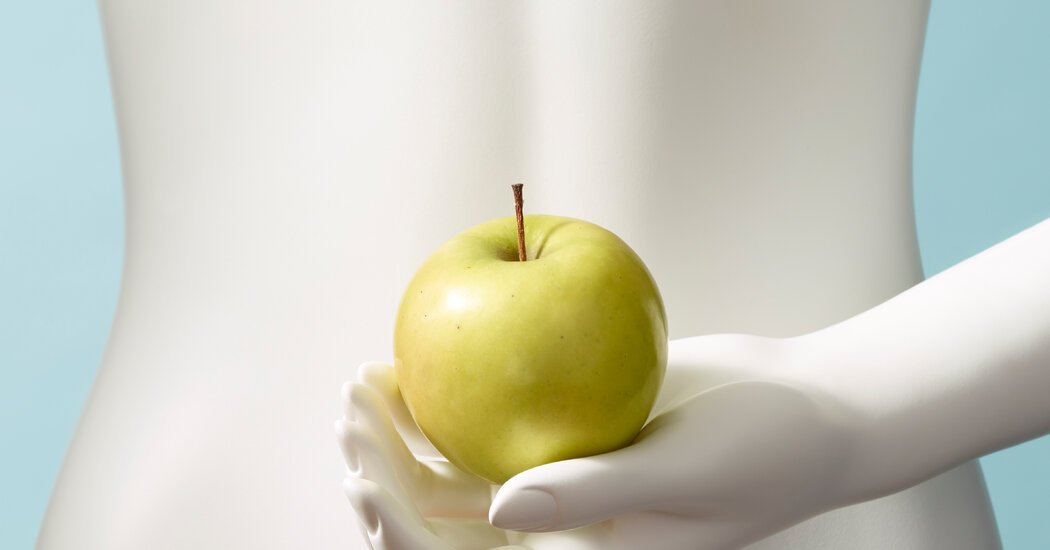
A white mannequin’s hand holds a yellowish-green apple in front of its torso, against a light blue background.
On the other hand, a 2022 eye-tracking study in the Journal of Plastic Surgery and Hand Surgery, in which volunteers looked at digitally altered images of a female patient, found that a 2 to 1 ratio of upper to lower abdomen was more pleasing than the golden ratio.
A white mannequin’s hand holds a yellowish-green apple in front of its torso, against a light blue background.
Divine proportions? Meet diverse ones — they can be beautiful too.
