

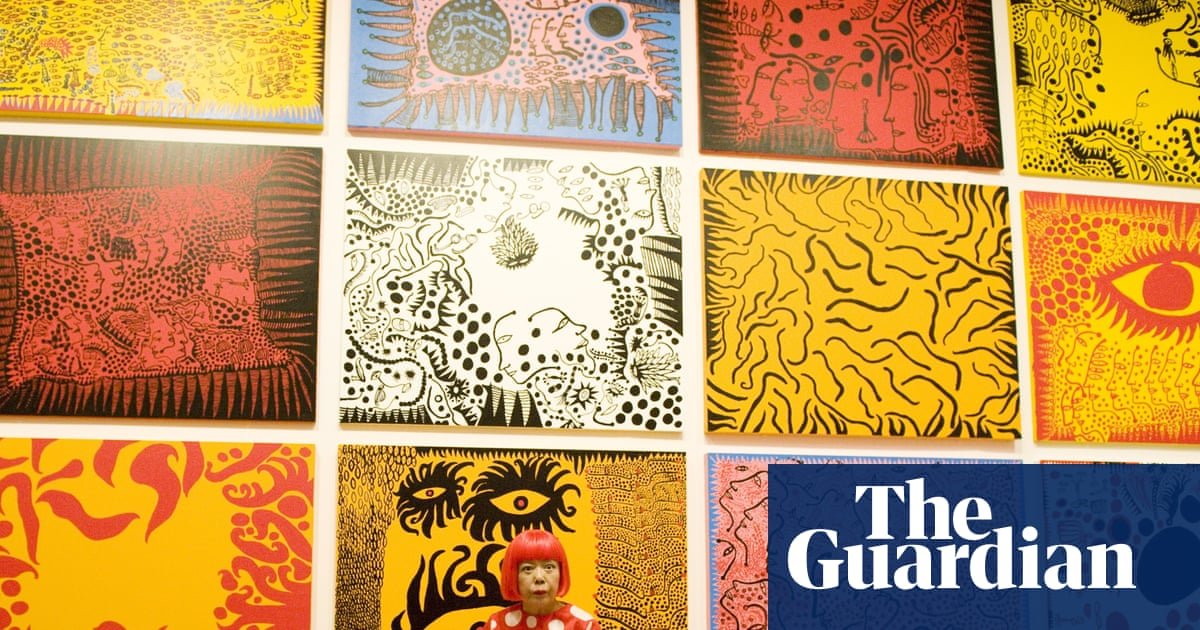
Yayoi Kusama – who has died at the age of 97 – was 10 when she first started experiencing vivid hallucinations consisting of visual and aural disturbances, which she described as “flashes of light, auras, or dense fields of dots”. A drawing from 1939, of a woman in a kimono assumed to be her mother, shows her obliterated by those dots; they would become Kusama’s artistic obsession. She hallucinated flowers, too. “I was looking at the red flower patterns of the tablecloth on a table, and when I looked up I saw the same pattern covering the ceiling, the windows and the walls, and finally all over the room, my body and the universe”, she once said, when asked about that recurring motif. “I felt as if I had begun to self-obliterate, to revolve in the infinity of endless time and the absoluteness of space, and be reduced to nothingness.”
For Kusama, art making was a means of survival. “I fight pain, anxiety, and fear every day, and the only method I have found that relieved my illness is to keep creating art. I followed the thread of art and somehow discovered a path that would allow me to live”, she said in a 2012 interview. In so doing, she became one of the most acclaimed and admired contemporary artists, staging happenings and influencing the pop art movement as a pioneering figure in the New York avant garde. Her exhibitions and major retrospectives draw huge crowds. In 2022, due to enormous public demand, Tate Modern in London extended her Infinity Mirror Rooms show for a whole extra year (it ended up running until 2024).
Nnena Kalu, winner of the Turner prize 2025. Photograph: James Speakman/PA
Kusama leaves a planet that is far more enlightened about mental illness and neurodivergence than that which she entered. Different ways of seeing are increasingly embraced by the art world, which is beginning to understand how the brilliant, beautiful diversity of the human brain can feed into groundbreaking artistic practice. Neurodivergent, disabled and autistic artists are nominated for major prizes, and last year Nnena Kalu, who is autistic and has a learning disability, won the Turner prize. Furthermore, artists such as Louis Wain, who was schizophrenic, and Andy Warhol – who had traits consistent with autism – are increasingly viewed through the lens of neurodiversity.
“Artists like Kusama, much like our own Nnena Kalu, have shown that great art does not come from a single source or follow a traditional route,” said a spokesman for ActionSpace, a London organisation who support and facilitate work by learning disabled artists. “The art world is richer for it, and their work continues to challenge us to recognise and celebrate the many voices that shape it.”
Despite the historically unfair stigma of mental illness, Kusama was always vocal about her struggles and how they fed into her work, in the 1970s voluntarily checking herself into a mental-health facility in Tokyo and working in a studio nearby. Processing the “obliteration” she experienced involved repetitive ways of working – those signature dots and flowers covering everything including her own clothing – while her extraordinary infinity rooms installations of mirrors and lights took the concept of sensory overload and turned it into something magical and all-encompassing. In this way, we were granted a powerful glimpse through Kusama’s eyes.
“Kusama’s practice seemed to channel the intrinsic auditory, repetitive and hallucinatory compulsions that she experienced,” says Kate Adams, director and co-founder of Project Art Works, a collective of artists with complex needs, and their collaborators who were nominated for the Turner prize in 2021. “Rather than create an escape from these, her installations shaped and described for others a sometimes beautiful, sometimes overwhelming world of intensity, pattern and form.
An enduring influence … Yayoi Kusama as a young woman. Photograph: Magnolia Pictures/Everett/Shutterstock
“This has parallels with the way in which stimming, hyper focus and innate sensory sensitivities find a way into the rich practices of neurodivergent artists and makers,” she continues. Adams points out that mental illnesses such as OCD are not necessarily the same as neurodivergence – we should be wary of grouping them all together. There can be parallels though, in Adams’ words “when anxiety overwhelms wellbeing”. Often diagnoses can overlap.
This is true of my brother, who is profoundly autistic: non-verbal, with OCD. Although he is unable to tell me, I have always instinctively known that he sees the world differently. He had a childhood fascination with the way light is reflected on water, and his fear of the dark knots in the wood of the pine bathroom’s walls saw my mother frantically painting them over the moment she realised what was going on. That ASD comes with sensory differences has long been known in the autism community, but awareness has now reached a point where sensory rooms are cropping up in schools, hotels and airports. Exploring Kusama’s infinity rooms at Tate Modern with my son, who was then a baby, was a meaningful moment for me. The older children at his nursery had also been to visit, and for a while the walls were covered with pictures of dots that they had made as a tribute to Kusama.
Kusama often referenced how art had saved her, saying: “If it were not for art, I would have killed myself a long time ago.” Although disabled and neurodivergent artists still face major barriers, and still experience moments of sadness and despair that are shared by those of us that love them, Kusama’s work and enduring influence stand as a lasting tribute to the complex magnificence of human perception and experience.
