

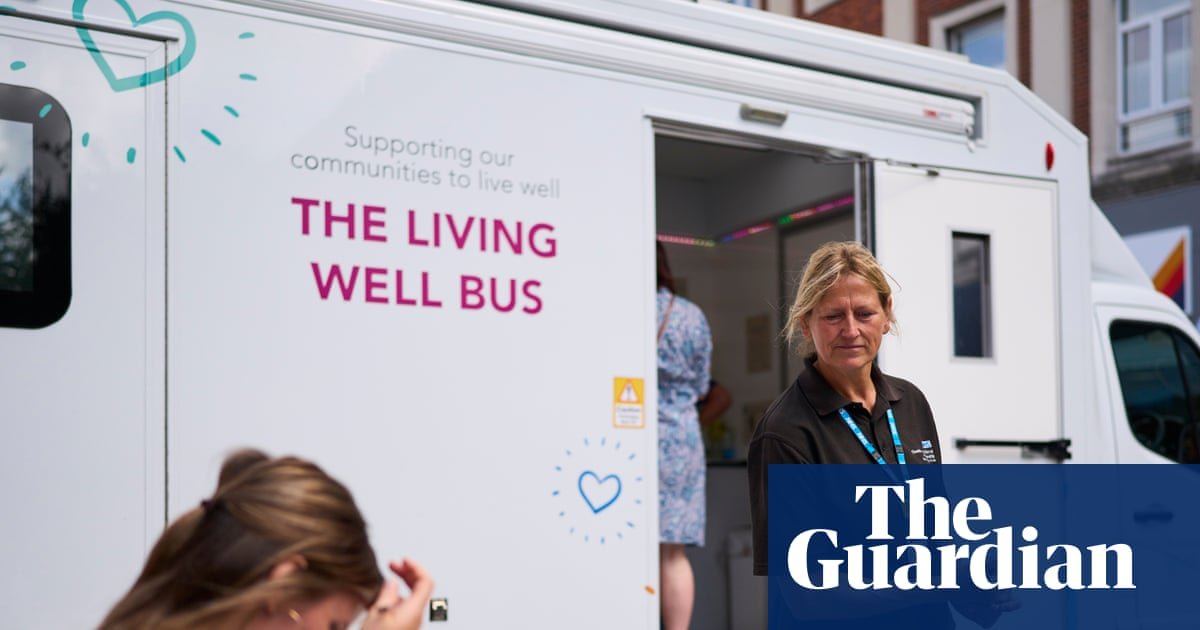
It’s 10am on one of the main pedestrian shopping streets in Warrington, and already there’s a queue of women outside a small bus the size of a supermarket delivery van. While some look calm, others are visibly nervous. This is no mobile library, post office or coffee truck – but one providing far more intimate services: cervical screening.
The bus feels surprisingly spacious. There’s a consultation area with room for the nurses, patients and anyone accompanying them to talk. Behind it, a separate room holds a bed, room to get changed and storage for all the clinical equipment. Purple lighting, smart decor and spa music add to the minimalist ambience.
Jill West, left, and Heledd Watkins, clinical staff on the Living Well Bus, say the service is game-changing. Photograph: Christopher Thomond/The Guardian
Catherine, 26, is the first in the queue. She has never had cervical screening before. She says the fact that it is a bus, with people she doesn’t know, persuaded her to go ahead with it. “I didn’t go for screening before because there’s only one nurse at my doctor’s and she’s my asthma nurse,” Catherine says. “So it felt too familiar.”
Cervical cancer is the fourth most common cancer in women, according to the World Health Organization. Its cervical cancer strategy states that by 2030 all countries should screen 70% of girls and vaccinate 90% of girls by the age of 15.
Cervical cancer screening rates graphic
But NHS figures show there are just over 4 million women in England who are not up to date with their cervical screening, and that number is rising. According to OECD data, in the decade since 2014, screening rates in England have fallen eight percentage points to 69%, the fourth steepest drop behind Luxembourg, the Netherlands and Turkey.
According to the Royal College of Obstetricians and Gynaecologists, women from ethnic minority backgrounds, disabled women, LGBTQ+ people with a cervix, and those in deprived areas are less likely to be up to date with screening.
England screening rates graphic
In 2024, in a move to improve take up, Living Well buses started running walk-in cervical screening clinics in Cheshire and Merseyside. Funded by NHS England North West, the service was so popular that this summer it expanded into neighbouring regions. Now, two buses run 10 cervical screening sessions a week across Lancashire and South Cumbria, as well as Cheshire and Merseyside. From October, the service will start going to locations in Greater Manchester.
Jill West, one of the nurses running the clinic, says mobile screening is game-changing. “The bus is fantastic. Women can sometimes forget about their own health – they’ve got children to think about, work to think about, they can’t get a convenient GP appointment, or fit it in with their menstrual cycle. So the bus is perfect because it’s advertised and women can come along and get screened without having to make an appointment.”
Some women prefer the anonymity of the bus to their local GP surgery. Photograph: Christopher Thomond/The Guardian
This morning session certainly seems to be working. Peggy, 57, works in the NHS but says she had to sneak out of her shift to come to the bus and is very overdue for screening. “I’ve had smears before but I can’t remember when the last one was,” she says. “I’m now on HRT and I had a little blood the other week, so when this came up, I thought that’s the signal that I need to go and get checked.”
Imogen, 35, who works as a pharmacy technician, says the only appointment at her GP surgery would have been for 7am. “I’ve got two children, I can’t get there that early,” she says. “It’s just hard because you think it’s so important and it’s so hard to get an appointment [at the GPs], but this is just brilliant.”
Despite that, Imogen is incredibly anxious and at one point almost in tears. “I don’t know why I’m so nervous,” she says. “It’s just uncomfortable, isn’t it? But I know it needs to be done.” Less than 10 minutes later she steps out of the bus. “I feel so relieved,” she tells me. “It was fine, it’s done now. The nurses were so lovely and put me at ease.”
By 4pm, 18 women have been screened – of whom five had never had a screening before and eight who were overdue. In all, the buses have screened more than 2,700 women across the north-west.
The NHS England North West bus screening service has been so successful that this summer it expanded into neighbouring regions. Photograph: Christopher Thomond/The Guardian
Dr Sue Mann, NHS England’s national clinical director for women’s health, says: “Screening saves lives – and thousands more women have now had cervical screening they likely wouldn’t have otherwise had thanks to these excellent roaming clinics-on-wheels.”
For some, even a friendly mobile bus would not be enough. Later this year, NHS England will start rolling out self-sampling, inviting women who are overdue a screening to order home kits.
HPV vaccination rates in UK graphic
Caroline Berchet, a health economist at the OECD, says this could increase rates without reducing efficacy of results. “Allowing women to collect samples at home and return them by mail helps address common obstacles like limited access to providers, travel barriers, time constraints and discomfort with clinician-based screening.”
Melanie Tipples, a consultant gynaecologist and vice-president for education at RCOG, says introducing home HPV testing kits is a positive step. “We now need sustained investment in raising awareness of screening, and a clear, funded, accountable plan to eliminate cervical cancer by 2040.”
Nurses say it’s crucial not to rush women in the screening and drop-in appointments make this possible. Photograph: Christopher Thomond/The Guardian
Elimination will involve concerted efforts to increase vaccination rates as well as screening by tackling barriers such as stigma, misinformation and logistical challenges, says Helen Hyndman, lead nurse at The Eve Appeal.
At 75.5% for girls and 70% for boys, HPV vaccination uptake in England lags far below the 90% target set by the World Health Organization and is falling – in 2017, the rate for girls was 85%. According to the OECD, getting to 90% could prevent 89% of all premature deaths due to cervical cancer in the UK.
Back on the bus, West says the crucial thing is not rushing women. “One of the things we can do on the bus is give them time. Because there’s no appointments, if it takes half an hour, it takes half an hour.
“It’s the best job in the world – I’ve retired three times but then I think I don’t really want to, I want to be doing this.”
