

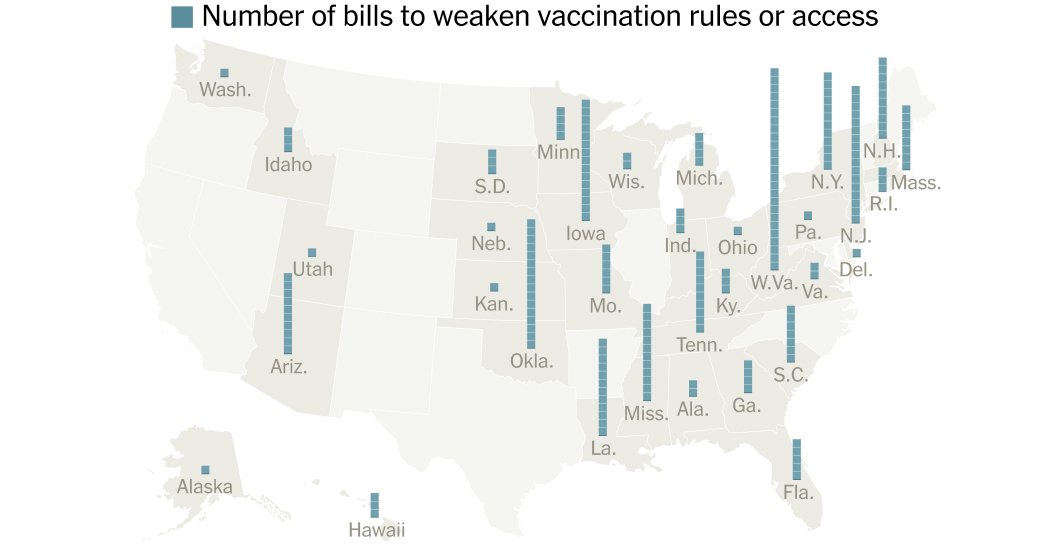
Number of bills to weaken vaccination rules or access
The reporters examined hundreds of bills related to vaccines that were introduced in statehouses this year.
July 28, 2026
Lawmakers flooded statehouses this year with bills seeking to dismantle vaccination rules or raise questions about vaccine safety, introducing more than 200 measures in 34 states.
The bills challenged every part of the system that states rely on to vaccinate the public, from the pamphlets patients receive before getting a shot to the requirements schools, day care centers and employers can implement. A proposal in Wisconsin would have designated October as “Immunization Injury Awareness Month.” A bill in Iowa would have eliminated all vaccination requirements for elementary and secondary schools.
All told, at least 400 bills related to vaccines were introduced this year. Many were intended to bolster or protect the public’s access to the shots. But 209 aimed to weaken vaccination rules or systems or to undermine public trust in vaccines, a New York Times analysis shows.
Although only a handful of these became law, leaders of the movement behind the legislative push plan to return next session with a raft of new proposals.
This session’s bills fell into five broad categories:
Bills to weaken vaccination rules or access, by category
Each rectangle represents one bill.
Passed two chambers
Passed one chamber
Introduced
Had all the bills passed, public health experts say, they would have led to a vast reduction in vaccine confidence and uptake, and eventually would have led to more outbreaks of disease.
Just nine became law, but advocates for the measures say their campaign was a success because many others got closer to the finish line this year. And some policy observers agreed that the movement made gains.
“Bills that would have died in committee in previous sessions are now passing one chamber, sometimes two,” said Jack McClure, who leads state policy efforts at the Association for Immunization Managers. “They may not be law yet, but legislators are taking them seriously.”
Bills to weaken vaccination rules or access, by state
Passed two chambers
Passed one chamber
Introduced
Pro-vaccine lawmakers found themselves playing defense. They proposed a slew of bills to make it easier to get vaccines or to emphasize their safety record. A dozen states passed laws to preserve childhood vaccination recommendations after federal health officials moved to limit them.
Lawmakers and others who believe vaccines are dangerous and should never be required were emboldened by Health Secretary Robert F. Kennedy Jr.’s efforts to oppose vaccines. The details of their latest proposals offer a window into the modern movement against vaccines, which has recently turned its focus to broader messages of health freedom and personal liberty.
What the bills say
Vaccine critics saw this year as an opportunity to upend a system that states have long relied on to vaccinate the public. They had built momentum after the coronavirus pandemic, capitalizing on anger over Covid vaccine mandates and questions about the safety of Covid vaccines.
Bills to remove or loosen vaccination requirements
1 / 62
Passed two chambers
Prohibits all vaccination and mask requirements by employers.
Passed two chambers
Prohibits vaccination requirements for adults and children residing in foster homes beyond those required for school entry.
Passed two chambers
Allows advanced-practice nurses and physician assistants to sign vaccination exemption forms.
Passed one chamber
Adds a constitutional amendment to prohibit all vaccination requirements by the government.
Passed one chamber
Requires the use of a simple form for requesting religious exemptions to vaccines.
Passed one chamber
Removes the hepatitis B vaccination requirement for children.
Introduced
Loosens the requirements for religious exemptions to school vaccination requirements.
Introduced
Requires vaccinations to have received full F.D.A. approval to be required.
Introduced
Prohibits vaccination and personal vaccination documentation requirements.
Introduced
Prohibits medical mandates, including for vaccinations.
Introduced
Expands religious vaccination exemptions to align with a “person’s bona fide religious tenets,” and not only the “religious tenets of an established church.”
Introduced
Adjusts the state’s 2025 medical freedom law to prohibit all medical mandates, including school, day care and employee vaccination requirements.
Introduced
Removes all vaccination requirements for elementary and secondary schools.
Introduced
Removes parental responsibility to provide immunization history when enrolling in private schools.
Introduced
Requires all communications about vaccination requirements from a school, child-care facility or health department to include information about exemptions.
Introduced
Requires that postsecondary medical schools offering clinical rotations identify placement options that allow exemptions to vaccination requirements.
Introduced
Prohibits vaccines from being required by employers, public services and businesses, and prohibits discrimination based on one’s vaccination status.
Introduced
Prohibits medical mandates, including for vaccinations.
Introduced
Repeals hepatitis B vaccination requirements for schools.
Introduced
Establishes a simplified process for employees to obtain exemptions from employer vaccination requirements.
Introduced
Removes meningococcal vaccination requirements for schools.
Introduced
Repeals vaccination requirements to receive Medicaid or temporary assistance.
Introduced
Allows medical and religious exemptions to the meningococcal vaccine for higher education students, unless there is an outbreak declared by the Health Department.
Introduced
Creates medical exemptions for school vaccine requirements and prevents schools from reporting exemptions outside the school.
Introduced
Prohibits anyone from being required to accept any health-related intervention, including vaccination.
Introduced
Prohibits health care facilities from requiring visitors to be vaccinated to visit patients.
Introduced
Prohibits vaccine mandates and prohibits discrimination against anyone who is unvaccinated.
Introduced
Creates medical exemptions for school vaccine requirements and prevents schools from reporting exemptions outside the school.
Introduced
Prohibits vaccination requirements for adults residing in a foster home.
Introduced
Prohibits vaccination requirements beyond current school enrollment requirements.
Introduced
Bans government vaccine mandates and passports, and requires employers with vaccine policies to accept proof of natural antibodies as an alternative.
Introduced
Establishes a simplified process for parents to obtain religious or philosophical exemptions to vaccination.
Introduced
Repeals all vaccination requirements, and allows the government to release only recommendations.
Introduced
Prohibits hospital staff members from requiring visitors to provide proof of vaccination, even during a state of emergency.
Introduced
Authorizes religious exemptions for vaccination requirements in schools.
Introduced
Prohibits schools from mandating vaccinations for admission, and loosens requirements for vaccination exemption.
Introduced
Establishes a “Teachers’ Bill of Rights” that includes the right to refuse vaccination.
Introduced
Prohibits all vaccination requirements.
Introduced
Prohibits any hospital or birthing facility from requiring a hepatitis B dose at birth and requires parental consent before administration.
Introduced
Prohibits hospitals from requiring staff members, patients or visitors to be vaccinated.
Introduced
Prohibits government agencies, employers, businesses and schools from mandating vaccines, which have some federal liability protections to ensure a stable vaccine supply.
Introduced
Exempts religious child-care facilities and private schools from adhering to the state’s vaccination requirements.
Introduced
Prohibits any vaccination requirements for infants under the age of 2.
Introduced
Prohibits any requirements for genetic-based vaccinations, including mRNA vaccines.
Introduced
Repeals the requirement for parents to complete an online education module or attend an in-person consultation to obtain a vaccination exemption for their children.
Introduced
Prohibits hospitals, nursing homes and assisted living facilities from establishing vaccination requirements for visitors.
Introduced
Removes hepatitis B vaccination requirements for schools.
Introduced
Establishes religious exemptions to vaccination requirements.
Introduced
Removes hepatitis B vaccination requirements for schools, and authorizes religious or personal exemptions to school and employer vaccination requirements.
Introduced
Removes and prohibits all vaccination requirements for schools.
Introduced
Prohibits all vaccination requirements and incentives for students and staff at all colleges and universities.
Introduced
Prohibits vaccination requirements in schools.
Introduced
Allows religious and philosophical exemptions to school and child-care vaccination requirements.
Introduced
Removes vaccination record maintenance requirements for private and parochial schools.
Introduced
Establishes religious and philosophical exemptions to school vaccine requirements; protects providers from penalties for issuing medical exemptions; and repeals the requirement for school staff to report unvaccinated students.
Introduced
Authorizes religious exemptions for employer vaccination requirements and prohibits descrimination against individuals with exemptions.
Introduced
Authorizes religious exemptions for school and child-care vaccination requirements.
Introduced
Authorizes religious exemptions for vaccination requirements in secondary schools.
Introduced
Loosens the requirements for exemptions to vaccination requirements.
Introduced
Removes hepatitis B and meningitis vaccination requirements for schools.
Introduced
The bill separately focuses on reporting requirements for alpha-gal syndrome, but includes an amendment to remove school vaccine requirements.
Introduced
Requires schools and child-care centers to create a formal process for submitting vaccination requirement exemptions.
Many of the bills proposed this year aimed to drastically alter longstanding rules to immunize enough people to keep diseases like measles and polio at bay. No state enacted one of these proposals, though Arizona and New Hampshire came close.
At least a dozen proposals would have removed some or all state requirements for children to be immunized before starting day care or school. Public health experts said that without requirements in place, some people would not vaccinate their children — not because they oppose vaccines, but because it takes time, effort and money to do so.
Bills that would establish protections for unvaccinated people
1 / 40
Passed two chambers
Prohibits mandated medical interventions, including vaccination requirements by employers and schools, and prohibits discrimination against workers who refuse vaccination for religious reasons.
Passed two chambers
Prohibits Medicare-participating providers from refusing to treat patients based on their vaccination status, and prohibits reimbursement if they do so.
Passed one chamber
Prohibits providers from refusing to treat patients based on their vaccination status.
Passed one chamber
Prohibits discrimination based on vaccination status; requires that parents sign a consent form before their child is vaccinated; and requires alternative vaccine schedule options.
Passed one chamber
Preserves school vaccination requirements but prohibits schools from excluding unvaccinated students, even if there is an outbreak or public health emergency.
Passed one chamber
Prohibits vaccination requirements by employers, public services and businesses, and prohibits discrimination based on vaccination status.
Introduced
Prohibits discrimination based on an individual’s refusal of certain drugs, vaccines or face coverings for reasons of conscience, including religious beliefs, and authorizes civil suits if the law is violated.
Introduced
Enacts a “Medical Freedom Bill” that allows religious and personal conscience exemptions to school vaccination requirements.
Introduced
Prohibits infringements on bodily autonomy, defining this right to include vaccine refusal based on religious or personal beliefs.
Introduced
Prohibits discrimination or refusal of service because of a person’s vaccination status.
Introduced
Prohibits employee termination because of vaccination refusal and prohibits employee vaccination mandates.
Introduced
Repeals school, employer and child-care vaccination requirements, and prohibits discrimination based on vaccination status.
Introduced
Adds the right to refuse a vaccine to the state’s Constitution.
Introduced
Grants individuals the right to select a willing blood donor for transfusions and prohibits healthcare facilities from refusing directed donations based on vaccination status.
Introduced
Declares parental freedom in the nurturing, education, care and custody of children as an uninfringeable fundamental right.
Introduced
Shields parents who decline medical interventions or pursue alternatives for their children from charges of medical neglect or abuse and other adverse consequences.
Introduced
Prohibits employment termination for refusing Covid-19 vaccination, and prohibits the requirement of Covid-19 vaccination documentation.
Introduced
Prohibits discrimination against a person for refusal to receive medical treatments, including vaccination.
Introduced
Prohibits providers from refusing to treat a child based on his or her vaccination status.
Introduced
Prohibits state Medicaid payments to facilities that discriminate against patients for valid medical and religious exemptions.
Introduced
Urges Congress to pass legislation to reinstate service members discharged for refusing Covid-19 vaccination.
Introduced
Establishes a “Children’s Vaccination Bill of Rights,” which requires parents to consent to their child’s vaccination and removes vaccination requirements to attend state-funded schools.
Introduced
Allows employees that refuse Covid-19 vaccination to be eligible for unemployment insurance.
Introduced
Prohibits discrimination against those who have not received a Covid-19 vaccine.
Introduced
Urges Congress to pass legislation to reinstate service members discharged for refusing Covid-19 vaccination.
Introduced
Prohibits mandatory Covid-19 vaccination; limits civil liability of employers; prohibits requiring vaccination for education, employment, travel or other activities; and enacts a “vaccine bill of rights.”
Introduced
Allows employees that refuse Covid-19 vaccination to be eligible for unemployment insurance.
Introduced
Requires any person fired from a job for refusing Covid-19 vaccination to be reinstated at the same position and pay.
Introduced
Prohibits vaccination requirements for schools and government entities, and prohibits discrimination by employers, ticket issuers and transportation operators based on vaccination status.
Introduced
Requires schools to inform parents of vaccination exemption rights; prohibits schools from requiring a specific form for exemptions and from excluding students without required vaccinations.
Introduced
Prohibits discrimination because of a person’s vaccination status, and prohibits any requirements for vaccination under a federal emergency use authorization.
Introduced
Establishes the right to refuse any vaccine, medication, microchip, external tracker or other manufactured product, and prohibits public entities from requiring any of them for employment, services or admittance.
Introduced
Establishes a “Citizen’s Bill of Rights,” which includes a provision prohibiting the government and businesses from forcing any citizen to undergo a medical procedure, including vaccination.
Introduced
Prohibits Covid-19 vaccination requirements and discrimination against those who have not received the Covid-19 vaccine.
Introduced
Establishes the right to refuse any vaccine; prohibits discrimination based on vaccination status; and safeguards medical professionals who oppose vaccination.
Introduced
Establishes a “Parental Bill of Rights,” which includes the right for parents not to vaccinate their children.
Introduced
Requires written consent before vaccination and prohibits discrimination against those who are unvaccinated.
Introduced
Adds a constitutional amendment stating that individuals have the right to refuse vaccination even in times of emergency.
Introduced
Adds an amendment to the state’s Constitution prohibiting the government from compelling any person to undergo medical treatment, including vaccination, even in a declared state of emergency.
Introduced
Adds the right to refuse a vaccine to the state’s bill of rights.
Some lawmakers tried expanding legal protections for people who forgo some or all vaccines. Several states proposed a “bill of rights” for those who are not vaccinated, while other proposals would have established anti-discrimination safeguards for the unvaccinated.
Lawmaker support for these measures was high in some states as officials prepared for their 2026 legislative sessions. Florida officials vowed to remove all vaccine mandates for children in the state. But their proposals failed to advance, and broader momentum stalled early this year after the White House pressured Mr. Kennedy to pull back on his vaccine agenda, worried that it could alienate voters in the midterms.
Vaccine advocates pushing against these bills said they found success reminding lawmakers that most of the public wanted to maintain childhood vaccine rules.
“One of our biggest calls to action is to let lawmakers know that their constituents want their schools to remain safe places to go,” said Jennifer Herricks, director of advocacy at American Families for Vaccines.
Bills that promote claims of vaccine dangers
1 / 30
Enacted
Requires autopsy reports for children who die suddenly to list any immunizations administered within 90 days of death, and for the reports to be submitted to a C.D.C. registry.
Enacted
Creates a panel that reviews infant and maternal medical records after the sudden death of an infant and then reports any vaccine adverse events to a C.D.C. registry.
Enacted
Requires autopsy reports for children who die suddenly to list any immunizations administered within 90 days of death, and for the reports to be submitted to a C.D.C. registry.
Passed two chambers
Requires autopsy reports for infants who die suddenly to list all vaccines received within 90 days of death.
Introduced
Requires any deaths that a medical examiner deems to be caused by a vaccine or vaccine side effect to be reported to the Health Department.
Introduced
Requires investigations for children who die suddenly to consider any immunizations administered within seven days of death.
Introduced
Requires autopsy reports for infants who die suddenly to list all vaccines received within 90 days of death.
Introduced
Requires autopsy reports for infants who die suddenly to list all vaccines received within 90 days of death.
Introduced
Urges the state’s Department of Public Health to conduct a study of the relationship between sudden unexpected deaths of infants and children and the administration of vaccines.
Introduced
Requires any product, including vaccines, that has used human fetal tissue in its research, production or testing to include explicit labeling of such use.
Introduced
Requires all infant death certificates to include the date and type of the child’s last vaccination.
Introduced
Prohibits the sale of food that contains vaccine or vaccine material unless it is labeled.
Introduced
Defines food that contains a vaccine or vaccine material as a “drug.”
Introduced
Requires the state’s immunization database to include reports of vaccine adverse events.
Introduced
Requires families be notified if a death is suspected to be caused by Covid-19 vaccination and authorizes corresponding autopsies without a court order.
Introduced
Requires autopsy reports for children who die suddenly to list all vaccines received within 90 days of death, and for the reports to be sent to a C.D.C. registry.
Introduced
Requires autopsy reports for infants who die suddenly to list all vaccines and emergency measures received within 90 days of death, and creates penalties for examiners who fail to report cases of sudden death.
Introduced
Requires vaccine manufacturers to provide information about any ways that individuals who did not receive the vaccine might be exposed to it.
Introduced
Requires autopsy reports for infants who die suddenly to list all vaccines received within 90 days of death.
Introduced
Eliminates the use of vaccines containing mercury over a three-year period.
Introduced
Requires infant death certificates to include all vaccines received within six months of death, and requires analysis of all fatalities and near-fatalities that were the result of vaccination.
Introduced
Requires autopsy reports for infants who die suddenly to list all vaccines received within 90 days of death.
Introduced
Requires autopsy reports for children who die suddenly to list all vaccines received within 90 days of death, and for the reports to be sent to a C.D.C. registry.
Introduced
Prohibits the sale or distribution of food items containing weakened viral or bacterial vaccines.
Introduced
Requires any vaccine to undergo placebo-controlled trials in order to be distributed in the state, and requires the tracking of adverse outcomes.
Introduced
Requires autopsy reports for individuals under age 20 to document any immunizations or emergency countermeasures given within 90 days of death.
Introduced
Requires autopsy reports for children who die suddenly to list all vaccines received within 90 days of death, and for the reports to be sent to a C.D.C. registry.
Introduced
Requires death investigations to include a review of vaccination history.
Introduced
Requires medical professionals to report injuries and side effects from vaccines to the Bureau of Public Health.
Introduced
Directs the secretary of health to conduct a study of health outcomes between vaccinated and unvaccinated children.
A few bills that passed echoed longstanding claims by Mr. Kennedy and the broader movement that vaccines are dangerous. For example, laws enacted in Louisiana, Mississippi and Oklahoma will require recent vaccines to be listed on the death reports of infants and children, which policy observers say is connected to a debunked claim that certain shots cause sudden infant death syndrome. Scientific research does not show a link between vaccinations and infant death.
Vaccine proponents say these bills are intended to sow doubt and may lead parents to second-guess vaccines, when scientists and doctors say they are safe.
“If you see a bill like that, you might think: We must not know enough,” said Dr. Herricks. “But vaccines are in large part responsible for babies and children living into adulthood.”
Bills that target mRNA or Covid vaccines
1 / 35
Introduced
Requires meat and food products derived from mRNA-vaccinated animals to be labeled as such.
Introduced
Prohibits the use of mRNA vaccines and declares them a “weapon of mass destruction,” a “toxin” and a “biological agent.”
Introduced
Establishes a two-year moratorium on mRNA immunizations for children and pregnant women.
Introduced
Mandates studies for gene-based vaccines prior to distribution, revokes manufacturer liability protections and establishes penalties for non-compliance.
Introduced
Prohibits using food as a delivery mechanism for mRNA vaccines; mandates a consent form written by the surgeon general detailing vaccine risks and benefits; and restricts vaccine consent during anesthesia, narcotics use or childbirth.
Introduced
Prohibits requirements for Covid-19 vaccines, mRNA vaccines or “gene altering” procedures.
Introduced
Prohibits gene-based vaccines, including mRNA products, from being ordered or administered by a person or government.
Introduced
Designates mRNA vaccines as “weapons of mass destruction” and prohibits their use.
Introduced
Directs the attorney general to investigate alleged criminal or wrongful actions of pharmaceutical manufacturers relating to the development, promotion and distribution of Covid-19 vaccines.
Introduced
Prohibits the use of mRNA vaccines until the Health Department conducts a study on their safety.
Introduced
Requires meat and food products derived from mRNA-vaccinated animals to be labeled as such, and allows unrestricted use of the label “mRNA-free.”
Introduced
Prohibits the administration of mRNA vaccines to food-producing livestock and bans the sale of food products derived from mRNA-treated animals.
Introduced
Requires meat and food products derived from mRNA-vaccinated animals to be labeled as such.
Introduced
Prohibits schools from mandating Covid-19 vaccination and tests for students or employees.
Introduced
Requires entities to accept proof of prior Covid-19 infection when proof of vaccination is required.
Introduced
Prohibits schools from requiring Covid-19 vaccination.
Introduced
Prohibits schools from requiring Covid-19 and H.P.V. vaccination or inquiring about vaccination status.
Introduced
Prohibits Covid-19 vaccination requirements at institutes of higher education.
Introduced
Prohibits mandatory Covid-19 vaccination for children, incapacitated people or employees of daycare facilities, and prohibits requiring people to carry or present evidence of having received the Covid-19 vaccine.
Introduced
Prohibits mandatory immunization against Covid-19.
Introduced
Prohibits the use of mRNA vaccines until the Health Department conducts a study on their safety.
Introduced
Requires health insurance plans to cover electrocardiograms for adults and children who have received a Covid-19 vaccination.
Introduced
Prohibits the production, sale or administration of any DNA- or RNA-based vaccines.
Introduced
Prohibits health care providers from administering any gene-based vaccines, including mRNA vaccines, until 2030.
Introduced
Prohibits mRNA vaccination requirements and establishes protections for individuals who choose not to receive them.
Introduced
Prohibits any health care provider from administering mRNA vaccines, and penalizes those who do with a minimum one-year license suspension.
Introduced
Requires individuals receiving a Covid-19 vaccine to be verbally notified of the risks and ingredients before administration.
Introduced
Requires the receipt of mRNA and Covid-19 vaccines to be disclosed and included on blood donations, allowing individuals in need of a blood transfusion to request different blood.
Introduced
Prohibits Covid-19 vaccination as a condition of employment, enrollment or receiving a service.
Introduced
Prohibits the administration of any mRNA vaccine or vaccine material.
Introduced
Classifies mRNA vaccines as “weapons of mass destruction” and prohibits their possession and use.
Introduced
Mandates that promotional statements regarding FDA-approved products, including Covid-19 vaccines, align with the terms of their official package inserts.
Introduced
Prohibits any state-funded entity from requiring Covid-19 vaccination for participation or employment.
Introduced
Allows residents to sue vaccine manufacturers for injury resulting from Covid-19 vaccines with no limit on financial awards.
Introduced
Requests that Congress convene a taskforce to investigate the response to the Covid-19 pandemic.
Other bills continued a yearslong push to ban Covid shots specifically. Some would have labeled any vaccine developed using mRNA technology as a “weapon of mass destruction.” Another proposed labeling blood donations from those who have received vaccines containing mRNA. (Few vaccines using the technology are on the market, though mRNA vaccines designed to fight cancer and infectious diseases are in development.)
Even though these bills did not pass, medical experts say the proposals spread false information that could prevent people from getting the health care they need.
Bills that alter vaccination systems
1 / 42
Enacted
Requires the approval of a parent or guardian for minors to receive vaccinations for sexually transmitted infections or diseases (such as the H.P.V. vaccine).
Enacted
Prohibits minors from consenting to certain types of medical care, specifically noting their inability to consent to vaccinations to prevent sexually transmitted infections (such as the H.P.V. vaccine).
Enacted
Requests that the surgeon general review the state’s informed consent laws related to vaccinations and then submit a report to the Legislature on whether any gaps exist in current laws.
Enacted
Requires that local health commissioners receive written approval from elected representatives before implementing certain health-related measures, including vaccine distribution.
Enacted
Makes several changes to the Health Department’s structure and requires a written and signed informed consent form, including a statement acknowledging vaccine risks, before vaccine administration.
Enacted
Prohibits health insurers from including patients who declined vaccinations in vaccine-related metrics or rate calculations.
Passed two chambers
Prohibits health insurers from altering reimbursement rates for medical providers based on a patient’s vaccination status.
Passed two chambers
Prohibits vaccine clinics from operating during school hours, with an exception for those administering influenza and emergency vaccines.
Passed two chambers
Requires that all promotional materials about vaccines include information about obtaining an exemption.
Passed one chamber
Repeals the statute establishing the New Hampshire Vaccine Association, which manages the universal purchase of vaccines for children in the state.
Passed one chamber
Designates October as Immunization Injury Awareness Month.
Introduced
Prohibits health insurers from requiring vaccination as a condition of coverage.
Introduced
Repeals the requirement that child-care facilities provide parents information about flu vaccination in August and September.
Introduced
Declares that a vaccine manufacturer is liable for vaccine injury if it advertises vaccines in the state.
Introduced
Establishes a state-level database for the reporting of adverse effects from vaccines.
Introduced
Requires vaccine side effects to be communicated in any promotional materials about the vaccines.
Introduced
Prohibits vaccination requirements during a state of emergency, and allows religious exemptions to vaccination requirements.
Introduced
Requires vaccine manufacturers to waive immunity of liability for injury caused by a vaccine in order for it to be distributed, sold or administered in the state.
Introduced
Prohibits vaccination requirements during a state of emergency, and requires informed consent before vaccine administration.
Introduced
Requires local health departments to provide information about exemptions with any vaccine-related information.
Introduced
Prohibits financial incentives or penalties to health care providers for the administration of vaccinations.
Introduced
Allows exemptions to vaccination requirements for children because of religious convictions or other objections to immunization.
Introduced
Prohibits health insurers from requiring vaccination as a condition of coverage.
Introduced
Mandates that vaccines must be recommended by the C.D.C. to be required.
Introduced
Requires that patients be notified of their ability to opt out of the state’s database of immunization records before being included, and prohibits any repercussions if they choose to opt out.
Introduced
Requires providers to tell patients about any benefits or payments the provider is receiving associated with a vaccine they are recommending.
Introduced
Prohibits state agencies and local governments from advertising vaccines.
Introduced
Repeals a 2025 law that requires health insurers to cover vaccines recommended by the state Health Department outside the federally recommended vaccine schedule.
Introduced
Prohibits state employers from requiring individuals unvaccinated for Covid-19 to undergo periodic testing or provide proof of a negative Covid-19 test.
Introduced
Prohibits providers from administering vaccines to any patient unless the patient receives a list of vaccine risks and ingredients 48 hours in advance.
Introduced
Requires a parent’s express, informed and written consent to enroll in the state’s infant vaccination registry.
Introduced
Establishes a state-level database for the reporting of adverse effects from vaccines.
Introduced
Requires that patients be provided vaccine information at least 48 hours before administration.
Introduced
Declares that the state is liable for any injuries caused by state-mandated vaccines, including those required by schools.
Introduced
Declares that a vaccine manufacturer is liable for vaccine injury if it advertises vaccines in the state.
Introduced
Requires that vaccine manufacturers prepare a plain-language summary of risks for providers to distribute to patients.
Introduced
Declares that a pharmaceutical company is liable if its products are proven to have directly caused harm to a resident of the state, superseding a federal injury compensation program.
Introduced
Prohibits immunization, mask or medical device requirements; prohibits descrimination based on vaccination status; and prohibits requirements for documentation of vaccination status.
Introduced
Requires that school vaccination requirement information include clear details about how to obtain an exemption.
Introduced
Requires informed consent from a parent or guardian before a minor receives a vaccination.
Introduced
Removes the responsibility of parents and legal guardians to ensure that their children receive vaccines as recommended by guidelines set forth by the C.D.C. or the American Academy of Pediatrics.
Introduced
Recognizes natural immunity from a disease as equal or superior to vaccine-induced immunity.
Another category of bills would change the way states vaccinate the public, sometimes adding more steps to the process, such as requiring parental consent for certain vaccinations or requiring new layers of approval before health officials can distribute vaccines.
Other bills would change how health insurers cover the cost of vaccination, or how officials and vaccine manufacturers deal with claims of vaccine injury. (Severe side effects from vaccines are rare.)
Looking ahead
Most of this year’s vaccine legislation found support or opposition along partisan lines. The bills assailing vaccination systems were primarily backed by Republicans and only passed in states where they held a legislative majority. In Arizona, where Republican majorities in both chambers of the Legislature approved proposals to prohibit vaccine mandates, the Democratic governor vetoed the bills.
Although few of the hundreds of bills backed by vaccine critics became law, supporters of the measures say they are already planning to bring more proposals across the country next session.
“It used to be that the medical freedom movement was just in a defensive position,” said Del Bigtree, the founder of the Informed Consent Action Network, which has developed more than a dozen model bills aiming to limit vaccine mandates.
“We’re moving the needle in several states,” he added.
About the data
The Times examined over 400 vaccine-related bills tracked by the Association of Immunization Managers and consulted about their effects with several organizations: advocacy groups including American Families for Vaccines and the Informed Consent Action Network, as well as academics at the International Vaccine Access Center at Johns Hopkins Bloomberg School of Public Health.
The bill information is from Aug. 1, 2025, through July 1, 2026, when nearly all states had finished their legislative sessions for the year. In cases where legislators introduced similar proposals, bill icons may represent multiple bills.
