

The most infamous financial scandal in US presidential history – the 1920s Teapot Dome affair – involved then president Warren G Harding’s interior secretary, Albert Fall, taking roughly $400,000 in bribes. Adjusted for inflation, that’s about $6m today. Last year, Donald Trump made at least $2.2bn; his single year of income is on the order of 200 to 300 times larger than the bribe that defined “presidential corruption” in the American imagination for a century.
It’s taken for granted that Trump flogs items like Bibles and gold sneakers as a way to wring more money from his loyal base. But of the president’s $2.2bn, at least $1.4bn came from his crypto businesses. That’s an extraordinary achievement, even for an unscrupulous sitting president. How exactly did he do it without any prior background in crypto?
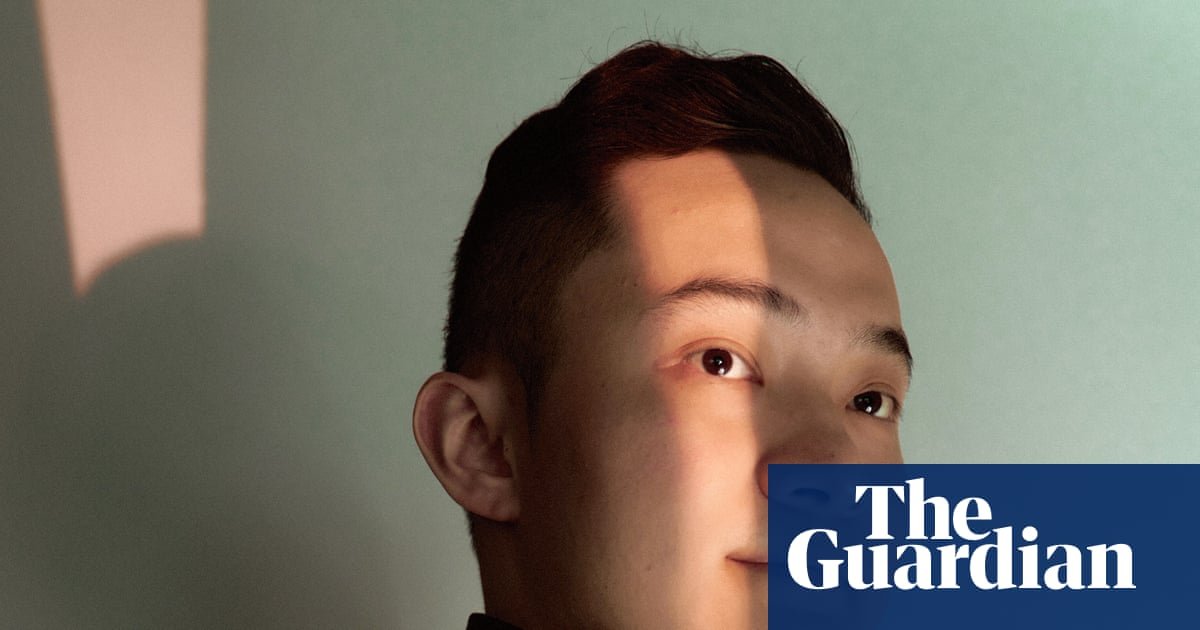
Many believe the answer is that he had help from a Chinese crypto billionaire called Justin Sun.
double quotation markIf crypto wants to succeed, we need to break the boundaries between traditional finance and the crypto worldJustin Sun
Sun is perhaps most famous for buying an artwork called Comedian – consisting of a banana duct-taped to a wall – for more than $6m, and then eating it. But the maverick entrepreneur, who refers to himself as “Crypto’s billionaire barker”, is better known in Washington as the real financial power behind the Trump family’s crypto fortune – investing nearly $200m of his own fortune into Trump’s digital asset ventures.
Recently, Sun and the Trumps’ crypto love-in has curdled into dueling lawsuits – with Sun accusing Trump’s crypto company, World Liberty Financial, of illegally freezing his assets, and World Liberty countersuing him for defamation.
I’m a documentary film-maker and over the past year I’ve been making a film for the BBC about the next generation of billionaires. That means I got to talk to Sun during and after this fortune-and-fallout saga with the Trumps in multiple interviews. The story of their financial entanglement raises concerning questions about Trump’s cozy relationship to the crypto industry.
Sun rises
Born in Qinghai in north-western China, Sun has made billions from crypto. His first big win came in 2017 with his crypto coin called TRX, which he offered on his Tron blockchain, a global, decentralized software network on which people can buy and sell cryptocurrencies. He told me it was supposed to be like “using blockchain technology to send money like you send emails on the internet”.
It was also an appealing platform for criminals and terrorists to store their money. “The marquee names are Hezbollah and Hamas,” said Chris Harland-Dunaway, the Verge’s investigative journalist who reported on much of Sun’s crypto dealing, “but North Korean hackers also are active users on the Tron blockchain.” Some estimate that in some years almost half of all illicit crypto transactions (such as criminals laundering illegal proceeds) happened on Tron.
Eric Trump, Zach Witkoff and Justin Sun participate in a session during the Token 2049 crypto conference in Dubai on 1 May 2025. Photograph: Giuseppe Cacace/AFP/Getty Images
“He became a sort of serial entrepreneur in the tech space, and he was always prepared to bend the rules or push technology as far as it could go in terms of what the authorities were willing to accept or tolerate,” says Harland-Dunaway.
When presented with claims about Tron’s illicit use, Sun said through a spokesperson: “Bad actors exist. The blockchain is just the latest in a long history of agnostic technologies to be misused – you don’t blame the internet for cybercrime, or cash for drug trafficking.” The spokesperson said that since Tron helped launch the T3 Financial Crime Unit to combat illicit activities in September 2024, it has helped freeze more than $450m in illicit assets and been praised by crypto regulators.
But Sun also likes to deflect questions of illegality with crypto idealism, touting his belief in technology’s power to bestow individual sovereignty, liberating people from the strictures of nation and government.
“Eating [a] banana … that’s all they know about [me],” Sun told me. “But I believe in a world with individual sovereignty. So basically everyone can use technology to do anything they want … If crypto wants to succeed, we need to break the boundaries between traditional finance and the crypto world. We want 8 billion people all on blockchain.”
But in March 2023, Sun’s large fortune was threatened by regulators. The US Securities and Exchange Commission (SEC), under the Biden administration, alleged Sun ran more than 600,000 fake trades between accounts he controlled in order to artificially inflate the trading volume of TRX, and that he personally pocketed $31m from illegal, unregistered sales of TRX.
They also charged him with hiding payments to celebrities who promoted his tokens to the public. They pointed to a period in February 2021 when a series of surprising names began tweeting about TRX, the crypto token associated with Tron. Lindsay Lohan, who had previously displayed no interest in crypto, posted: “Exploring #DeFi and already liking $JST, $SUN on $TRX. Super fast and 0 fee. Good job @justinsuntron.” Ne-Yo, Akon, Jake Paul and Lil Yachty all posted similar tweets. It is against section 17(b) of the Securities Act for a celebrity to tout a security without disclosing they are being financially compensated to do so. All five celebrities have settled with the SEC for amounts between $40,000 and $200,000 without admitting or denying allegations. None have publicly commented except Lohan, whose spokesperson clarified she was unaware of the disclosure requirement.
During the investigation, Sun avoided the US out of fear of arrest, the Wall Street Journal reported.
Sun’s spokesperson said he vigorously denied any wrongdoing from day one of the SEC case. On the issue of whether Sun avoided the US for fear of arrest, the spokesperson said that he didn’t enter the country because he had Covid concerns.
But Gary Gensler, who was then head of the SEC, told me in April 2024: “We had very significant ongoing actions with regard to where we’ve alleged significant fraud around Justin Sun and Tron,” Gensler said. “This is a field that is rife with fraud and scams and mischief.”
Then Trump entered the White House.
A new friendship
The majority of Trump’s new wealth comes from his family’s crypto ventures, World Liberty Financial and the $Trump memecoin. Both ventures are dressed up with the language of decentralization and financial innovation.
World Liberty Financial was started in September 2024, founded by Trump, with his special envoy to the Middle East, Steve Witkoff, a co-founder emeritus. The company is run in part by Trump’s sons, including Donald Jr, Eric and Barron, as well as Witkoff’s son Zach. Trump officially stepped down from the company once he took office, but his family trust still owns and profits from it.
double quotation mark[The Trump family] needed to raise more than $20m. Justin just knocked it out of the parkChris Harland-Dunaway
The highly technical and esoteric nature of crypto is intentionally opaque, but World Liberty Financial basically sells what it calls a “governance token”, $WLFI, which the company says allows investors who purchase it to have a say in how the company is run.
In decentralized finance models, the funds earned through purchase of governance tokens are supposed to be reinvested into the token’s ecosystem. But with $WLFI, 75% of all profits from token sales go directly to the Trump family trust.
It’s an ambitious, brazen proposal – one that very few traditional investors would be likely to go for. For it to work, it needed a large injection of cash and support from someone with legitimacy in the crypto world. Despite the profile of its founders, at the time of $WLFI’s launch it struggled to get investment. The founders drastically cut their fundraising target from $300m to $30m.
Then Sun entered the picture. Shortly after Trump was elected, Sun bought $75m worth of $WLFI tokens. Sun’s crypto pedigree gave the venture the legitimacy it needed to gain further investment, and they soon generated $550m in token sales. Forbes called Sun’s investment a “bailout”.
Justin Sun first ‘became a fan of Trump’ while growing up in Guangdong, China, where he learned English by pirating episodes of The Apprentice. Photograph: Bloomberg/Getty Images
“For the Trump family to get money from this project, they needed to raise more than $20m,” Harland-Dunaway told me. “Justin just knocked it out of the park – way over that threshold.”
With Sun involved, perception of the company had shifted from probable wheeze to serious potential player.
Sun told me how he first “became a fan of Trump” when he was growing up in Guangdong, China, where he learned English by pirating episodes of The Apprentice on BitTorrent, a company he would later acquire.
“The Trump family is a very important US business family,” Sun said. “So we want to be their important long-term partners. It’s not only about policy and decision-making – the Trump family has its own brand. The Trump Tower is everywhere … Collaborating with Trump tokens will benefit crypto as a whole.”
The summer after his investment, Sun posted a selfie with Donald Jr on Instagram. He also bought more than $100m worth of Trump’s memecoin, $Trump, and launched it on the Tron platform so it could be bought and sold there. “$TRUMP on TRON is the currency of #MAGA,” Sun tweeted. His initial purchases of the memecoin won him a private dinner with the president at his golf course in Washington DC and a $100,000 golden Trump watch.
It could be argued that Sun simply saw his stake in $WLFI as a shrewd investment with the bonus of influence with the White House, but the $WLFI tokens were non-transferable at the time, so Sun couldn’t cash out a cent. The Trumps, meanwhile, walked away with an estimated $400m.
So why pour so much money into the Trumps’ crypto schemes when the returns were being hamstrung? Some have pointed to the timing of his investment, questioning whether it could be related to an investigation by the SEC into Sun.
Harland-Dunaway said that a couple months after Sun invested $75m into $WLFI, “Justin Sun and the SEC together filed a motion to the judge who’s overseeing the SEC case against Justin to put a stay on the case … This is a new SEC at this point. One appointed by Trump.”
Several months after that, Tron was launched on the Nasdaq stock exchange via a reverse merger deal that was brokered by Dominari Securities, a firm that names Donald Jr and Eric among its board of advisers.
In March of this year, the court dismissed all allegations brought by the SEC against Sun and Tron Foundation Limited with prejudice, meaning the charges cannot be refiled.
I asked Sun what it meant that Tron had become a publicly listed company despite the historical legal accusations against it.
“Yeah, I think it’s just totally a perfect answer to all the unfair accusations before,” he beamed in response.
When I asked him whether he could have done any of this without the Trumps, he was quick to praise them.
“Yeah, I want to express my really big appreciation to the current Trump administration,” Sun said. “I think they really did everything for crypto [to] happen in [the] United States and for crypto development.”
The Trumps and Sun have firmly denied any connection between the investigation being paused and the investment. At the time, the SEC also paused several other civil cases into crypto companies. The case against Sun was eventually settled, with the SEC agreeing to dismiss remaining claims against Sun and the Tron and BitTorrent foundations in exchange for a $10m penalty paid by Rainberry Inc, the company behind Sun’s BTT token.
I tried to ask Sun about the relationship between the SEC investigation and his Trump investments in an interview last December in Hong Kong. I pointed specifically to the timing of the SEC investigation being paused, around the time that he invested heavily in the Trump family crypto projects.
His PR team wouldn’t let him answer these questions: “No comment on the current case, Matt.” I tried to redirect the conversation to Sun, but he repeated the “no comment” response.
A cartoon image of Trump with bitcoin tokens at a Coinhero store in Hong Kong, China, on 7 March 2025. Photograph: Bloomberg/Getty Images
A spokesperson for Sun later told the Guardian: “Justin’s crypto purchases are wholly unrelated to the SEC’s decision to pause the enforcement action against him. The suggestion that any crypto purchase was linked to the decision to stay and review that action is completely baseless and attempts to create causation from temporal proximity, which is patently contrary to widely reported public approach the SEC was taking to crypto cases in general at that same time.”
But lawmakers have asked questions about the timing. Richard Blumenthal, a Democrat senator, wrote to the SEC chair to ask why Margaret Ryan, the agency’s director of the division of enforcement, left her role shortly before the SEC dismissed fraud charges against Sun, citing reporting in Reuters that Ryan wanted to pursue enforcement against Sun and was blocked. “This is a clear example of how President Trump’s blatant crypto corruption creates back doors for his family’s business partners, creating a pay-to-play enforcement regime that turns a blind eye to grave threats to national security and consumer protection,” Blumenthal wrote.
A representative for Trump told the Guardian: “All of the president’s assets are in held in fully discretionary accounts managed by independent third-party financial institutions. There are no conflicts of interest.”
Crypto divorce
In August 2025, the friendship between Sun and the Trumps had begun to fall apart when it turned out Sun didn’t have as much influence at World Liberty Financial as he thought.
The $WLFI governance token is meant to give buyers like Sun the chance to vote on things, but a feature written into the coin’s self-executing computer code actually gives all the real power to a handful of secret admins. These anonymous admins have the technical capability to exercise near-total control over any wallet’s funds, and could theoretically disregard the results of any vote.
It appeared that these admins quietly upgraded the code in August to give designated wallets the power to freeze any holder’s funds. They then unlocked 20% of the tokens for sale, making the Trumps an estimated $5bn. But Sun said his tokens were frozen.
“That is the irony,” Harland-Dunaway said. “They’re evangelizing a decentralized banking system on the one hand. But then when someone appears to be about to withdraw their investment from their venture, they froze it. Which is a very centralized way of running a cryptocurrency project.”
Donald Trump displays the Genius Act after signing it at the White House on 18 July 2025. Photograph: Brendan Smialowski/AFP/Getty Images
World Liberty Financial alleged Sun had violated investment terms by moving about $9m in tokens; Sun denied any intent to sell, but by December 2025 his frozen position had lost an estimated $60m in value.
When I asked him about this in Hong Kong last December, his opinion on World Liberty Financial had shifted drastically from earlier that summer, when he was heaping evangelical praise on the company. Now he was highly critical.
“Fundamentally speaking, I think they just don’t understand the value of cryptocurrency and why it got invented in the first place,” Sun said. “[World Liberty Financial] see crypto when crypto [is] strong, right? So they think, you know: ‘If we are allies with crypto, we can make money, right?’ … It’s worrisome, right, because World Liberty Financial has all the freezing functions. They can freeze everybody’s assets, which is wrong, and they need to take [that function] out.”
In a statement, representatives for World Liberty Financial said that Sun agreed to World Liberty’s freezing authority, which was spelled out in the token unlock agreement that Sun signed.
double quotation mark[Sun] is convinced that these actions are not at all consistent with the president’s valuesSpokesperson for Justin Sun
The argument soon became a legal one. Sun sued World Liberty Financial on 21 April in California federal court over it using what he called a “backdoor blacklisting function” to freeze his tokens. He also accused the company of treating him like a “personal ATM”. World Liberty Financial responded by saying: “See you in court pal,” and countersued him in Florida on 4 May, accusing him of shorting World Liberty and defaming the company. Both lawsuits remain unresolved, with neither side’s allegations yet tested in court.
Sun’s spokesperson insists Sun still supports Trump and “is convinced that these actions are not at all consistent with the president’s values”.
The Trump family owes a great deal of its huge crypto windfall to Sun’s support. The profit-per-sale model and top-down control revealed in its spat with Sun raises serious questions about whether World Liberty Financial was ever truly motivated by the lofty goals of decentralization it projected. Given that its white paper is emblazoned with a portrait of Trump splattered with gold paint, and one of its co-founders, Chase Herro, once said of crypto that: “You can literally sell shit in a can, wrapped in piss, covered in human skin, for $1bn if the story’s right, because people will buy it,” perhaps these questions should have been there from the start.
For Sun’s part, he at least claims to still believe in the dream of crypto.
“We need to remind ourselves,” he told me, “why we started crypto in the first place. It’s never about money … We just want to do a financial infrastructure better than the traditional one.”
The Trump family are certainly still bullish on crypto. Crypto is not a generator of money – their fortune will continue to grow mostly at the expense of ordinary retail investors who have now lost the billions they collectively ploughed into the president’s ventures, and now also at the expense of wealthy investors like Sun.
During the 2023 New York financial fraud lawsuit against him and his three eldest children, Trump once explained why he wanted to become president: “Because of the brand,” he said. “I think it’s the hottest brand in the world.”
When pressed on the total brand value of being the US president, he estimated “$10bn”.
Sun’s complaint agrees that the brand is valuable, but puts it differently: “World Liberty’s operators have used the project as a golden opportunity to leverage the Trump brand to profit through fraud.”
