

Josh Katz has covered drug deaths and addiction in America for almost a decade. He reported from Phoenix.
July 15, 2026
For years, the opioid supply in Arizona was dominated by little blue pills pressed and stamped to look like 30 milligram oxycodone tablets, often called “blues.” But two years ago, that began to change. Now the market is mostly powdered fentanyl, and drug deaths are rising. In Phoenix, this shift in the illicit drug supply has combined with heat, meth and homelessness to create an emerging crisis of overdose deaths in America’s fifth-largest city.
Marck Martinez grew up outside Phoenix, and when he first encountered fentanyl, it was those blue pills. But when he relapsed this past February, he had trouble finding them. “I tried to look for blues again, and there were no blues at all,” he said. In their place, he found fentanyl powder, which was stronger and less predictable.
With the switch to powder, he began to overdose much more frequently, most recently in April in a public park next to his 5-year-old son. He survived only because his mother found him and called paramedics, who were able to revive him with naloxone. After being driven to a hospital, Mr. Martinez, 26, fled to a gas station bathroom to smoke fentanyl again.
Harm reduction workers, local researchers and people who use drugs all echoed the same idea: Blues with significant quantities of active ingredients have been disappearing. Blues didn’t vanish all at once, they said. Rather, over the past year or two, it became increasingly difficult to find pills with enough fentanyl in them to have any effect at all. For the most part, the pills remaining on Phoenix streets today are “fake,” Mr. Martinez said, no longer containing enough fentanyl to prevent withdrawal. For drug users in Phoenix, it’s mostly powdered fentanyl that remains.
Brian Clark, associate chief of operations for the Drug Enforcement Administration’s Pacific and Southwest region, said the suppliers of fentanyl haven’t changed, with the Sinaloa and Jalisco New Generation cartels remaining the primary movers of fentanyl across the southern border. But he couldn’t say why these cartels shifted from counterfeit pills to powder in Arizona.
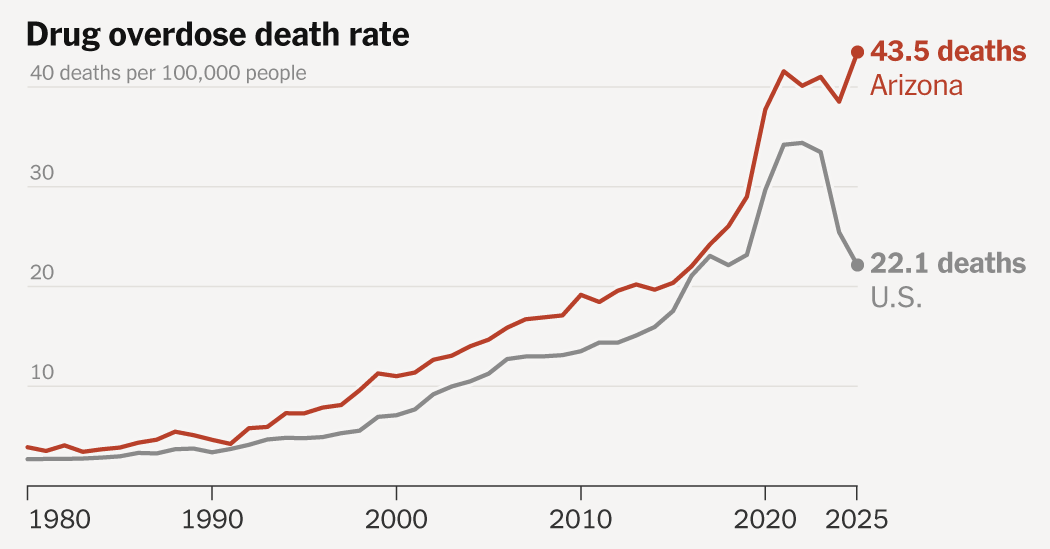
Neighboring New Mexico is seeing the same transition from pills to powder, said Dave Daniels, harm reduction manager for the New Mexico Department of Health. These two Southwestern states had the largest increases in the drug death rate in 2025, all while drug deaths in West Virginia, once the center of the opioid epidemic, have plummeted. According to a New York Times analysis of provisional mortality data from the Centers for Disease Control and Prevention, the drug death rate in Arizona last year overtook West Virginia’s for the first time since the proliferation of prescription painkillers in the late 1990s. Arizona and New Mexico now have the highest rate of drug deaths in the contiguous United States.
The rising drug deaths in the Southwest are in sharp contrast to the large-scale decline that has returned the U.S. drug death rate to its pre-Covid level. The reasons for this decline are still a matter of debate. “Epidemic curves can only go up for so long,” said Caleb Banta-Green, a research professor at the University of Washington. And the shift to powdered fentanyl in the Southwest already happened in much of the country years ago.
The surge of powder in Arizona, however, has spread through a population that is not accustomed to using it. “People adapt to market changes,” said Raminta Daniulaityte, a professor at Arizona State University who researches illicit drug use. “But initially when things change, it can have devastating consequences because people haven’t developed strategies to adapt.”
Margarita Macías, Marck’s mother, remembers coming home one day to find him lying limp in the driveway, soon after he’d returned from four months in rehab, after powdered fentanyl had taken over. Foam was coming out of his mouth. She screamed for her husband. “I felt so helpless,” she said in Spanish, “seeing things spiraling out of control and being unable to do a thing.”
Powdered fentanyl sold on the streets is particularly dangerous because of its higher variability. One recent study of the fentanyl supply in Los Angeles, for example, found that one gram of what was sold as “fentanyl” contained anywhere from less than one milligram of fentanyl to almost 650 milligrams. The variability combined with the potential for extreme potency makes it difficult to dose properly. “With the powder, you would overdose instantly if you weren’t careful,” said Francisco Cabrera, who has used fentanyl for over a decade.
Among the people interviewed for this article who use opioids, most expressed a preference for blues over powdered fentanyl, all else being equal. But ultimately they would use whatever product was available to stave off withdrawal, which causes debilitating pain, vomiting and mental anguish. “It’s like your blood is itching,” said Mr. Martinez, who would scratch himself so severely that his mother would often find him bleeding through his shirt.
‘It is like a blast furnace’
Phoenix, the largest city in Maricopa County and the center of the broader metro area, sits low in the Salt River Valley, under a blanket of warm air at the northeastern edge of the Sonoran Desert. The relentless heat of the city has only compounded the dangers of the fentanyl supply shift. Drug deaths in Phoenix typically peak during the summer months, when temperatures routinely exceed 110 degrees, often remaining above 90 degrees even at night.
The hot nights make it harder for vulnerable populations to recover from hot days spent in a city with wide boulevards and relatively sparse tree cover. “There’s nowhere to hide,” said Scott Greenwood, C.E.O. of Sonoran Prevention Works, a local harm reduction agency. “It is like a blast furnace. It’s like taking a hair dryer and pointing it at your face. That’s what it feels like when there’s a breeze here in July.”
According to a Times analysis of data from the Maricopa County medical examiner’s office from 2024 through March 2026, when the daily high in Phoenix crossed 110 degrees, drug deaths in the county increased by 40 percent. On the 17 days in that period when the temperature reached 115 degrees, drug deaths nearly doubled.
In Maricopa County, drug deaths rise along with the temperature
Drug deaths begin to rise once temperatures in Phoenix cross 110 degrees. Above 115 degrees, they nearly double.
As part of the street medicine team for Circle the City, a nonprofit organization that provides medical care to homeless people in Maricopa County, Dr. Matt Evans has witnessed these dangers firsthand, describing patients who had passed out from fentanyl and suffered third degree burns from pavement superheated by the desert sun. “Substance use and extreme heat do not mix,” he said.
These dangers are aggravated by the widespread use of methamphetamine. Ms. Daniulaityte said 80 to 90 percent of fentanyl users in the region also use meth. The depressive effects of fentanyl are so strong that many drug users said they use meth just to function, smoking fentanyl to bring themselves down and then meth to bring themselves back up again. Several described using methamphetamine to ease the pain of withdrawal.
The combination of heat and meth can be deadly. Whereas a fentanyl overdose causes the brain to stop reminding the body to breathe, methamphetamine kills by pushing the body past its limits, effects that are heightened by heat exposure, lack of sleep and dehydration. “It raises your body temperature, it makes you tachycardic,” Dr. Evans said. “It puts you at risk for heat exhaustion, heat illness, heat stroke in a way that is very dangerous.” The body can quite simply overheat.
In 2025, over half of heat-related deaths in Maricopa County involved drugs. At least 19 people in Maricopa County have died from heat exposure already in 2026, with drug use implicated in 11 of those deaths. In all but one of those drug-related cases, methamphetamine intoxication was listed among the causes.
The interplay between heat and meth is one of the reasons the Maricopa County Department of Public Health broadened its internal definition of drug deaths in 2024 to include any death where drug toxicity was a contributing factor. “There really isn’t a bright line” between a heat death and a meth death, said Dr. Jeffrey Johnston, the chief medical examiner for Maricopa County.
The twin pressures of heat and meth are felt by the large homeless population in the area, who have few options to escape the heat and often use meth as a tool of survival, to stay vigilant. Annual surveys estimate that on any given night there are about 10,000 homeless people in Maricopa County; roughly half are unsheltered, living on the streets, in parks and river beds. Sustained meth use can easily trigger meth-induced psychosis, in which a person begins hearing voices. One man described starting using fentanyl merely to quiet the voices in his head so he could sleep.
According to Arlene Mahoney, the executive director of the Southwest Recovery Alliance, displacement from homeless encampments — like the 2023 dismantling of “the Zone,” the city’s largest encampment — has further heightened the risk. When people can no longer find the drug supply they’re used to, they’re forced to choose between the agony of withdrawal or new, untested sources. “It’s about destabilization,” Ms. Mahoney said. “People are losing the places and people they rely on.”
Advocates for the homeless are especially concerned about a new city parks ordinance that restricts the provision of medical care and food in city parks. City officials have defended the measure as a way to improve safety and sanitation. Outreach workers and medical providers say it will make it harder to reach people who already have little access to health care, at a time when city parks, with shade and grass, can provide a rare respite from the heat. “I think what’s coming here is terrifying,” Ms. Mahoney said. “That’s not public health, that’s not public safety.”
A ‘wake-up call’
After Mr. Martinez overdosed in the park, he returned to living on the streets. Shortly after, a close friend who’d just left rehab, unable to find the blues he was used to, turned to fentanyl powder. The friend died. A few days later, Mr. Martinez checked into the HOPESS Residential Recovery Center.
“It was kind of like my wake-up call,” Mr. Martinez said. He guesses he’s entered inpatient treatment around a dozen times, but he’s determined to make this visit his last. “Every time I come across fentanyl now,” he overdoses, he said. “I’m not gonna make it, you know? It just gets worse and worse.”
The initial data from 2026 appears promising. Reports of nonfatal overdoses in Phoenix through June are 17 percent lower this year than last. Data pulled from the Maricopa County medical examiner’s office shows drug deaths through March tracking lower than last year. It’s possible the crisis has begun to ebb. But it takes months to classify many drug deaths; a complete picture won’t emerge until well after summer is over.
Mr. Martinez has entered a sober living house and has started taking classes at the local community college, where he hopes to pursue welding. Ms. Macías follows his progress closely, eager to see the return of the son she knew from before he started using: “People would say to me, ‘Listen, why do you keep chasing after him?’ But I’d say: I have to help him. If I don’t, who will?”
Methodology
The chart of drug death rates is a Times analysis of mortality data from the Centers for Disease Control and Prevention. Deaths before 1999 reflect the underlying cause of death, using ICD-9 codes E850-E858, E950.0-E950.5, E962.0 and E980.0-E980.5. Deaths from 1999 onward include all deaths in which acute drug toxicity was listed among the contributing causes, using ICD-10 codes X40-X44, X60-X64, X85 and Y10-Y14.
Drug death numbers for Arizona in 2008 are omitted due to a known data issue. Death numbers for 2025 are preliminary, with rates calculated using the Vintage 2025 state population estimates from the Census Bureau.
The chart of Maricopa County drug deaths classifies a death as drug-related if either the primary or contributory cause of death contains any of these words: acetaminophen, alprazolam, amphetamine, amlodipine, buprenorphine, buproprion, bupropion, caffeine, chlordiazepoxide, citalopram, cocaine, codeine, cyclobenzaprine, diphenhydramine, doxepin, fentanyl, fluoxetine, gabapentin, heroin, hydrocodone, ketamine, kratom, kratum, lorazepam, methadone, methamphetamine, mitragynine, morphine, oxycodone, phenobarbital, polydrug, polysubstance, sertraline, tramadol, venlafaxine or zolpidem; or the phrases acute drug, drug intoxication or drug toxicity. It excludes homicides, in which causes of death are redacted. Drug deaths classified as homicides are rare. Some case data is preliminary and subject to change.
