

80
TRUMP v. SLAUGHTER
SOTOMAYOR, J., dissenting
Searching for a distinction, the Government (echoed by the majority) contends that Humphrey’s should not control as to the present-day FTC because the FTC’s powers have expanded over the years since Humphrey’s was decided. See Brief for Petitioners 25-28; ante, at 25-27. The premise that the FTC has fundamentally changed, however, is un- true: Contrary to the Government’s assertions, the FTC of 1935, like today’s FTC, had the power to conduct investiga- tions, make rules, and bring enforcement actions. See Fed- eral Trade Commission Act, 38 Stat. 719–723.¹ To the ex- tent the FTC has gained power since 1914 (for example, the Government cites its ability to seek civil penalties, see Brief for Petitioners 25-26), those changes at the margins do not so transform the “character of the office” as to bring the agency outside of Humphrey’s rule. 295 U. S., at 631. If, it was true that the political branches went too far in assign- ing certain powers to the FTC over the years, moreover, it is unclear why the appropriate remedy at this point would not be to sever these additional, objectionable powers. Cf. United States v. Arthrex, Inc., 594 U. S. 1, 24-25 (2021) (opinion of ROBERTS, C. J.) (remedying Appointments Clause violation by altering the officers’ powers); see also id., at 44 (Breyer, J., concurring in judgment in part and
1 Humphrey’s did not explicitly identify each power, but the idea that “a court including Charles Evans Hughes, Louis Brandeis, Benjamin Cardozo, and Harlan Stone somehow misunderstood [the FTC’s] powers lacks all plausibility.” Seila Law LLC v. Consumer Financial Protection Bureau, 591 U. S. 197, 287, n. 10 (2020) (KAGAN, J., concurring in judg- ment with respect to severability and dissenting in part) (citation omit- ted). It is also true that, despite these powers existing at the time, Humphrey’s described the FTC as sharing “no part of the executive power.” 295 U. S., at 625, 628; see ante, at 18–19, 21, 33–34 (highlighting this point). For decades, however, this Court has recognized that even for agencies exercising powers that “would at the present time be consid- ered ‘executive,’” Humphrey’s rule applies. Morrison v. Olson, 487 U. S. 654, 689-690, and n. 28 (1988). Congress, even before Morrison, exten- sively legislated, creating many agencies like the FTC, based on that un- derstanding. See infra, at 10-11, 35–38.
Subscribe to Updates
Get the latest creative news from FooBar about art, design and business.
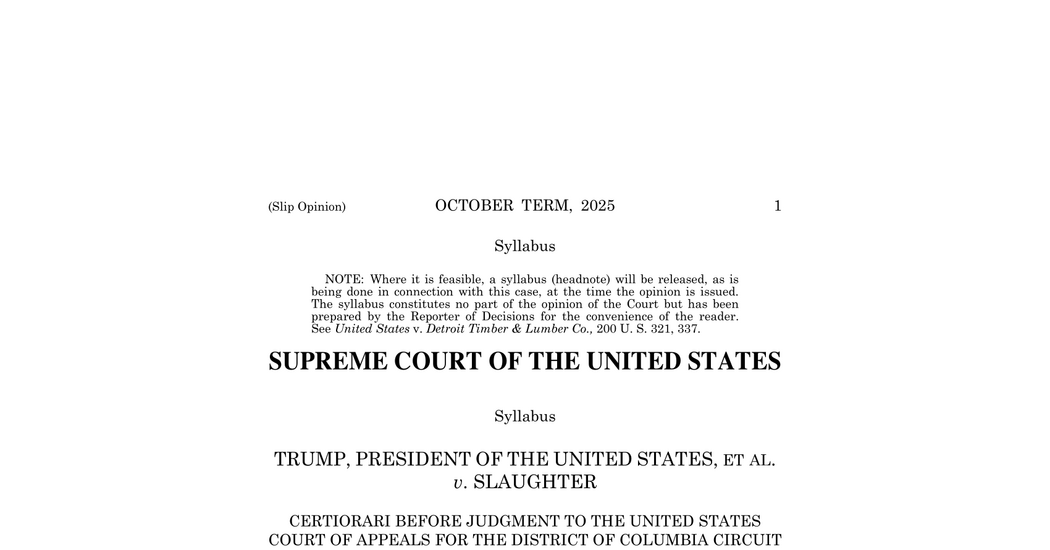
Read the Supreme Court’s Decision to Expand Presidential Power Over Regulators

Related Posts
Add A Comment