

In this new era of rampaging oligarchs, nothing may seem as satisfying as slapping a tax on Elon Musk’s new trillion-dollar fortune. What most bothers Americans about federal taxes is that billionaires don’t pay their fair share. As the race to develop artificial intelligence mints more billionaires, policymakers’ temptation to directly tax their brobdingnagian wealth is becoming unbearable.
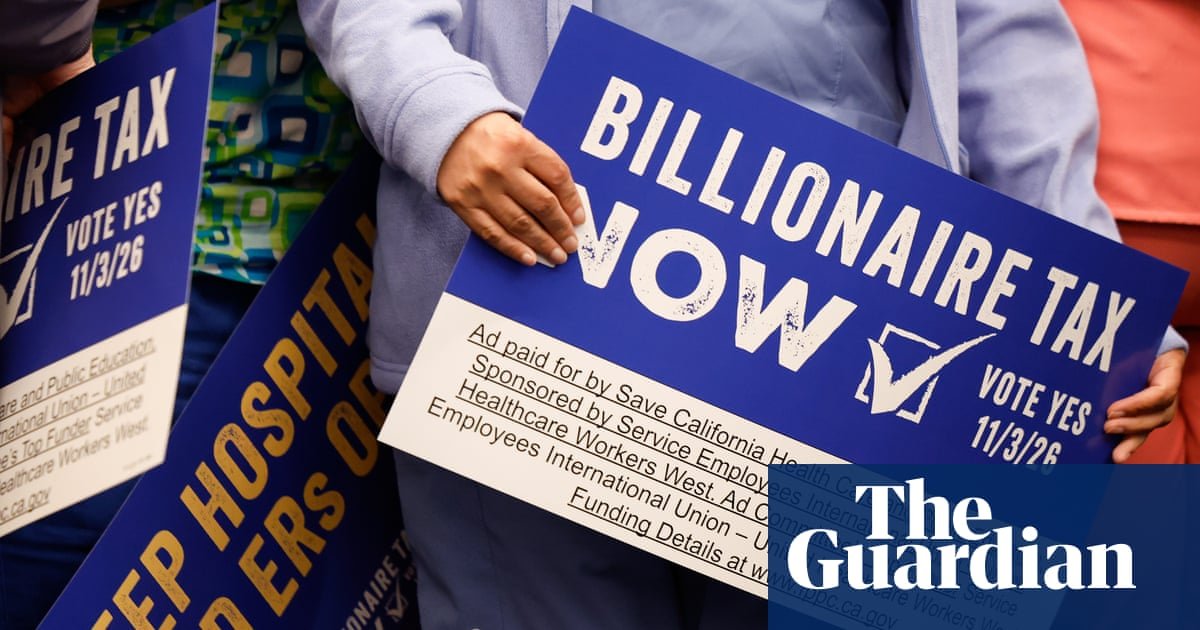
The first state out of the blocks is California, where voters in November will decide whether to impose a one-time tax of 5% on fortunes worth more than $1bn. Given the ease with which plutocrats avoid paying income taxes, the case for this sort of direct tax on their stash appears unassailable.
The US government needs money for all sorts of reasons, starting with the imperative to restore one of the rich world’s most meager social safety nets and do more to mitigate America’s mushrooming income inequality. Increasing demands on the safety net by an ageing population will require considerably more money. And the prospect of an AI-laced economy with little human income to tax argues for efforts to find other sources of revenue.
And yet deploying a newfangled wealth tax that has been largely abandoned across the world’s industrialized nations could actually put at risk the prospect of building the more capable state the US needs, draining political capital that would be best used to restore the decimated array of taxes it already uses.
Just consider that in 2024 the richest 1% of Americans paid, on average, about 31.5% of their income in federal taxes and about 7.2% in state and local taxes. That is more than eight percentage points less than what they paid at the turn of the century. Considering that the top 1% report a total adjusted gross income of over $3tn, those eight points could add up to nearly $300bn of additional tax revenue per year.
Raising more money is not particularly complicated, from a technical perspective. Rather than taxing wealth or raising income tax rates sky-high, it can be done by closing the elaborate array of holes that have been drilled into the current tax schedule by offering preferential tax treatment to specific types of income, reducing at every step the plutocracy’s tax liability.
A recent analysis from the Yale Budget lab finds that the effective tax rate on the top 1% of earners can be anywhere between 45% and a miserly 3%, depending on how they make a living. A straightforward way to increase tax revenues is to restore some fairness to a system that allows vast discrepancies in the ways different forms of income are taxed.
In 2024, only three of the advanced economies in the Organization for Economic Cooperation and Development (OECD) – those of Norway, Spain and Switzerland – collected any revenue from recurrent wealth taxes. That is down from 12 countries in 1990. And none of the four collect much. In 2024, only the Swiss raised more than 1% of GDP.
There are practical problems with wealth taxes, starting with how to value certain types of wealth, such as a privately held business, and how to tax owners who may not own liquid assets to meet obligations. Wealth taxes have been found to encourage capital flight and discourage entrepreneurship. They tend to penalize people with safer investments, which have low returns.
An OECD study concluded that “from both an efficiency and equity perspective, there are limited arguments for having a net wealth tax in addition to broad-based personal capital income taxes and well-designed inheritance and gift taxes”. Moreover, taxing wealth is politically perilous, raising the objection that it amounts to double taxation: a tax on savings from income that has already been taxed.
There are better tested ways to tax capital, though, starting with the estate tax, which has been eviscerated by multiple “reforms” over the last 25 years. In 1972, 6.5% of decedents paid estate taxes. By 2021, the share had fallen to less than 0.1%. The revenue it generated dropped from 0.4% to 0.08% of GDP, despite the massive accumulation of inheritable wealth over the period.
The estate tax could be improved simply by restoring tax rates and reducing exemptions to where they were at the turn of the century. The US could also cut tax breaks on some assets, like life insurance, and on transfers to close relatives. Critically, it could nix the step-up basis under which unrealized capital gains are zeroed out upon their owner’s death, allowing dynastic wealth to grow across the generations tax-free.
Transforming the estate tax to an inheritance tax levied on heirs, like that existing across most OECD countries, would deal with the double taxation critique, and it would provide an incentive to divide large estates among heirs to avoid the highest marginal tax rates.
There are other available fixes. Taxes on capital gains – which currently top out at 20% – should be raised closer to the 37% top rate on labor income, reducing the incentive for high earners to reclassify wages as returns on investment. The corporate tax rate should also be brought closer to where it was before Donald Trump’s Tax Cuts and Jobs Act chopped it from 35% to 21%. And large companies should be taxed as companies, rather than allow them to fiddle with their status to reduce their tax liability.
Finally, the government could simply ensure all taxes due are paid. One study based on data from the Internal Revenue Service estimated that eliminating the “tax gap” of uncollected tax revenue would yield a total of $7.5tn in the decade from 2020 to 2029.
To be sure, achieving these changes will be hard in the American political system, in which the identity of one of the two major parties is defined by the imperative to cut taxes while the other, once committed to a robust welfare state, has lost faith in an activist government championing redistribution.
Other things must be done – starting with something like the agreement stitched together in the Biden administration yet ditched by Trump to ensure multinational corporations pay a minimum tax on their profits, no matter what tax haven they choose to domicile in.
The broader point is that it is possible to tweak the tax system to raise more revenue in a relatively efficient way, consistent with standard beliefs about fairness, without reinventing the wheel. Indeed, ambitious proposals to sharply raise marginal income tax rates won’t raise much money unless many of the exceptions, loopholes and so forth are dealt with.
It may not feel as satisfying as going after Musk’s stash. But closing loopholes to broaden the tax base and walking back the many tax cuts and reforms over the years could raise needed money and reduce the many preferences, exemptions and deductions which the rich use to amass their wealth.
