

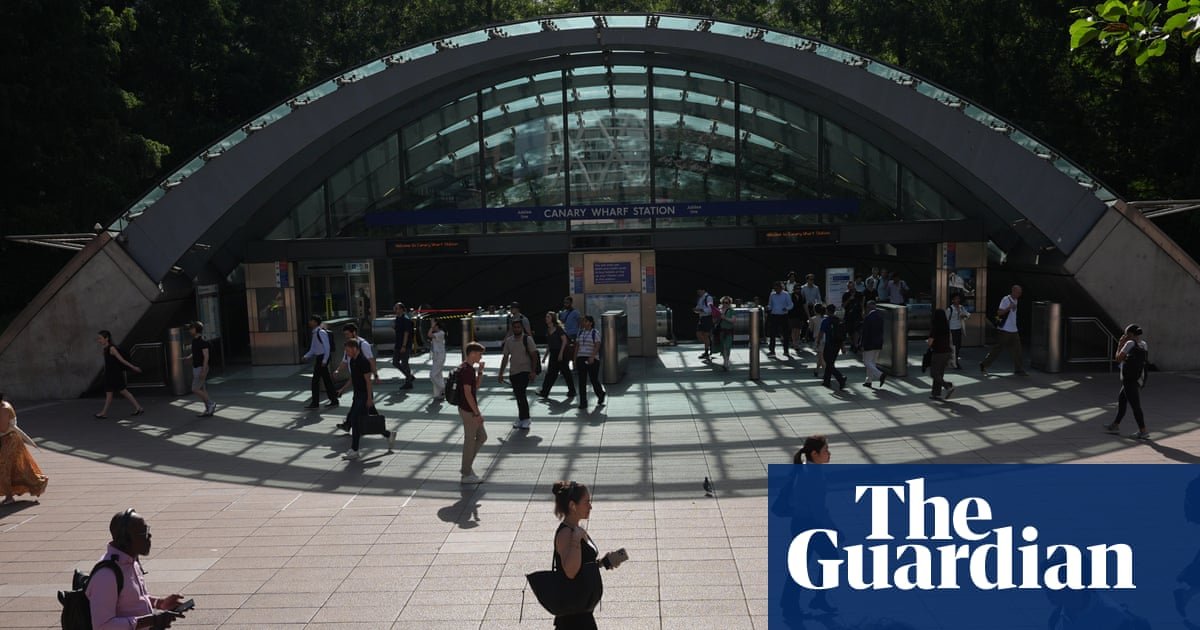
Monique Mosley is used to sweltering conditions at the food factory in Yorkshire where she works, but June’s record-breaking heatwave has made conditions unbearable. “We make hot filled food products and it’s common that we see temperatures in the high 30s,” she said. “Thanks to our union, our employer is offering extra breaks, but not every workplace is the same.”
The latest heatwave to grip the UK and much of western Europe has presented significant challenges to employers and their employees, from sweltering offices, disrupted commutes and school closures to dangerous construction sites where workers are at risk of dehydration, heatstroke and other injury.
There is now a growing acceptance that increasing spells of extreme heat have a significant impact on productivity and threaten Europe’s already sluggish economies. Economists warn that the climate crisis will dent economic growth unless European countries adapt their ageing buildings and infrastructure.
Robert Marks, the lead climate economist at Oxford Economics, said temperatures in the high 30s and low 40s would “likely lead to substantial productivity losses and directly disrupt labour across construction, agriculture, manufacturing, retail and hospitality and other sectors which are unable to provide a protected work environment”.
“These sectors represent 27% of economic activity in the UK and an average of 35% in western Europe,” he said. As a result, a four-day heatwave “could reduce quarterly labour productivity growth by 1.5 percentage points in the UK and up to two percentage points in the rest of western Europe”.
The largest loss of working hours in western, northern and southern Europe by 2030 is expected to be felt by the agriculture and construction sectors, according to research by the International Labour Office.
A construction worker in Wimbledon. The largest loss of working hours in western, northern and southern Europe is expected to be felt by the agriculture and construction sectors. Photograph: Amer Ghazzal/Shutterstock
Researchers at the insurance group Allianz found extreme heat was emerging as a “structural economic risk” for Europe. They found France, Spain and Italy were among the European economies most exposed to the growing economic cost of heat stress (the UK was not included in the study). This was because productivity losses intensify sharply above a 30C threshold, while at the same time the cost of energy required to cool machinery and buildings rises.
France could lose $240bn (£182bn) in economic output between 2026 and 2030 under the study’s stress scenario, followed by $147bn for Italy and $120bn for Spain, representing a cumulative loss of as much as 7% of gross domestic product.
“The heatwave is not an exception, it is a direction,” said Katharina Utermöhl, the head of thematic and policy research at Allianz Investment Management and a co-author of the study. “Extreme heat costs all of us as workers, as businesses, as taxpayers, and there is a difference between countries that adapt and those that wait. It would be better to stop treating it as a summer problem and start treating it as a permanent economic policy challenge.”
Graph of working hours lost to heat stress
The heatwave has reignited tensions between employees and employers. While workplace regulations in the UK set out a minimum working temperature – 16C in an office, or 13C if strenuous physical work is required – there is no maximum legal temperature. This is because some places such as kitchens or foundries can be hot all the time. Instead, the Health and Safety Executive’s (HSE) guidance to employers tells them to keep the environment at a “reasonable” temperature for employees.
There are separate regulations for workers on construction sites, where “reasonable” temperatures are required for indoor areas and the rest areas of outdoor sites, and workers also need to be protected from adverse weather.
A contractor working in the early morning heat in Bristol. Construction is likely to be one of the worst-affected sectors. Photograph: Ben Birchall/PA
The HSE suggests rescheduling work to cooler times of day, providing more frequent rest breaks and free access to cool drinking water, and encouraging workers to remove their personal protective equipment while resting.
David D’Souza, the director of profession for the Chartered Institute of Personnel and Development, said: “A lot of organisations which have flexibility will be making use of it. However, that flexibility isn’t available to every organisation, so it provides far more of a challenge where people have to be on site or they have to wear specific protective clothing. There’s a mutual benefit to flexibility in situations like this.”
In several parts of the UK, including the south of England, refuse collectors have opted to start bin collections earlier than usual, with some in Bristol beginning their rounds at 4am.
In Italy, where parts of the country were under red alert, the Lazio region around Rome issued an order for construction workers and delivery riders not to work between 12.30pm and 4pm on Wednesday. However, reports suggested food delivery riders widely flouted the order and were still seen dropping off orders.
While many people in office-based roles have been allowed to work from home on the hottest days, many workers – from nurses and bakers to transport and shop workers – are unable to carry out their jobs remotely.
skip past newsletter promotionFree newsletter | Every weekday
Sign up to Business Today
Get set for the working day – we’ll point you to all the business news and analysis you need every morning
after newsletter promotion
Elusive Brewing, an independent brewery in Berkshire, has halted production for much of the week. “We don’t want to be brewing… [It’s] north of 40 degrees in the brewery and that’s not safe for staff,” said Andy Parker, the owner. “Our brewer came in on Monday at 5am to make sure we were done by midday and we’ve cancelled Friday’s brew and moved it to next week.”
The heatwave has reignited discussions about the inequality in flexible working offered to different workers during and since the pandemic. Trade unions in the UK have said for several years that guidance does not go far enough and have called on the government to introduce a maximum working temperature, although this has previously been rejected by ministers and business groups. The Confederation of British Industry (CBI) has instead called for a “commonsense approach”.
Matthew Percival, the CBI’s future of work and skills director, said: “Employers have a duty of care to their employees which includes managing heat-related risks.”
The Bakers, Food and Allied Workers Union and the Fire Brigades Union, along with Extinction Rebellion, called for workers to take part in a strike on the hottest day. Photograph: Immo Klink
The Bakers, Food and Allied Workers Union and the Fire Brigades Union, along with Extinction Rebellion, called for workers to take part in a strike on the hottest day.
Even though Britain’s European neighbours, including France and Germany, have been dealing with higher temperatures for longer, they also do not have a maximum legal temperature. However, French authorities introduced new regulations last summer requiring employers to alter working arrangements or schedules, reduce sun rays entering workplaces and provide fresh drinking water.
German employers are required to take measures to cool workplaces if the temperature inside rises above 30C, while stricter rules apply if the temperature hits 35C.
Spanish authorities have gone a step further and workers who cannot reach their workplace are entitled to up to four days of paid leave, while companies can temporarily suspend workers’ contracts if more time off is needed.
In the UK, workers have wrestled with cancelled trains – after advice to travel only if “absolutely essential” – more breakdowns and school closures.
Catrin Mills, an employment lawyer and partner with Sharpe Pritchard, said employees did not have an automatic right to time off if their child’s school was closed.
“UK employment law does provide employees with a statutory right to take a reasonable amount of unpaid time off for dependants where there is an unexpected disruption to childcare arrangements.” However, she said the purpose of this leave was to allow workers to make alternative arrangements.
Additional reporting by Rob Davies
