

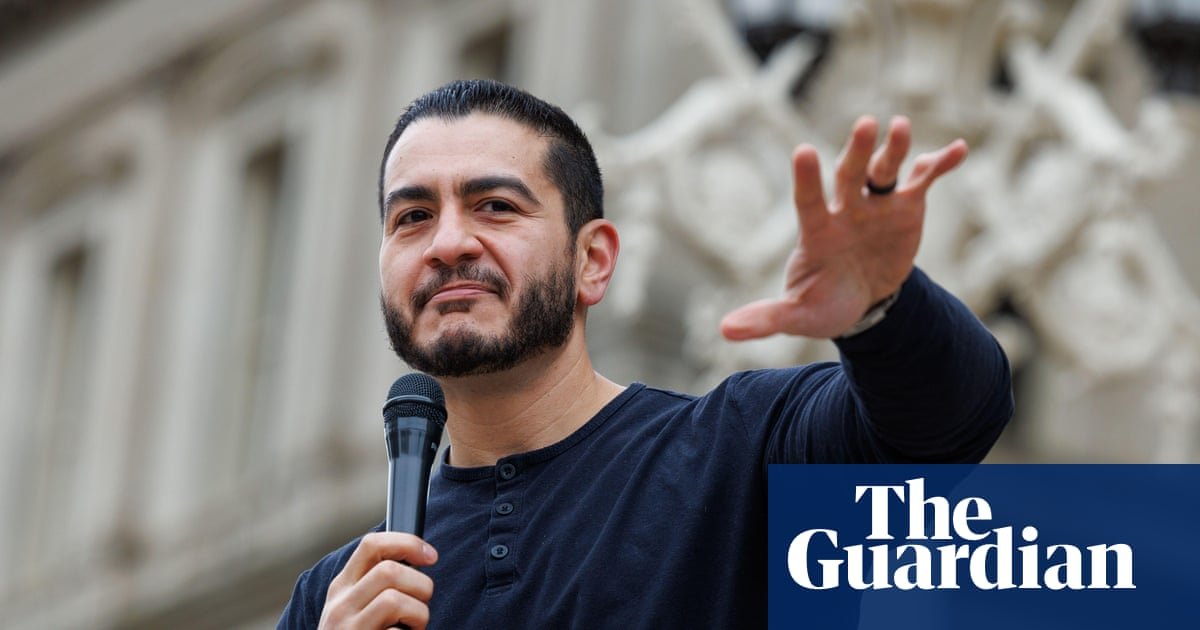
When Abdul El-Sayed walked into Detroit’s health department in 2015, he found about 85 employees crammed into the back of a municipal parking building. The city had recently gone bankrupt and the 185-year-old institution was placed under state emergency management. His job was to rebuild it from practically nothing.
Within a year and a half, El-Sayed, who has a medical degree and PhD in public health, said he expanded the department to 220 staff members, opened a new headquarters and launched efforts that still define his reputation: free glasses for low-income schoolchildren; a legal fight that forced an energy company to invest $10m to improve air quality; lead testing in every school, daycare and Head Start facility in the city; and a peer mentor program for newly pregnant moms to address a surge in infant and maternal mortality.
“It was a rude awakening,” said El-Sayed, who chose to forgo a medical residency and an assistant professorship in favor of public service. “I went from an ivory tower to the bowels of city government. But it’s because I recognize that so much of what makes us sick and keeps us sick is a function of structures that are downstream of public policy.”
Now El-Sayed is running for the US Senate from Michigan. He is part of a wave of Democratic doctors, scientists and public health professionals across the country seeking office in the midterm elections. They share a diagnosis of what ails American governance – disinformation, funding cuts and the rollback of research, among other things – and the belief that their clinical and scientific training equips them to treat it. They have watched the Trump administration’s health policies play out in their exam rooms, their labs and the communities they serve, and they want to stop the bleeding.
“I am appalled seeing infectious diseases spreading through our communities that we had once declared eradicated,” said Jasmine Clark, a microbiologist who teaches at Emory University’s nursing school and recently won her Democratic primary for Georgia’s 13th congressional district. “We need some science perspectives in the decision-making process.”
A referendum on Trump’s health cuts
The wave of doctors entering electoral politics is a direct rebuke of Robert F Kennedy Jr’s tenure. Since taking over the Department of Health and Human Services in early 2025, he has overseen a sweeping reorganization that has cut the department’s workforce by 20,000 employees. Funding for public health has been reduced by more than $12bn, and more than 2,000 National Institutes of Health research grants have already been canceled. Kennedy has fired or forced out top scientific leaders at every major health agency, including four NIH directors and a CDC director he had himself appointed less than a month earlier. More than 1,000 current and former HHS employees have called publicly for Kennedy to resign.
In California’s sixth congressional district, Richard Pan – a pediatrician who spent more than a decade in the state legislature, where he chaired health committees in both chambers and helped reduce California’s uninsured rate by two-thirds – is running in the 2 June primary with a campaign explicitly framed as a counter-offensive against what he calls a systematic attack on evidence-based governance.
Richard Pan, a former state senator, speaks about the need to have insulin available to everyone for $30 in Downey on Saturday, 18 March 2023. Photograph: MediaNews Group/Pasadena Star-News/Getty Images
“We’ve had a long-term bipartisan consensus that science should drive our health decisions,” Pan said. “The FDA was a scientific agency, NIH was a scientific agency, the CDC was a scientific agency. But this administration has gotten rid of a lot of the scientists.”
The doctors have put the stakes of disinformation at the center of their campaigns. The measles outbreaks spreading through communities are a direct consequence of falling vaccination rates fueled by the kind of misinformation that Kennedy spent years amplifying, public experts say. His “make America healthy again” agenda – with its attacks on childhood vaccination schedules, unsupported claims linking vaccines to autism and overhaul of federal dietary guidelines without scientific review – represents a particular offense to Clark, who has served as a Georgia state representative since 2019 and has spent her career teaching microbiology and infectious disease.
“They’re pushing a narrative that might make them popular among certain people,” Clark said. “But it’s very, very dangerous, and unfortunately costing the lives of children.”
She is equally alarmed by what she sees as an echo of historical medical abuses. Reports that the administration is testing health protocols of questionable quality on impoverished populations abroad draw a pointed comparison: “It’s very reminiscent of what they did with the Tuskegee project. We all recognize that now as being very bad.”
El-Sayed and others have drawn connections between the social determinants of health, the non-medical conditions that affect health outcomes, to public policy. He recalls touring Detroit schools in 2015 and finding a first-grade classroom with an icicle forming on the ceiling because the boiler had been broken for months. “If you cannot fund the school building that kids are in, if you cannot make sure they can see the blackboard, then the other funding conversations miss a lot of the point.”
His signature policy, Medicare for All, flows directly from what he witnessed treating Medicaid patients in Detroit, where providers were turning away pregnant mothers because Medicaid reimbursement rates were too low. “Medicare for All would mean that everybody would be an equal healthcare citizen,” he said.
Adam Hamawy is another candidate running on Medicare for All. A combat surgeon running for New Jersey’s 12th congressional district, Hamawy is perhaps best known for saving the life of Senator Tammy Duckworth after a grenade struck her helicopter in Iraq. He said his time treating people during war and in disaster zones, including Gaza, has prepared him to defend the idea that healthcare is a human right.
“In an area where there’s killing and misery every day, it feels good to be able to actually help people,” he said. “When you were called to operate – we were on call 24 hours a day and seven days a week for months at a time – you just did it no matter what was happening. You were often the only hope that the person in front of you had.”
Behind the wave of doctors running for office
The presence of physicians in the halls of Congress is not a new phenomenon. The Senate currently has four physicians, while the House has 16. But for years, Republican doctors have outnumbered Democratic ones. These new Democratic candidates argue that the presence of Republican physicians in office has been no guarantee of scientific independence.
For instance, Bill Cassidy, a Louisiana senator, gastroenterologist and the chair of the Senate health committee, expressed deep reservations about voting to confirm Kennedy and as health secretary, but after pressure from the White House, he cast the vote that put Kennedy in power. Cassidy, who had already drawn Trump’s ire by voting to convict him in his second impeachment trial, recently lost his Louisiana Senate primary to a Trump-backed challenger.
Bill Cassidy, chair of the Senate health committee, at a hearing on Capitol Hill in Washington DC, on 25 February 2026. Photograph: Kylie Cooper/Reuters
Cassidy’s fate illustrates a defining question for any physician in or seeking elected office, Pan said. “The challenge for physicians is: are you going to be a doctor first, or are you going to be a politician first? Unfortunately, we’ve seen too many doctors who, because of the political pressure, have decided to put aside their training as physicians and the oaths they took.”
The medical school to elected office pipeline does not run only to Congress. Amanda Litman, co-founder and executive director of Run for Something, which recruits and supports young progressive candidates for lower-level offices, has watched the same wave emerge at the state and local level in recent years. And she argues that this is where near-term progress will actually be made.
“Basically every elected body touches healthcare in some way,” Litman said, “whether it’s a city council talking about healthcare funding on the local level, school boards talking about sex education or state legislatures tackling all kinds of healthcare issues. Having people in these governing bodies that really understand the issue from the perspective of a provider matters deeply.”
Run for Something and political action committees like 3.14 Action and Emily’s List have been pivotal in supporting medical doctors and scientists in recent elections. Emily’s List-endorsed Annie Andrews, a South Carolina pediatrician who has made the state’s measles outbreak a central part of her campaign, is only trailing four-term Republican Senator Lindsey Graham by a few points in the polls.
Win or lose, ‘still made a difference’
Whether these candidates’ medical backgrounds will translate into electoral victories remains to be seen. Today, Pan faces a competitive five-person primary in a Sacramento-area district that has been redrawn with more conservative territory. El-Sayed is running in what observers are calling Michigan’s first truly competitive Democratic Senate primary in 32 years, against two well-funded and well-known rivals.
Not every Democratic doctor has made it through. In Texas’s 15th congressional district, Dr Ada Cuellar, an emergency room physician, lost her March primary Bobby Pulido, a Tejano music star, who captured more than 67% of the vote in a South Texas district where name recognition proved key.
“I don’t have any regrets because I still made a difference,” said Cuellar, who funded much of her campaign herself. “I raised issues about healthcare that put pressure on my opponent and the incumbent. Hopefully, I get to run in the future and have an even better campaign and platform.”
Clark, whose primary win was the clearest proof of concept so far, will face a general election in November. She is poised to become the first Black woman with a doctoral degree in science ever to serve in Congress, a distinction she called “way past due” – sees something larger than individual campaigns at play. Scientists, she argues, have long ceded politics to others and have only recently recognized the cost of that absence.
“More and more scientists are now realizing that we actually do play a role, policy does impact us and we should have some say in the decisions being made,” she said. “I was elected when we went through the Covid-19 pandemic, and my constituency really appreciated having a science voice to just explain to them what was going on. It’s not a matter of if, but when, is the next pandemic, and are we going to be prepared? We need those perspectives in the room.”
