

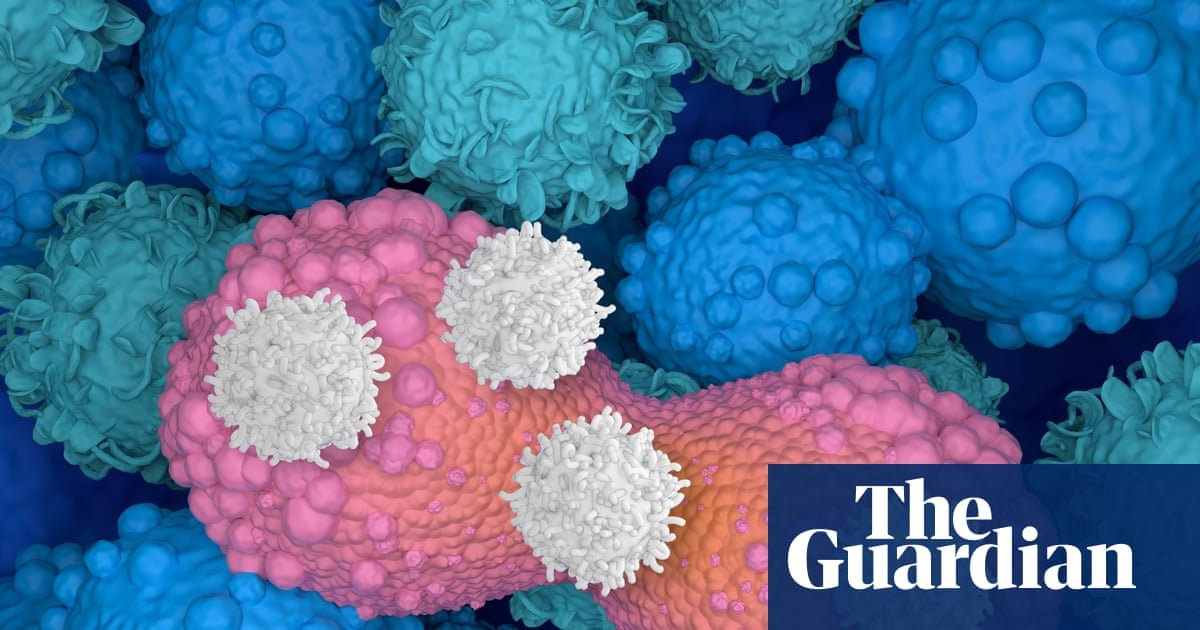
A smart drug that stops cancer cells “hiding” from treatment can shrink tumours by at least 30% in six of the world’s most common forms of the disease, early trial results show.
While immunotherapy treatments have improved survival rates for many patients, their effectiveness can stall or fail when tumour cells hide and then spread.
Researchers in Oxford have developed a drug designed to stop cancer cells concealing themselves from the immune system, allowing immunotherapy treatments to identify and destroy them.
In a trial spanning the UK, France, Spain and Australia, 83 patients with cervical, bladder, liver, bowel, lung or head and neck cancers were given the experimental drug, GRWD5769, alongside the immunotherapy treatment cemiplimab.
Researchers, led by the Christie NHS foundation trust in Manchester, England, found that tumours shrank in 26 patients. Of those, 15 experienced tumour reductions of at least 30%.
All participants had previously failed to respond to treatment, and most had no options left when they joined the study. Crucially, immunotherapy had not worked or had stopped working.
The smart drug was able to remove “invisibility cloaks” from tumour cells, exposing them to the parts of the immune system that attack infections and diseases. This allowed the cemiplimab immunotherapy to pinpoint and destroy the cancer.
The findings were presented at the American Society of Clinical Oncology’s annual meeting in Chicago, the world’s largest cancer conference.
GRWD5769 was shown to shrink tumours in all six cancer types included in the trial. The drug halted progression of the disease for at least six months in 18% of cervical cancer patients, 32% of liver cancer patients, 36% of bladder cancer patients, 38% of those with neck and head cancer, and more than half of bowel (51%) and lung (55%) cancer patients.
Results from the phase 1 trial were presented at the conference by its principal investigator, Prof Fiona Thistlethwaite, a consultant medical oncologist and medical director of the Christie clinical research facility.
Speaking to the Guardian in Chicago, Thistlethwaite said: “For a drug that is given as a tablet, this is very impressive. It’s early days, and we need further studies, but this is a new drug with a new mechanism that clearly helps immunotherapy perform more effectively.”
The tablets, which can be taken at home, were developed by Oxford-based Greywolf Therapeutics and were tolerated well by patients. The trial remains ongoing, with a larger study planned.
Immunotherapy enlists T-cells – immune system cells that attack infections and diseases – to hunt and destroy cancer. Although it has revolutionised cancer care, it fails in about two-thirds of patients. This is because immunotherapy struggles when tumours hide from the immune system.
Tumours can evade the immune system by manipulating an enzyme called ERAP1 (endoplasmic reticulum aminopeptidase 1). By altering this enzyme, cancer cells can hide from a patient’s T-cells.
GRWD5769 solves this problem by inhibiting ERAP1. This, in effect, removes cancer’s invisibility cloak and makes tumour cells visible to T-cells that could not previously find them.
“Immunotherapy has been a gamechanger in the way we treat cancer, but the number of people that can benefit is still relatively low,” Thistlethwaite said. “What excites me about this trial is the combination of what we’re seeing – strong signals of efficacy across six tumour types that have shown great resistance to immunotherapy, with very few side-effects. That’s unusual at such an early stage, when we’re usually just looking at how safe it is.
“There’s a lot more work to be done before it reaches the clinic, but for a brand new drug to show that kind of profile so early – and in so many different types of hard-to-treat cancers – it gives me genuine optimism.”
The trial’s UK principal investigator, Prof Stefan Symeonides, a consultant medical oncologist at the Edinburgh Cancer Centre and professor of experimental cancer medicine at the Institute of Genetics and Cancer, University of Edinburgh, described the early results as “exciting”. “It is fantastic to have been able to bring this promising new immunotherapy approach through to clinical trials and to see our patients benefiting,” he said.
Cancer Research UK’s research information lead, Dr Samuel Godfrey, who was not involved with the trial, said: “Immunotherapy has transformed treatment for some cancers but it doesn’t yet work for everyone. This trial seems to show how this new drug could make immunotherapy more effective, including in some cases where immunotherapy had previously failed.
“It is unusual to see such outcomes in patients whose cancers have already stopped responding to treatment, particularly across several hard‑to‑treat cancer types, so these results are encouraging. However, this is still an early‑stage study, and larger trials will be needed to determine whether this approach can deliver lasting benefits for patients.”
