

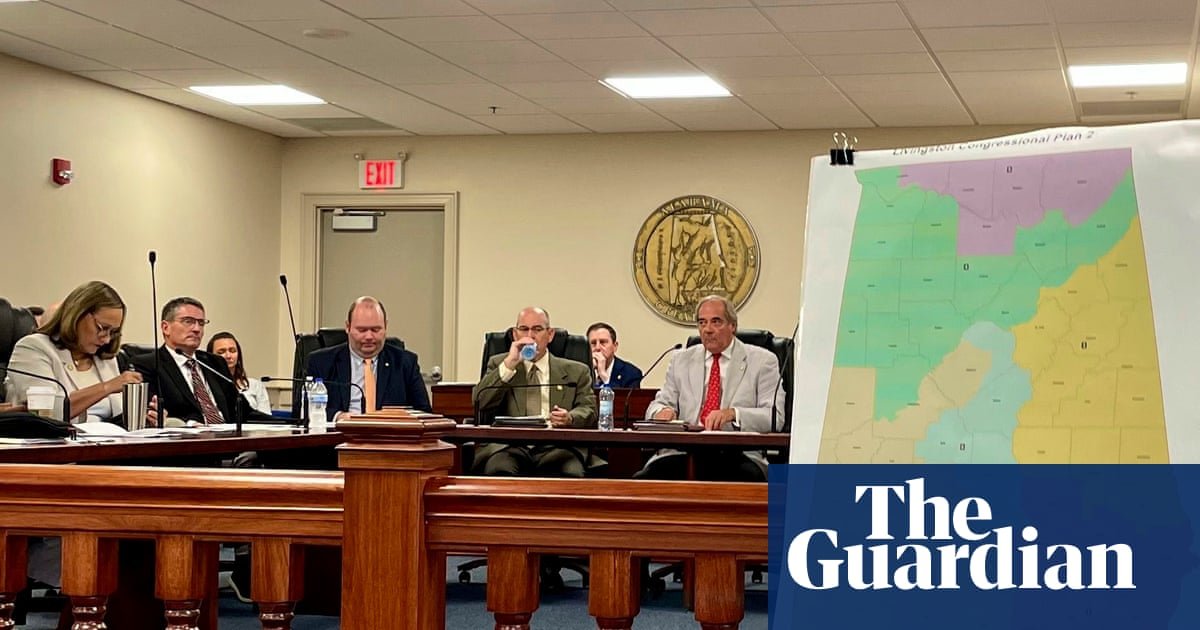
Alabama can use a congressional map a lower court had previously said was intentionally drawn to discriminate against Black voters in the state, the US supreme court ruled on Monday.
The court’s decision allows Alabama to use a congressional map it passed in 2023 after courts struck down an earlier version of its map as a violation of the Voting Rights Act – a decision the US supreme court agreed with at the time. Alabama will be able to use the map in this year’s midterm elections.
A three-judge panel concluded the 2023 map did not fix the VRA violations and instead said it was passed to intentionally discriminate against Black voters in the state. “We cannot understand the 2023 Plan as anything other than an intentional effort to dilute Black Alabamians’ voting strength and evade the unambiguous requirements of court orders standing in the way,” that panel wrote. The panel had a special master redraw the map, which resulted in two majority-Black districts, and issued an injunction that prohibited Alabama from using another map until after the 2030 census.
The supreme court’s majority offered no explanation for its decision, even though it said in its Voting Rights Act case two weeks ago that the relevant law in the Alabama case had not been overturned. The court’s three liberal justices dissented from Monday’s ruling.
Alabama’s current map has five congressional districts represented by white Republicans and two represented by Black Democrats. The 2023 map that will now go into effect eliminates the seat held by Shomari Figures, a representative, that stretches from Mobile and across the state’s Black belt, and replaces it with a Republican district.
Monday’s decisioncame just days after the country’s highest court decided to gut section 2 of the Voting Rights Act in a case dealing with Louisiana’s congressional districts. Alabama quickly returned to the US supreme court and asked them to lift the injunction, which they did on Monday.
The court’s decision on Monday shows how aggressively the justices are willing to move to free up Republican states to redraw districts that dilute the influence of Black voters.
The court’s three liberal justices dissented from the opinion, saying that the court offered little explanation for overturning the lower court’s finding of intentional discrimination.
“The court today unceremoniously discards the District Court’s meticulously documented and supported discriminatory-intent finding and careful remedial order without any sound basis for doing so and without regard for the confusion that will surely ensue,” Justice Sonia Sotomayor wrote in a dissent, joined by Elena Kagan and Ketanji Brown Jackson. “The record showed that Alabama made an intentional choice to perpetuate and entrench, rather than remedy and uproot, the racial discrimination that the District Court had previously found and that this Court had affirmed.”
Alabama’s primary was set to take place on 19 May, but Republicans passed a law last week moving that primary in the event the US supreme court would act. In the past, the supreme court has refused to upend districts or other election rules on the eve of an election, a principle it abandoned both in the Louisiana case – where it is issued its decision as voting was underway – and in Alabama.
In addition to Alabama, Republicans in Tennessee, Louisiana, and South Carolina have all moved quickly to try to get new maps in place to boost Republicans’ chances in this fall’s elections.
