

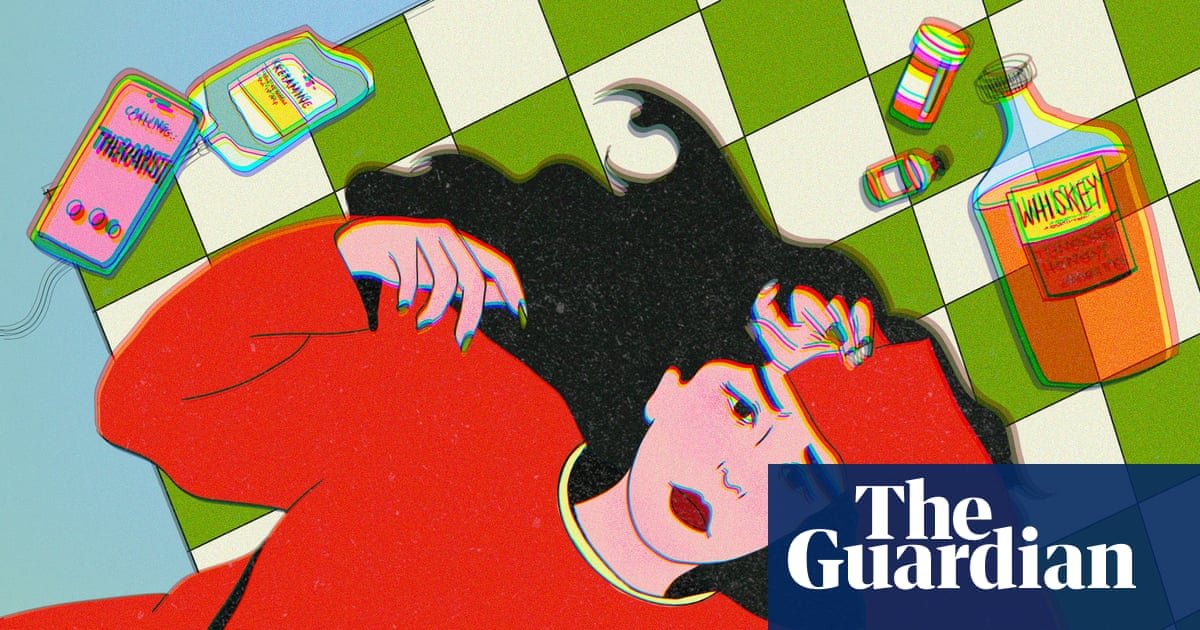
On a threadbare carpet in the living room of a Bernal Heights bungalow, I lay blindfolded on my back. Two middle-aged rescue terriers, one missing an eye, sniffed my feet and climbed up and down my legs. F**kin’ Perfect by Pink blared in the background, but the music sounded muffled and distant, like I was listening from underwater.
It was 1pm on a Thursday. Instead of going to the office, I’d allowed a shaman named Jonathan to inject my thigh muscle with a large dose of liquid ketamine. Even in my compromised state, high and spread out like a corpse on a stranger’s rug, I knew I’d reached peak absurdity. I also knew I wouldn’t emerge from this activity with even a slight improvement to my mental health.
Jonathan was a kind man who had studied psychedelic medicine under the tutelage of respected practitioners. He’d helped many of my friends address deep-seated issues in remarkable ways. But my friends weren’t suffering from suicidal, treatment-resistant depression.
The ketamine’s effects fizzled away as I peeled off my blindfold, feeling even worse than when I’d arrived on the shaman’s doorstep that morning, an hour late for my “journey”. He attempted to guide me through some concluding exercises, but all I could focus on was my comfortable bed waiting for me at home.
I beelined out of there and trudged the few blocks to my house, practically nose-diving into my pillows when I reached my bedroom. I stayed under the covers, horizontal and tucked away from the rest of the world, for the next 24 hours straight. Eventually, I peeled myself out of bed and shuffled over to a nearby house party.
I’d come to San Francisco – considered by many to be the most innovative city in the world – in the hopes of finally finding a solution to my longstanding mental health struggles. Intramuscular ketamine injections from an underground shaman were only the latest in a long line of cutting-edge treatments I’d attempted. I was running out of ideas. So far, the only reliable way I knew how to escape from my demons was drinking until I blacked out.
A year earlier, in the fall of 2016, I’d returned to my home city after a disastrous stint in Panama, where I’d spent the past year living in a jungle eco-community. The relentless rainy season, a dearth of local mental health resources and the community’s chaotic management were no match for my blossoming depression, and at the advice of a kind stranger on the other end of a suicide hotline, I boarded a one-way flight back to the states.
Arriving back in San Francisco after several years in Latin America was like stepping into the future. Twelve-dollar cold-pressed juices, a municipal composting program, bikes with electrified pedals and one-tap credit card payments? Surely this bustling hub of technological innovation, a city obsessed with “disrupting” every industry, was the most logical place on earth to tackle my mental illness.
The Bay Area in the mid-2010s was a petri dish for the wellness industry. People stirred yak butter into their morning coffee and guzzled Soylent for breakfast, lunch and dinner. Therapy and nutrition startups had popped up in WeWorks all over the region. Mental health apps like Calm, BetterHelp and Lyra Health had all been founded locally. “Cold-plunging”, “nootropics” and “intermittent fasting” were becoming part of the casual lexicon. Big tech companies, like the one I joined once I’d settled back home, offered generous mental health benefits, including paid medical leave and in-house therapists.
With a buffet of options spread before me, I forged ahead in earnest, sampling every avant-garde mental health treatment on the table. Despite cycling through nine different combinations of pharmaceutical antidepressants, I hadn’t had much luck with traditional medicine. An outpatient psychiatric program, the most institutional of my efforts, left me feeling cold and disconnected.
I took the bus over the Golden Gate Bridge to a holistic health center in Marin county after work, where a nurse escorted me to the “IV Lounge” and pricked my inner arm. Wearing an eye mask and a pair of gigantic headphones blaring new-age music, I lay back in one of five recliner chairs and let ketamine drip into my bloodstream for 45 minutes. When it was over, I felt a little woozy, but not much else. Still, I returned four more times, braving rush hour traffic and paying under the table in cash, because I’d read so much about ketamine’s miraculous effects on persistent depression.
After the ketamine ran its course, I began an intensive, demanding cycle of transcranial magnetic stimulation therapy. TMS, an emerging and promising depression treatment, involves attaching a magnetic coil to the side of your skull that pulses against areas of the brain associated with mood stability.
In order for TMS to work, you have to do it regularly – so regularly that I was required to receive the treatment every single weekday. On my way home from the office each afternoon, I detoured to a sterile beige office above a jewelry store in Union Square. A nurse monitored me as I sat perfectly still in a chair, the device jabbing at my scalp like tiny, rhythmic needle pricks. Although I came to appreciate the predictability of the routine, the depression didn’t budge. Eight months in, my mood as heavy as when I arrived, the clinic’s head doctor recommended I end my sessions.
When all else failed, I went to see one of those WeWork nutritionists, who put me on an elimination diet and asked me to poop in a Tupperware container for a fecal analysis. I don’t remember what the examination concluded, but I know my symptoms didn’t improve. Not even when I switched to sugar-free, coconut milk yogurt and cut out all forms of gluten (except for beer).
In the epicenter of Silicon Valley’s high-octane, experimental culture, I wasn’t alone in my quest to get well. Research that would be published just two years later revealed more than half of the surveyed tech workers struggled with anxiety or depression. And roughly 30% of people with major depressive disorder have a treatment-resistant form of the disease, which means, like me, they failed to respond positively to at least two adequate interventions.
A few months after my episode on the shaman’s living room carpet, a fleeting moment of honesty led me to residential rehab for substance abuse. In the throes of a particularly brutal hangover, I told my therapist about my increasingly frequent drug and alcohol benders. Until then, I hadn’t been willing to face the idea that perhaps the one thing offering me temporary relief was the one thing preventing me from actually getting well.
Rehab marked a turning point. Being immersed in a supportive environment, surrounded by individuals with similar struggles, was profoundly transformative. For the first time in my adult life, I was able to address the root causes of my illness without the manufactured respite of substances making everything worse.
Newly sober and back in the real world, with more unstructured time than I knew what to do with, I began attending 12-step meetings in church basements and community centers. These gatherings were the antithesis of San Francisco’s dazzling futurism: watery coffee, metal folding chairs arranged in a circle, unflattering fluorescent lighting overhead. They didn’t cost anything except for an optional dollar or two stuffed in a collection basket. The treatment regimen could hardly be described as innovative, relying on a framework developed nearly a century earlier, and attenders didn’t “optimize” for anything aside from staying clean.
Yet inside these rooms, I learned I wasn’t alone. Through candid conversations with other people who understood my darkness, I started to cultivate a sense of true belonging. Pretty soon, a full year passed without depression’s grip on my body and mind.
A meta-analysis of 100 studies involving 500,000 people found that greater social support was associated with significantly lower odds of depression across all life stages. Longitudinal research suggests loneliness not only correlates with but causes and worsens depression over time. These nondescript church basements offered me something that couldn’t be coded into an app – deep, emotional connections with other human beings.
That sense of support helped me foster my sense of belonging among other loved ones: the 13 quirky housemates with whom I shared a big communal home, my family across the bridge in Oakland, dear friendships I’d taken for granted during the worst of my mental illness. Seven and a half years later, my community continues to keep me sober and depression free.
The treatments I tried in San Francisco have genuinely transformed some people’s lives. A recent study showed 52% of participants who received intravenous ketamine infusions for depression achieved complete remission from the disease. Research on the effectiveness of TMS is even more promising.
Meanwhile, wellness is even hotter now than it was when I returned to SF a decade ago. AI therapists are on the rise, venture capital is pouring into ketamine clinics and biohacking trends have become outright bizarre.
None of these “disruptive” advancements put a dent in my depression, though. Tech culture has a tendency to turn everything into a product, a platform or a scalable solution. But I eventually learned from experience – lots and lots of experience – that I couldn’t hack human nature in order to find happiness.
