

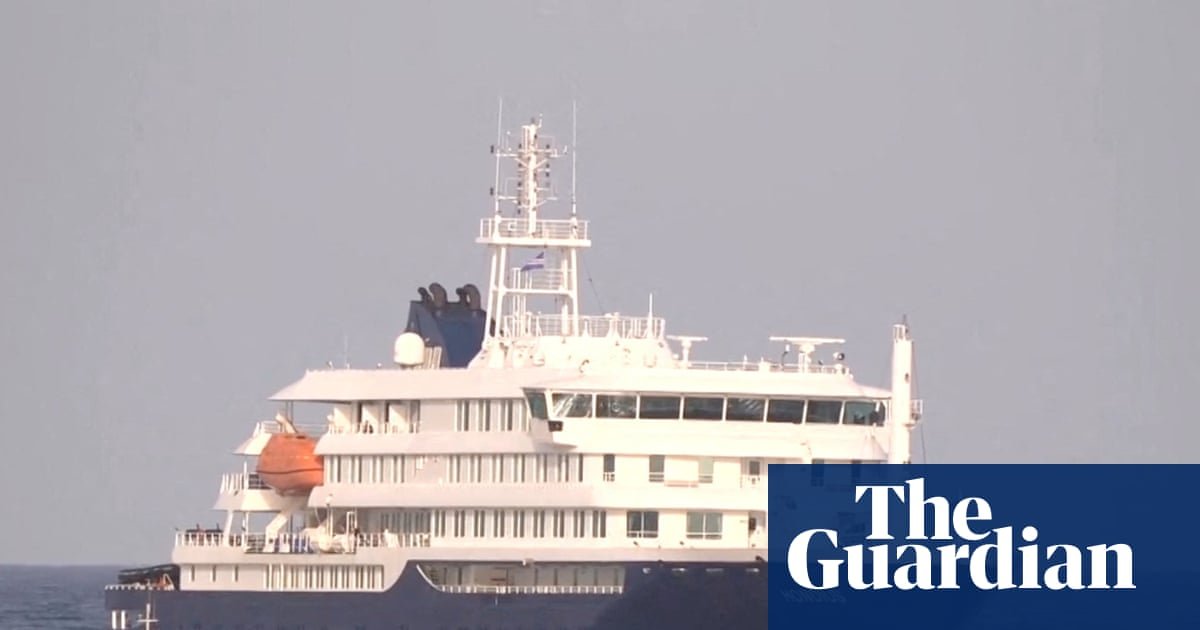
Three people with suspected hantavirus, including a British crew member, have been medically evacuated from the cruise ship linked to the outbreak.
The crew member, along with a Dutch colleague and another passenger, were taken from the Dutch-flagged cruise ship MV Hondius for onward travel to the Netherlands, the World Health Organization (WHO) confirmed.
The evacuation means the ship, with close to 150 people on board, can now continue on its three-day journey to the Canary Islands after Spanish authorities gave permission for the vessel to dock.
Tedros Adhanom Ghebreyesus, director general of the WHO, posted on X: “Three suspected hantavirus case patients have just been evacuated from the ship and are on their way to receive medical care in the Netherlands in coordination with WHO, the ship’s operator and national authorities from Cabo Verde, the United Kingdom, Spain and the Netherlands.
“WHO continues to work with the ship’s operators to closely monitor the health of passengers and crew, working with countries to support appropriate medical follow-up and evacuation where needed.
“Monitoring and follow-up for passengers onboard and for those who have already disembarked has been initiated in collaboration with the ship’s operators and national health authorities.
“At this stage, the overall public health risk remains low.”
A Dutch couple and a German national who had been on the ship, the MV Hondius, have died, while a British national is in intensive care in South Africa. There are also at least four Australian nationals on the ship.
Since the start of the outbreak, the WHO has emphasised that the risk to the public is low.
People are usually infected by hantavirus through contact with infected rodents or their urine, their droppings, or their saliva. Human-to-human transmission is rare.
But a limited spread among close contacts has been observed in some previous outbreaks with the Andes strain, which has spread in South America, including Argentina, where the cruise trip started in March.
South Africa’s health ministry said contact tracing was under way, with 62 contacts identified, including flight crew and healthcare workers. The contacts will be monitored until an incubation period has passed. None have been diagnosed with the hantavirus so far.
Cape Verde was meant to be the ship’s final destination, but the country off West Africa has not allowed the vessel to put passengers ashore because of the outbreak.
Have you been affected?
If you or a friend or family member has been affected, please get in touch by filling in the form below or by messaging us.
Your responses, which can be anonymous, are secure as the form is encrypted and only the Guardian has access to your contributions. We will only use the data you provide us for the purpose of the feature and we will delete any personal data when we no longer require it for this purpose. For alternative ways to get in touch securely please see our tips guide.
If you or friend or family member have been affected, we would like to hear from you
Please include as much detail as possible.
Do you have any concerns? Optional
Please include as much detail as possible.
If you are happy to, please upload a photo of yourself here Optional
Please note, the maximum file size is 5.7 MB.
Choose file
Can we publish your response?
You can add more information here Optional
If you include other people’s names please ask them first.
Would you be interested in speaking to our audio and/or video teams?
By submitting your response, you are agreeing to share your details with us for this feature.
Submit
Show more
Late on Tuesday, the Spanish health ministry said it had been asked by the World Health Organization and the EU to take the MV Hondius and had agreed “in accordance with international law and humanitarian principles”.
The ship will dock at the Canary island of Tenerife, the Spanish state broadcaster TVE reported on Wednesday, citing sources from the country’s health ministry.
The Spanish archipelago’s leader, Fernando Clavijo, said he was opposed to the ship docking and requested an urgent meeting with Spain’s prime minister, Pedro Sánchez. The decision ultimately belongs to the central government.
