

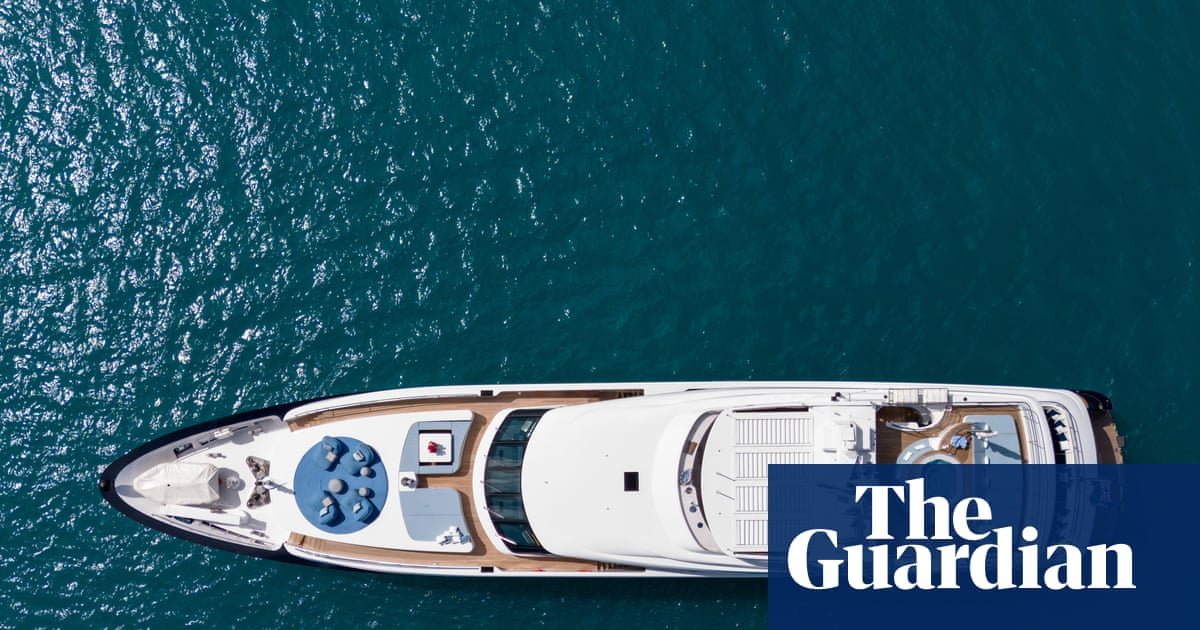
The view of the Whitsundays is postcard-perfect. The setting – a private yacht – extravagant. There’s a gym downstairs, a spa upstairs and a staff ratio of 14:1.
Floating off the Australian coastline is one of the world’s most luxurious rehabilitation and mental health programs. Operating on a superyacht called “Mischief”, a trip on Ocean Blue costs $600,000 a week.
While many Australians struggle to navigate a fragmented treatment system with long waitlists for public rehab facilities, the private sector is booming.
Treatment onboard Mischief is secluded, anonymous and decadent. Photograph: Jeff Brown/Harp
Ocean Blue is rehab for the ultra-wealthy – C-suite professionals and elite athletes struggling with gambling, alcohol or cocaine dependence. Reached via private jet, it is secluded, anonymous and decadent.
“It’s really a product for someone who is used to it,” says the Melbourne-based Hills and Ranges Private (Harp) chief executive, Edward Handley. “They probably hop on our yacht and think it’s a little bit smaller than their yacht.”
While Ocean Blue targets a global market, it represents the pinnacle of Australia’s private rehab industry – a sign the sector is growing rapidly.
After opening Harp’s first clinic in 2020, the organisation has expanded to five centres. Over the next two years, Handley plans to open facilities in Sydney, Perth, Brisbane and Auckland.
Harp is not the only new player – but not all have succeeded. Highlands Recovery in Bowral, New South Wales, closed less than a year after opening amid community backlash. The Bowral Action Group called for tighter regulation, noting the facility was not among NSW Health-accredited services.
In Geelong, the Hader Clinic went into liquidation last year after accumulating $3.5m in tax debt.
Others are expanding. The Banyans in Queensland – reportedly costing $120,000 for a four-week stay – has opened a second facility to meet demand. Luxury rehabs have also emerged on the Gold Coast and in Byron Bay.
Harp’s chief executive Edward Handley in the grounds of the company’s Stonehurst of Sassafras rehab centre in Victoria’s Dandenong Ranges. Photograph: Penny Stephens/The Guardian
While an estimated 500,000 Australians struggling with addiction miss out on treatment each year, those who can afford it can access private care almost immediately. Harp can transport patients via private jet or on business-class flights within hours.
Handley founded Harp with his late wife, Raya, a psychologist, after his own experience in rehab.
Stonehurst of Sassafras offers five-star accommodation, concierge services, massages and personal training. Photograph: Penny Stephens/The Guardian
“The beautiful thing about substances is that they work,” he says. “But they don’t solve the problem – they amplify it.”
When he sought help, he avoided the public system, describing it as under-resourced.
“It’s one psychologist for 30 patients – sometimes more,” he says. “But what I found in the private sector also needed to change.”
Canapés made from scratch by Stonehurst’s personal chef. Photograph: Penny Stephens/The Guardian
Rehab at Harp comes with all the bells and whistles. Five-star accommodation, concierge services, massages and personal training. It’s equine therapy on weekends, family days by the tennis court, and a private chef to cook every meal. Patients can do “24/7 therapy” if they want, Handley says.
Handley in Stonehurst’s talk therapy room. Photograph: Penny Stephens/The Guardian
Those patients are politicians, chief executives, doctors, influencers, athletes and actors. They come here, continue working, while receiving treatment for burnout, booze, coke, gambling or meth addictions.
Harp has just started working with Australian Securities Exchange companies whose board members or management team might be having substance issues, to help tap them on the shoulder and offer a stint in rehab before it gets worse.
They often stay for 28, 60 or 90 days, with aftercare support for up to a year.
Sitting in the therapy room at Sassafras, a Tudor-style mansion in the lush Dandenong Ranges that costs $25,000 a week to attend, Handley rests his hands on the velvet sofa.
The facility only takes four clients at a time, who often need anonymity. Sometimes, executives will be in Sassafras, working while receiving treatment, unbeknown to the companies they are running.
The treatment is accredited by Monash University and Handley says success is measured by completion rates rather than long-term sobriety.
“We don’t have a revolving door,” he says. “We’re not about people coming and going prematurely.
“If you’re ready to do this, I’m going to tell you right now, this program is completely flawless. The only non-flawless thing about it is the person participating.”
Handley is reluctant to criticise the government: “God bless them,” he says, before admitting the process of rolling out new facilities can be slow. He feels hamstrung by the bureaucracy. Monreale House, a boutique new facility that will cost $50,000 a week, is 18 months past its due date.
A bathroom at Monreale House, a new Harp facilty at Olinda in the Dandenong Ranges. Photograph: Penny Stephens/The Guardian
“Back to the yacht, it was like, OK, how can we start something that won’t then be criticised or held up all the time?” he says. “And I thought, take it out to sea.
“There’s just too many fingers in the pie … [the authorities are] the ones whinging there’s not enough beds. But they’re the reason why there’s not enough beds.”
More than 2 million Australians are estimated to experience addiction. Data from the Australian Institute of Health and Welfare shows there were 46,000 hospitalisations due to alcohol and other drugs in 2023-24. Alcohol is the biggest killer, causing almost five drug-induced deaths a day.
Nicole Lee from the National Drug and Alcohol Research Centre says waitlists aren’t published because they are long and change frequently – someone seeking treatment will put their name down at five or six places, hoping to get to one.
She says this has caused a “two-tier system in addiction treatment” where wealth determines access to faster, more comfortable care, while everyone else is left to wait.
“The biggest problem is that that whole sector is completely unregulated,” she says. “So anybody can go and set up a private rehab.”
Families and loved ones looking for care can easily be “convinced by dodgy providers to mortgage their houses or take out loans to put their family members through the private system”, she says. The increase in private equity ownership in the space has providers like Harp and healthcare practitioners worried – there are an increasing number of voices calling for strict guidelines for practitioners to meet.
Mineral springs run through the Monreale House grounds. Photograph: Penny Stephens/The Guardian
“The unregulated system is a problem,” Lee says. “Even for providers doing the right thing.”
After alcohol, the most common substances that lead people to seek rehabilitation treatment are amphetamines, cannabis, heroin and other opioids.
Matt, who asked for only his first name to be used, knew he had a problem. A house painter, he had been put on opioids after having surgery on his hand due to a work injury.
“After a while, I started noticing that the dose I was on with the endone wasn’t working, so I would up my dose slightly,” he says.
“I was addicted before I knew I was addicted. I’ve never been addicted to anything before.”
Last year Matt, who lives on the Gold Coast with his wife and four kids, went to his GP, who put him on a tapering plan. He tried that for a few months, going through multiple withdrawals, but couldn’t come off it.
In December, during a severe withdrawal, his wife took him to the hospital. But, after waiting for five hours in pain, he left.
Desperate, they tried five places in the public system but couldn’t get in. They were rejected from one private place because Matt’s health insurance didn’t have hospital coverage. In February he finally secured outpatient treatment.
“There are a lot of people out there who do want help,” he says. “But they can’t get it because there aren’t many places that can get you in fast enough.”
Matt now takes a medication that reduces opioid cravings and is sober. But for others, delays can be fatal – drug-induced deaths have exceeded the road toll for more than 15 years.
In support groups across the country, family members share horror stories – wives taking their husbands to the hospital, only to have them discharged back into the throes of addiction the next day. One woman says she lost her brother while he was waiting to get into a service. A mother says her daughter is just 23 – she can’t afford to send her to private rehab, and hasn’t been able to get her into the public system.
The view from the gym at Stonehurst. Photograph: Penny Stephens/The Guardian
Dr Hester Wilson chairs the Royal Australian College of General Practitioners’ specific interests addiction medicine network and is now helping one young patient get into a non-profit. It’s been a slow process, and while a bed has been secured, paying for it is a problem.
“This is a not-for-profit but it’s going to cost them $8,000 for the six months,” Wilson says. “They don’t have that money.”
Addiction treatment is complex and often requires multiple attempts. Completion rates in the public sector sit at about 65%, with relapse rates comparable to other chronic conditions such as asthma and diabetes.
Wilson says one of the biggest challenges to the system is not happening between public and private rehabilitation, but in the community and the culture of some healthcare providers. It’s stigma.
“As a species, we have used intoxicating substances for millennia,” she says. “We always have. We probably always will.
“And it’s not a bad thing. Not all drug use is bad.
“But for some people, it does cause them harm, or it makes them dependent. And there is help there, you know, so reach out for it. Don’t suffer in silence.”
