

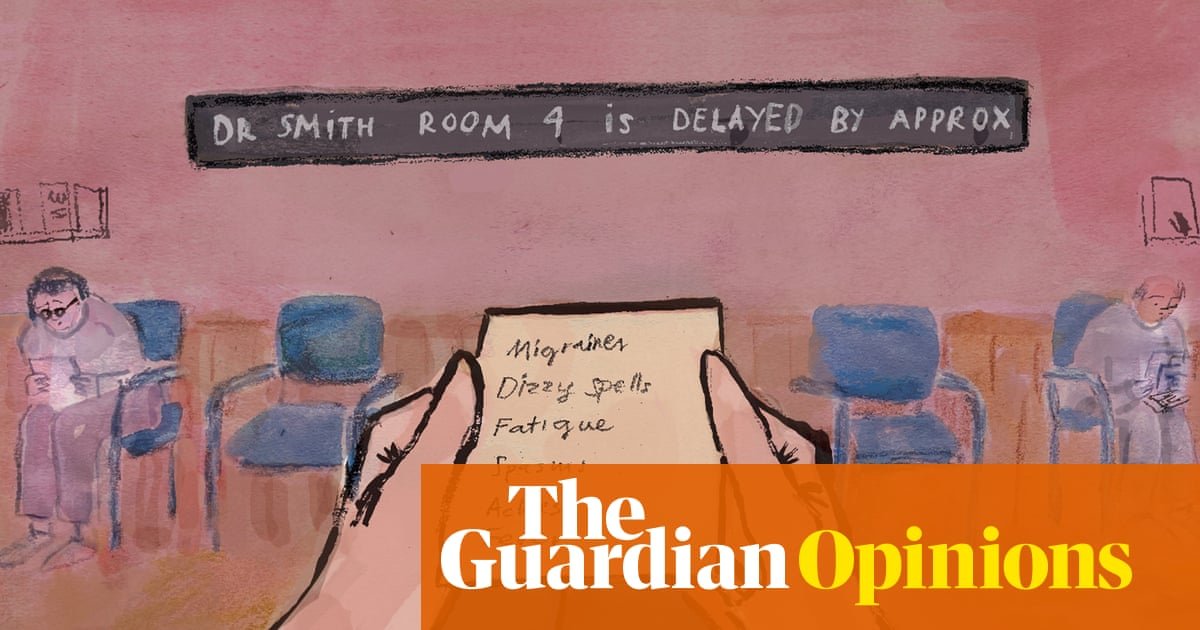
As she battles cancer, my mum fears that she will forget to tell her consultant something important. Like many people with complex and chronic health needs, she clutches a Post-it note with 10 bullet-pointed symptoms, such as “cannot stand” and “spasms”. It is her companion during stressful appointments. We rehearse her list before we enter, and worry that we deviated too much when we leave.
Even then, her peer-reviewed lists, sometimes on the back of envelopes, are inadequate when her condition may change day to day. Each list, too, must be tailored for each of her consultants – many lists get lost in her tall pile of notes and letters. I hate those car rides home when we’re upset that we didn’t say something important, fearing the consequences of this omission. In a health system in which people can wait more than a year for an appointment, you wonder how meticulous these Post-it notes need to be to convey every change in their medical condition since the initial referral letter. It raises the question of how many people have experienced this unsettling ride home.
Throughout my mum’s cancer treatment, the NHS has been wonderful and I have a special gratitude for all the staff, as well as for those at the the cancer charity Macmillan, who have made our uncertain lives bearable. However, communication is essential throughout the treatment process, so it troubles me when it breaks down.
This breakdown is apparent in one 2025 study from Healthwatch England, in which 23% of patients reported noticing inaccuracies in their NHS medical record; of these patients, only 17% said the errors had not impacted them. Now that AI is increasingly trained on patient data to improve NHS efficiency, accuracy is more important than ever to safeguard patients’ outcomes. Our concern about the safe transfer of my mum’s complex history from Post-it to medical note is, therefore, not unfounded. Surely, there must be a better way.
What if patients had a secure way to upload their bullet points before their appointment? What if they had the same after the appointment as well – for the bullet points forgotten, and for the points raised during the consultation that require further clarification? Such a system would be voluntary, low-commitment and safe.
So why don’t we do this already? In the US, such a system, called OurNotes, has been introduced to great effect. Patients co-author their medical record by submitting an “agenda” and a brief “interim history” before appointments. In a follow-up study of doctors across 74 clinics, 97% described agendas and 93% described interim histories as “good ideas”. In addition, 35% of these clinics believed co-authoring notes actually “saved time” – so they’d be unlikely to further burden an already overwhelmed NHS.
OurNotes is a great start, but it still doesn’t resolve the difficult car rides home when important information has been overlooked. If co-authoring works beforehand, I see no reason for it not to work after appointments, too. This is particularly important when doctors interrupt their patients on average after 11 seconds, making it challenging to fully voice all concerns and clarify them during consultations. Uploading a formal record of bullet points would give patients such as my mum a voice in scenarios where empathic listening is limited. This is not a criticism of doctors, but merely a reflection of NHS pressures.
Coroners repeatedly warn of patients dying because of complications with the sharing of crucial medical information between professionals. This is a result of each NHS service using its own eclectic range of systems that cannot share information effectively. The UK government attempted to address this systemic fragmentation through the failed £10bn National Programme for IT (NPfIT) programme, which sought to create a unified national record system, but became “one of the worst and most expensive contracting fiascos in the history of the public sector”, according to an MP on the public accounts committee.
Both Wes Streeting’s three-point plan to modernise the NHS and the NHS Spine infrastructure’s advancements in internal messaging systems between professionals seek to address coroners’ concerns by digitising staff communications. But the NHS is repeatedly marginalising patients by not adequately acknowledging their reliance on Post-it notes. Streeting’s proposal to introduce “patient passports” to hold unified medical records remains extremely controversial, with valid concerns regarding data security, the fostering of a “big brother” state and the selling of patient data.
Proposals to digitise the NHS are vital, but at a time when public satisfaction in the NHS is at a record low, they must not come at the expense of patients’ voices. The NHS is now trialling Cancer 360, a centralised system intended to speed up cancer treatment for patients by collating patient information from spreadsheets, emails and records into a single digital system. This is a significant advancement in cancer care, and one that will save lives. Yet it still fails to acknowledge patients such as my mum who arrive clutching Post-it notes. Once again, she is denied authorship within her own treatment plan. Again, the US may offer a solution.
After 9/11, the US intelligence community acknowledged that, had key information been shared between agencies, “the attack would have been prevented”. Like NHS trusts, US agencies each use separate systems and have their own impermeable bureaucracies. An unorthodox solution, Intellipedia, was launched in 2006 to prevent future missed opportunities by sharing intelligence across government agencies. It celebrates its 20th anniversary this month. Inspired by Wikipedia, it lets agencies collaborate to create and dynamically edit pages that include top-secret information relevant to national security.
Intellipedia’s solution avoids the pitfall of NPfIT by offering an established technology designed to coexist with diverse internal systems. It could provide a centralised but separate and secure repository for patients and professionals to upload their notes in a way that is workable and inherently collaborative. An NHS Intellipedia could give millions of patients, including my mum, a proper voice in their treatment and end Post-it note culture for good.
Will Parman is the winner of the The Guardian Foundation’s 2026 Emerging Voices award (19-25 age category), recognising young talent in political opinion writing
Do you have an opinion on the issues raised in this article? If you would like to submit a response of up to 300 words by email to be considered for publication in our letters section, please click here.
