

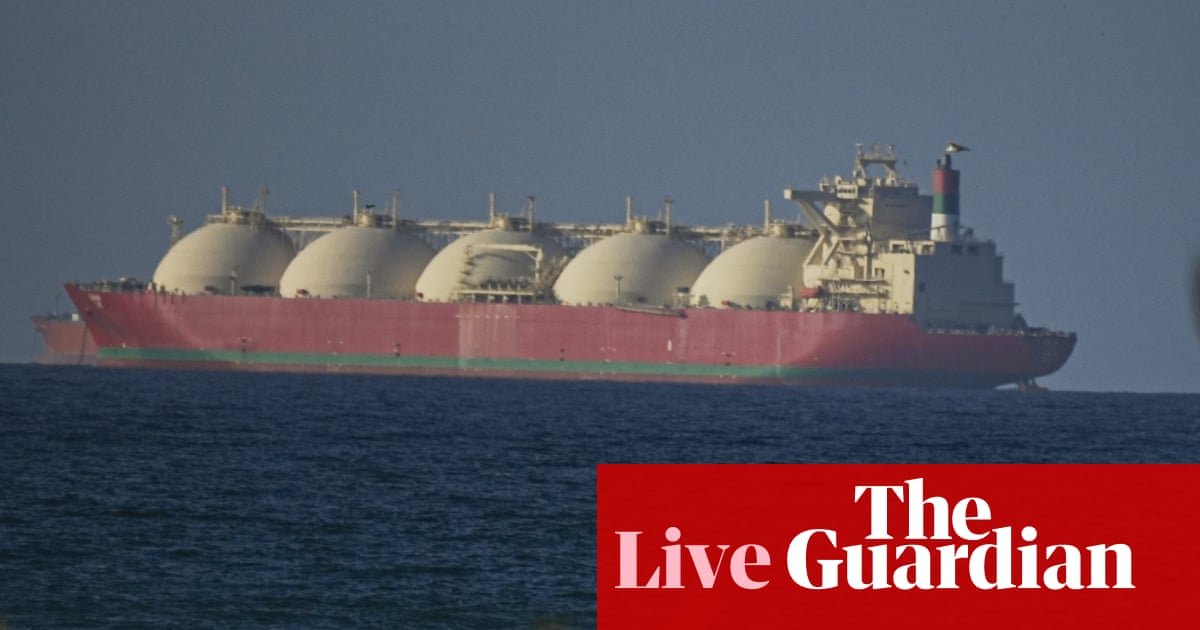
Oil tumbles 10% as Iran declares strait of Hormuz ‘completely open’
The oil price is tumbling, after Iran announced that the strait of Hormuz is now open.
Crude oil has plunged by 10% on hopes that energy supplies could resume after weeks of disruption.
Iran’s foreign minister, Abbas Araghchi, posted on social media that the waterway is ‘completely open’, following the ceasefire agreed between Israel and Lebanon overnight.
double quotation markIn line with the ceasefire in Lebanon, the passage for all commercial vessels through Strait of Hormuz is declared completely open for the remaining period of ceasefire.
Araghchi added that vessels must travel on the “coordinated route” previously announced by Iran’s Ports and Maritime Organisation.
Brent crude has plunged below $90 a barrel, a 10% fall.
Although that account, on X, isn’t verified, president Trump has also announced that Iran has reopened the strait.
Posting on Truth Social, he says:
double quotation markIRAN HAS JUST ANNOUNCED THAT THE STRAIT OF IRAN IS FULLY OPEN AND READY FOR FULL PASSAGE. THANK YOU!
Optimism was already building in the markets after Axios reported that the US. and Iran are negotiating over “a three-page plan to end the war”.
One element under discussion being that the U.S. would release $20bn in frozen Iranian funds in return for Iran giving up its stockpile of enriched uranium, Axios reported.
Share
Updated at 09.17 EDT
Key events
Show key events only
Please turn on JavaScript to use this feature
“A huge sigh of relief to global markets”
The London stock mrket is higher too – with the FTSE 100 up 66 point, or 0.6%, at 10,655 points.
Axel Rudolph, chief technical analyst at IG:
double quotation mark“The reopening of the Strait of Hormuz, even on a temporary basis, has come as a huge sigh of relief to global markets, easing immediate fears around energy supply disruption with the oil price instantly dropping more than 10% and providing a degree of stability to shipping routes.
However, the conditional nature of the move, tied to the duration of the Lebanon ceasefire, means this is far from a permanent resolution. Investors will remain wary of how quickly tensions could resurface, and for now this looks more like a pause in volatility rather than a definitive turning point.”
Share
Expectations that the Bank of England might raise interest rates more than once this year are fading.
The money markets are now only indicating around 23 basis points of increases to Bank rate by the end of this year, meaning one quarter-point rate rise is no longer fully priced in.
Earlier this week, the markets were indicating around 35bps of rises – meaning one rise was fully priced in, with the possibility of a second.
Share
European stock markets are ripping higher.
Germany’s DAX and France’s CAC 40 have both jumped by around 2%.
Neil Wilson, Saxo UK investor strategist says the markets have received “a massive shot in the arm for risk sentiment”:
double quotation markIran says the Strait of Hormuz is open to all commercial shipping during the Israel-Lebanon ceasefire…a good chance for fomoop (fear of missing out on peace) trades to ratchet up into the weekend, though watch for what the US says and consider even if Iran says it’s open, how many will get through?
Also, risk remains for shooting to start again…nevertheless as I said before it’s less about the actual route being taken and all the various stops on the way, and more about the direction of travel – so markets are happy to roll on with this latest development being viewed as a considerable easing of tensions. Rotation is in play again – now watch airlines/travel/luxury for the pickup.
Share
A senior Iranian official has told Reuters that transit through the strait of Hormuz will be through ‘designated safe lanes’ which Iran deems safe for maritime navigation.
Share
UK gas prices down
UK gas prices have slumped too, on hopes of a pick-up in deliveries from the Gulf now Iran has announced the strait of Hormuz is open.
The month-ahead UK gas contract is down almost 8% at 98p per therm.
That’s still higher than before the conflict began, when it was below 80p a therm. But it’s also rather lower than the highs of 180p seen in March.
Share
Updated at 09.48 EDT
US stock market jumps at the open
Wall Street has hailed Iran’s announcement that the strait of Hormuz is fully open.
Stocks have opened higher in New York, with the Dow Jones industrial average jumping by 578 points, or 1.2%, to 49,157 points.
The broader S&P 500 index is up 0.7%.
Share
Trump: the naval blockade remains in full force
The US is not, yet, lifting its own blockade on Iranian ports.
Donald Trump has posted on Truth Social that it will remain in place until a peace deal (or ‘transaction’, as he calls it) is complete.
The US president says:
double quotation markTHE STRAIT OF HORMUZ IS COMPLETELY OPEN AND READY FOR BUSINESS AND FULL PASSAGE, BUT THE NAVAL BLOCKADE WILL REMAIN IN FULL FORCE AND EFFECT AS IT PERTAINS TO IRAN, ONLY, UNTIL SUCH TIME AS OUR TRANSACTION WITH IRAN IS 100% COMPLETE. THIS PROCESS SHOULD GO VERY QUICKLY IN THAT MOST OF THE POINTS ARE ALREADY NEGOTIATED. THANK YOU FOR YOUR ATTENTION TO THIS MATTER! PRESIDENT DONALD J.TRUMP
Share
Oil company shares are slumping, as the reopening of the strait of Hormuz threatens to end their earnings boost from the war.
BP (-6.7%) and Shell (-5%) are among the top fallers in London.
Share
Airline shares jump
Shares in airlines are soaring after Iran announced the strait of Hormuz was ‘completely open’.
IAG, the parent company of British Airways, has jumped 6%, to the top of the FTSE 100 leaderboard.
Rolls-Royce, which makes and services jet engines, are up 5.5%.
Among smaller stocks, Wizz Air are up 10% and easyJet has jumped by 8.2%.
Share
Oil tumbles 10% as Iran declares strait of Hormuz ‘completely open’
The oil price is tumbling, after Iran announced that the strait of Hormuz is now open.
Crude oil has plunged by 10% on hopes that energy supplies could resume after weeks of disruption.
Iran’s foreign minister, Abbas Araghchi, posted on social media that the waterway is ‘completely open’, following the ceasefire agreed between Israel and Lebanon overnight.
double quotation markIn line with the ceasefire in Lebanon, the passage for all commercial vessels through Strait of Hormuz is declared completely open for the remaining period of ceasefire.
Araghchi added that vessels must travel on the “coordinated route” previously announced by Iran’s Ports and Maritime Organisation.
Brent crude has plunged below $90 a barrel, a 10% fall.
Although that account, on X, isn’t verified, president Trump has also announced that Iran has reopened the strait.
Posting on Truth Social, he says:
double quotation markIRAN HAS JUST ANNOUNCED THAT THE STRAIT OF IRAN IS FULLY OPEN AND READY FOR FULL PASSAGE. THANK YOU!
Optimism was already building in the markets after Axios reported that the US. and Iran are negotiating over “a three-page plan to end the war”.
One element under discussion being that the U.S. would release $20bn in frozen Iranian funds in return for Iran giving up its stockpile of enriched uranium, Axios reported.
Share
Updated at 09.17 EDT
With rather awkward timing, the Bank of England’s chief economist has criticised calls for the central bank to “wait and see” how the Iran war pans out before changing policy.
Huw Pill told a roundtable event hosted by Barclays:
double quotation mark“If you’re waiting and seeing and you don’t see, then you’ve just waited.”
“And I’m not sure waiting is necessarily the appropriate response to the sort of inflationary dynamics which have the potential, at least, to have some self-sustaining momentum.”
Pill is one of the more hawkish members of the Bank’s monetary policy committee, who voted against an interest rate cut in February.
Share
IMF: UK can’t afford another debt-fuelled energy support package
Richard Partington
The IMF has warned the UK faces a “fiscal problem” amid the economic shock from the Iran war.
Helge Berger, an assistant director of the Washington-based fund, said the sharp rise in UK government bond yields since the outbreak of the war reflected investor fears over higher levels of borrowing.
He said:
double quotation mark“There is a reflection of an underlying fiscal problem that I know the government is looking to address through its multiyear consolidation strategy”.
Speaking at the Washington-based fund’s press conference on the regional economic outlook for Europe, he warned the IMF believed the UK “does not have the fiscal space” to announce a package of household energy support using higher levels of borrowing.
double quotation mark“Our advice for the UK is broadly aligned with what we’ve been telling many countries: it’s important to keep the course on fiscal consolidation.
“The country has been making tough choices. It’s weighing the benefits of costs of acting on the revenue side… It’s also looking at spending. That is what countries have to do. The balance is a function of political discussions and societal consensus.”
Berger said the government would therefore need to focus on “temporary, targeted and timely” energy support for the most vulnerable households to help limit the cost of any package.
double quotation mark“Let’s make sure we hold the course of fiscal consolidation, not to make sovereign debt markets nervous.”
Share
Updated at 09.21 EDT
IMF: Bank of England should leave interest rates on hold this year
The International Monetary Fund is urging the Bank of England to leave interest rates on hold this year.
Alfred Kammer, director of the IMF’s European Department, has just told the media in Washington DC that the BoE should maintain “a restrictive monetary policy stance”.
Speaking at the IMF and World Bank spring meeting, he adds:
double quotation markThat means keeping the policy rate unchanged for the remainder of the year, Ie, to not go forward with the expected cuts.
Before the Iran war, City investors had expected the Bank to cut rates this year. Now, though, at least one rate rise is priced in by the money markets. Bank rate is currently 3.75%.
BoE governor Andrew Bailey said earlier this week the Bank would not “rush to judgments” about how to respond to an inflation shock fuelled by higher energy prices (which the Bank can’t affect through changing interest rates).
Kammer argues that the European Central Bank should maintain “a neutral monetary policy stance”.
That, he says, means two quarter-point interest rates increases in 2026, which it might be able to reverse in 2027.
Kammer adds:
double quotation markOf course, there is uncertainty on this and we need to adjust over the next few months what scenario we are in.
Share
Updated at 08.49 EDT
IMF: We were going to upgrade Europe’s growth forecast, before Iran war
The Iran war has crushed hopes that European growth would pick up this year.
Alfred Kammer, director of the IMF’s European Department, is briefing the media in Washington DC now.
Outlining the outlook for Europe’s economy, Kammer says:
double quotation markWe were ready for an upgrade on growth. And then, the war in the Middle East happened, and we now have a downgrade on growth and upgrade on our inflation forecast.
The Fund’s “reference scenario” is that the Iran war will shave 0.5% off euro area growth over the next two years.
In a more severe scenario, up to 1.7 percentage points could be cut off European GDP, he adds.
Share
Britain’s energy price cap forecast to rise 12% this summer
The jump in energy prices since the Iran war started is expected to push British energy bills higher this summer, but not by as much as previously feared.
Consultancy Cornwall Insight is now predicting that the energy price cap will rise by 12% in July, to £1,837 per year for a typical dual fuel consumer in Great Britain.
That’s lower than a few weeks ago – at the end of March, Cornwall forecast the cap would rise to £1,929 per year.
Since then, oil and gas prices have dropped, on hopes of a peace deal in the Middle East.
Share
Updated at 08.33 EDT
A chart showing jet fuel pricesShare
Jet fuel shortage could lead to flight cancellations in Europe, IATA says
Fears are growing that European airlines could start cancelling flights this summer unless supplies of jet fuel pick up back to pre-Iran war levels.
The International Air Transport Association’s director general Willie Walsh has suggested today that flights in Europe could be cancelled due to a lack of jet fuel starting from the end of May.
Walshe said:
double quotation mark“Along with doing everything possible to secure alternative supply lines, it’s important that authorities have well-communicated and well-coordinated plans in place in case rationing becomes necessary, including for slot relief.”
[’Slot relief’ would mean airlines wouldn’t lose their landing slot at an airport if they cancelled flights due to fuel shortages].
Yesterday the head of the International Energy Agency warned that Europe has only six weeks of jet fuel left before shortages will hit.
Share
The drop in motor fuel prices, and in mortgage rates, today will provide a little help to UK families facing a cost-of-living squeeze.
New data from the Office for National Statistics has found that two-thirds (67%) of adults reported that their cost of living had increased compared with a month ago, up from 56% in February 2026.
The ONS says:
double quotation markAmong those reporting that their cost of living had increased compared with a month ago, the price of food shopping remained the most commonly reported reason (91%); the proportion reporting the price of fuel (75%) as a reason for increased living costs increased from February 2026, when it was 38%.
Share
RAC: fuel prices start to drop
Petrol and diesel supplies at an Esso petrol station in Denham, Buckinghamshire, earlier this week. Photograph: Maureen McLean/Shutterstock
There is finally some relief for motorists at the pumps, after weeks of rising prices.
Petrol and diesel prices dropped yesterday for the first time since the Iran war started, and are a little lower today too.
This has pulled petrol to just below 158p a litre on average. However, that’s still 19% higher than before the conflict began, when a litre of petrol cost 132.83p.
The average cost of diesel has slipped to 190.94p – still 48% higher than at the end of February.
This follows a drop in wholesale fuel costs earlier this week.
RAC head of policy Simon Williams says:
double quotation mark“After 46 days of rising prices, the cost of both petrol and diesel across the country has finally begun to drop very slightly. Wholesale prices are still lower, so we’re hopeful there will be further reductions amounting to several pence a litre in the coming days.
After record rises, drivers will be relieved to finally see prices going the other way. While we’re a long way from a return to the prices we had at the start of the conflict, there’s now a glimmer of light at the end of the tunnel.”
Share
Updated at 06.16 EDT
