

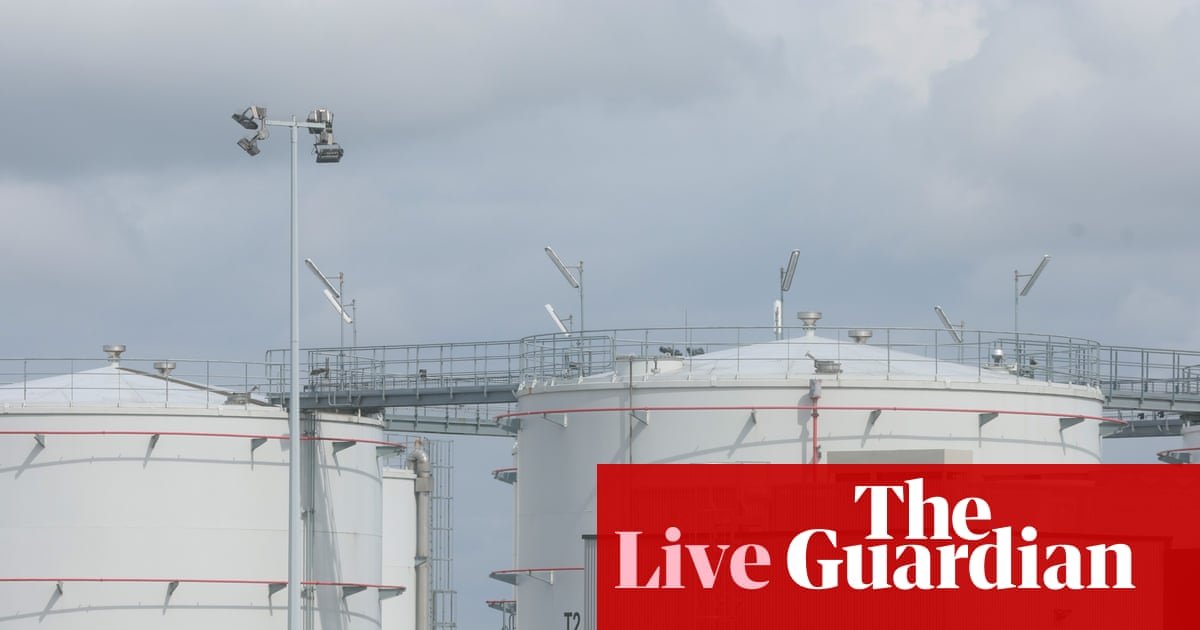
Europe has ‘maybe 6 weeks of jet fuel left,’ energy agency head warns
The head of the International Energy Agency has warned that Europe has about six weeks of jet fuel left.
In an interview with Associated Press published today, IEA executive director Fatih Birol warned that flight cancellations could begin “soon” if oil supplies remain blocked by the Iran war.
Birol said Europe has “maybe 6 weeks or so (of) jet fuel left,” after the effective closure of the strait of Hormuz led to “the largest energy crisis we have ever faced.”
He told AP that the impact will be “higher petrol (gasoline) prices, higher gas prices, high electricity prices,” adding that some parts of the world will be hit worse than others.
“The front line is the Asian countries” that rely on energy from the Middle East, he said, naming Japan, Korea, India, China, Pakistan and Bangladesh, adding:
double quotation mark“Then it will come to Europe and the Americas.”
And if the strait of Hormuz isn’t reopened, Birol said that for Europe:
double quotation mark“I can tell you soon we will hear the news that some of the flights from city A to city B might be canceled as a result of lack of jet fuel.”
The US is currently blockading Iranian ports, whiel Tehran has laid mines in the vital waterway to restrict traffic through the strait.
Yesterday, IMF chief Kristalina Georgieva warned that the disruption from the Middle East conflict would continue even after the war stops, explaining:
double quotation mark“We need to recognise disruptions are not going to evaporate overnight even if the war ends tomorrow. Why? Because a tanker is a slow-moving vessel. It would take 40 days to get all the way to Fiji.”
Share
Updated at 07.12 EDT
Key events
Show key events only
Please turn on JavaScript to use this feature
US industrial production fell in March
American industrial output dropped last month – an early sign that higher energy price are hurting Donald Trump’s domestic economy.
Production at US factories, mines and utility companies fell by 0.5% in March, data from the Federal Reserve shows, including a 0.1% drop in manufacturing output.
Capital Economics told clients:
double quotation markThe 0.1% m/m fall in manufacturing output was a touch weaker than the 0.1% gain that we and the consensus expected.
While growth in February was admittedly revised up to 0.4%, from 0.2%, that only offset a similar-sized downward revision to growth in January.
Most of the weakness in March stemmed from a 3.7% m/m fall in motor vehicles & parts manufacturing, continuing its volatile run.
Share
Wall Street’s main indexes have opened higher on Thursday on rising hopes that the worst of the Middle East conflict may have passed.
The Dow Jones industrial average has gained 119 points, or 0.25%, to 48,582.84 points.
The S&P 500 index, which hit a record high yesterday, is up 0.15%.
Share
Huge Nigerian refinery ‘boosts jet oil supplies to Europe
A mega-refinery owned by Africa’s richest person is becoming an increasingly important source of vital jet fuel supplies to Europe, helping fill a gap left by the impact of the Iran war while boosting profitability, Bloomberg are reporting.
Here’s the details:
double quotation markAliko Dangote’s $20 billion plant in Nigeria reached full capacity just a couple of weeks before the conflict in the Middle East created a historic oil-supply disruption. Benefiting from local crude purchases that save cost, the upheaval in the market has given the billionaire a greater advantage amid deepening concerns about fuel shortages.
The 650,000 barrel-a-day facility, one of the world’s biggest, has raised its jet fuel shipments to Europe to unprecedented levels with prices in the continent recently hitting the highest on record. It marks a major turnaround for Nigeria that for years bought fuel from Europe, and leaves Dangote with room to raise supplies further just as European refineries face the prospect of cutbacks because of expensive crude and a lack of Middle Eastern supply.
“Given that Europe is particularly reliant on jet barrels via the Strait of Hormuz, we could expect to see a larger portion of Dangote’s jet exports heading towards Europe,” said Qilin Tam, head of refining at FGE NexantECA, who estimates the plant can make as much as 150,000 barrels a day of the fuel at full tilt.
Share
Iran war is a “major new external shock” for Africa, IMF warns
Over in Washington DC, the IMF is warning that Africa’s economic growth has been hit by the Iran war.
Abebe Aemro Selassie, director of the IMF’s African Department, is telling reporters:
double quotation markSub-Saharan Africa entered 2026 with the strongest economic momentum it had seen in a decade. And then came the war.
The good news is that in 2025, economic activity accelerated across nearly all country groups, with regional growth reaching 4.5%, the fastest pace in over a decade.
Selassie points to countries such as Ethiopia and Nigeria, who he says reaped the benefits of “macroeconomic reforms, exchange rate realignments, subsidy reductions, and strengthened monetary policy frameworks.”
But now, the Fund has cut its growth forecast for 2026 to 4.3%,down from 4.6%.
Selassie says:
double quotation markThe war in the Middle East is a major new external shock. Oil, gas, and fertilizer prices have surged. Shipping costs have risen. Trade with Gulf partners has been disrupted. Tourism and remittances are being squeezed. Financial conditions have tightened, particularly for fuel-importing countries.
Share
US jobless claims fall
The US jobs market appear to be holding up well in the face of the energy shock from the Middle East.
The number of Americans filing new claims for unemployment benefit has fallen by 11,000 to 207,000 last week.
Share
Here’s our news story on the IEA’s warning that Europe is running low on jet fuel:
Share
The European Union is drafting plans to tackle a looming jet fuel supply crunch and maximise refinery output, officials have said.
From next month, the European Commission will introduce EU-wide mapping of refining capacity for oil products and introduce measures “to ensure that existing refining capacity is fully utilised and maintained”, a draft proposal seen by Reuters said.
Share
Thomas Pugh, chief economist at audit, tax and consulting firm RSM UK, says:
double quotation mark“Oil prices might have fallen back, but it’s refined product prices that matter for business and inflation. Jet fuel prices are still above their 2022 peaks and diesel prices aren’t far off.
“The last tanker of jet fuel to pass through the Strait of Hormuz docked in Europe on Saturday. The UK is importing more from the US, but not enough to fill the gap. With jet fuel prices close to record highs, it’s not surprising we are seeing airlines increase fuel surcharges, as well as smaller airlines cancelling routes and it won’t be long before larger ones follow suit, as they have in Asia. That’s demand destruction in action.
A chart showing jet fuel prices Photograph: RSMShare
Jet fuel prices have already been rising sharply, hitting airlines’ profitability.
The budget airline easyJet warned this morning that the impact of the Iran war on bookings and oil prices will hit its profits, having driven up fuel costs by £25m in the last month alone.
It said it expected to report an increased pre-tax loss of £540-£560m for the six months to March, up from £394m in the first half of 2024-25. The carrier typically makes its money in the second half of the year which includes the peak summer period.
The airline said it remained confident in its fuel supply. While it has hedged 70% of its needs for the rest of the financial year to September, it said that each $100 (£74) movement in the spot price jet of fuel per metric tonne was adding £40m in costs for its unhedged supply – and currently the price is about $800 higher than before the conflict started.
More here:
Share
Europe has ‘maybe 6 weeks of jet fuel left,’ energy agency head warns
The head of the International Energy Agency has warned that Europe has about six weeks of jet fuel left.
In an interview with Associated Press published today, IEA executive director Fatih Birol warned that flight cancellations could begin “soon” if oil supplies remain blocked by the Iran war.
Birol said Europe has “maybe 6 weeks or so (of) jet fuel left,” after the effective closure of the strait of Hormuz led to “the largest energy crisis we have ever faced.”
He told AP that the impact will be “higher petrol (gasoline) prices, higher gas prices, high electricity prices,” adding that some parts of the world will be hit worse than others.
“The front line is the Asian countries” that rely on energy from the Middle East, he said, naming Japan, Korea, India, China, Pakistan and Bangladesh, adding:
double quotation mark“Then it will come to Europe and the Americas.”
And if the strait of Hormuz isn’t reopened, Birol said that for Europe:
double quotation mark“I can tell you soon we will hear the news that some of the flights from city A to city B might be canceled as a result of lack of jet fuel.”
The US is currently blockading Iranian ports, whiel Tehran has laid mines in the vital waterway to restrict traffic through the strait.
Yesterday, IMF chief Kristalina Georgieva warned that the disruption from the Middle East conflict would continue even after the war stops, explaining:
double quotation mark“We need to recognise disruptions are not going to evaporate overnight even if the war ends tomorrow. Why? Because a tanker is a slow-moving vessel. It would take 40 days to get all the way to Fiji.”
Share
Updated at 07.12 EDT
Aluminium hits four-year high on Middle East supply worries
Ouch! Aluminium prices have hit a four-year high today, adding to the inflationary pressures on companies.
Benchmark three-month aluminium on the London Metal Exchange rose as high as $3,672 a metric ton this morning, its highest level since March 24, 2022.
Reuters reports that the global aluminium market is facing a supply deficit this year due to the Iran war.
One Gulf producer warned earlier this month that fully restoring production at one of its UAE smelters hit by an Iranian attack in late March could take up to a year.
The Middle East accounts for about 9% of global production of aluminium, and Chinese aluminium exports are expected to rise as buyers look for other sources of the metal.
Share
Eurozone inflation revised up to 2.6% in March
Over in the eurozone, inflation was faster than initially reported in March,as the Iran war drove up costs.
Statistics body Eurostat has calculated that consumer prices rose by 2.6% in the year to March across the single currency block, up from an initial estimate of 2.5%.
It says:
double quotation markThe lowest annual rates were registered in Denmark (1.0%), Czechia, Cyprus and Sweden (all 1.5%). The highest annual rates were recorded in Romania (9.0%), Croatia (4.6%) and Lithuania (4.4%). Compared with February 2026, annual inflation fell in three Member States, remained stable in one and rose in twenty-three.
Energy prices were 5.1% higher than a year ago, while services inflation came in at 3.2%, and unprocessed food inflation was 4.2%.
Share
UK GDP: More expert reaction
Today’s GDP report suggsts the UK economy began to turn a corner after the Autumn Statement and before the latest developments in the Middle East, says Barret Kupelian, chief economist at PwC:
double quotation markThe UK economy looked to be finding its feet, but geopolitics may yet kick the chair away. Output grew by 0.5% in the three months to February, with both production and services expanding together.
More importantly, this was growth powered by the private sector rather than the public sector-dominated parts of the economy that had propped up much of the post-2023 picture. That suggested the recovery was becoming broader and more durable.
But the question now is whether that recovery can withstand the fresh external shock from the Middle East.
Chris Beauchamp, chief market analyst uk at investing and trading platform IG, says Rachel Reeves and Kier Starmer need to be careful about doing a victory lap:
double quotation markA look back at last year shows that April 2025 was also good, but then things took a decidedly poor turn. Companies across the UK are warning about the outlook for earnings and consumer spending, and with energy costs hitting consumers hard, today’s good news could turn to dust all too quickly.”
Andrew Wishart, senior UK economist at Berenberg, warns that the Iran war will snuff out the UK’s early 2026 momentum, adding:
double quotation markEven before the war, we doubted that the economy could enjoy a sustained acceleration. Flat employment, decelerating pay growth and a rising personal tax burden were set to reduce real household spending power.
Now we can add higher energy prices and mortgage interest rates to the list of headwinds. Businesses, meanwhile, face another input cost shock just as they were overcoming the last one (minimum wage and payroll tax hikes). Amid limited pricing power, the squeeze on profitability will probably weigh on output and employment as much as it generates cost-push inflation.
Pre-war, a slowdown in inflation to an acceptable pace should have provided a silver lining to our below-consensus 2026 growth forecast. The new energy price shock means the UK must now endure both weaker growth and higher inflation, postponing bank rate cuts but not derailing them.
Share
