

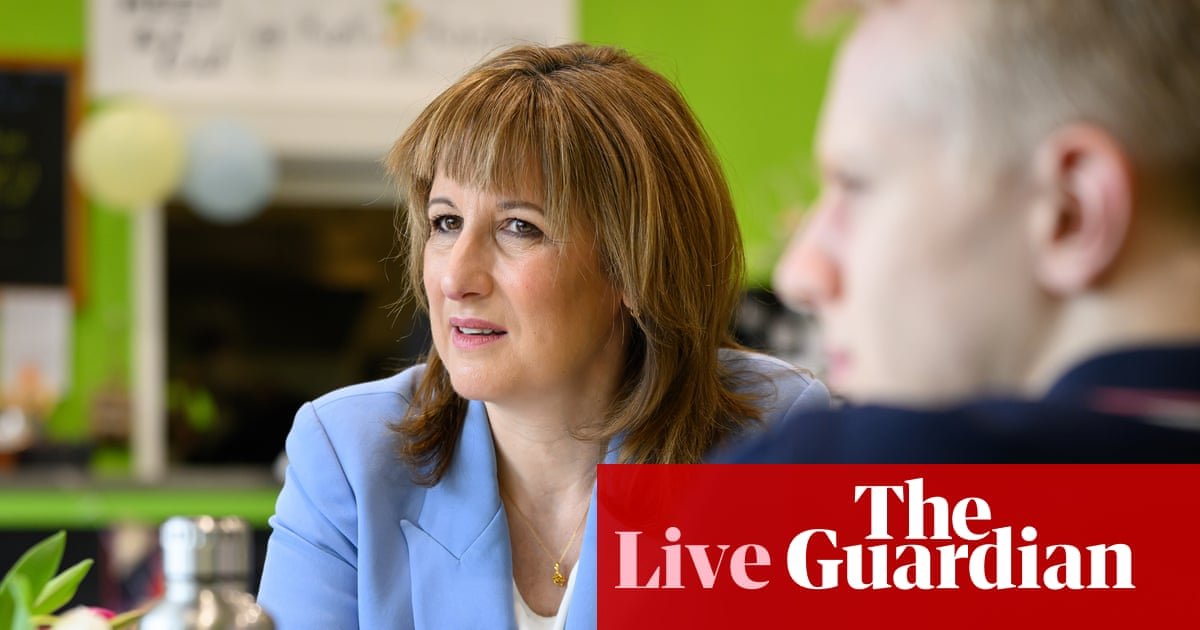
Reeves condemns Trump’s decision to launch war against Iran as ‘folly’
Rachel Reeves, the chancellor, has described Donald Trump’s decision to go to war against Iran as “folly”.
She used the comment in an interview with the Daily Mirror, ahead of her trip to Washington for IMF meetings where she will discuss the global impact of the war with her counterparts.
Reeves has already said publicly that she is “angry” about the war, but she was blunter speaking to the Mirror. She said:
double quotation markThis is a war that we did not start. It was a war that we did not want. I feel very frustrated and angry that the US went into this war without a clear exit plan, without a clear idea of what they were trying to achieve. And as a result the strait of Hormuz is now blocked.
Asked why she was so angry, she explained:
double quotation markBecause of the impact it’s having on families and businesses in our country. When I presented the spring statement at the beginning of March, it showed that inflation was coming down, interest rates were projected to fall further after having been cut six times since I became chancellor of the exchequer.
Borrowing and debt were falling and the economy was set to grow. It was already the fastest growing G7 economy in Europe last year, and that was projected to continue
Obviously no sensible person is a supporter of the Iranian regime, but to start a conflict without being clear what the objectives are and not being clear about how you are going to get out of it, I do think that is a folly and it is one that is affecting families here in the UK but also families in the US and around the world.
Sometimes politicians make the news when they say things that are unusual or controversial. This is an example of the opposite sort of news; a politician making a statement of the bleeding obvious, but one that is still unexpected because, for reasons of tact or diplomacy, most of her colleagues would never say it in public.
In private, “folly” may be one of the milder things being said by government ministers about Trump’s war. But Reeves’s comment is still stronger than anything anyone else in the government has said openly.
Keir Starmer and his team have spent much of their time in office trying to avoid saying anything at all critical of Trump, for fear of offending him. But increasingly Trump’s conduct, and domestic political considerations too, are making that policy impossible to sustain.
Share
Key events
Show key events only
Please turn on JavaScript to use this feature
Afternoon summary
For a full list of all the stories covered on the blog today, do scroll through the list of key event headlines near the top of the blog.
Kemi Badenoch cleaning graffiti off a wall in Herne Hill, south London. She is saying that, under the Tories, vandals would be forced to clean up graffiti they cause immediately. Photograph: Stefan Rousseau/PAShare
Richard Norton-Taylor on why MoD is itself to blame for its funding problems
Richard Norton-Taylor, the Guardian’s former security editor, says the Ministry of Defence is itself to blame for its funding problems. Here is his article.
And this is how it starts.
double quotation markGeorge Robertson, Tony Blair’s first defence secretary, a former Nato secretary general and an author last year of the latest in a series of evasive strategic defence reviews, accused Keir Starmer on Tuesday of a “corrosive complacency towards defence”. He said the prime minister was not willing to make the “necessary investment”.
Lord Robertson could have directed his fire elsewhere. He must know that no government department has been so complacent in the face of years of devastating evidence of waste, profligate contracts, and policy decisions that have avoided confronting new but increasingly clear security threats to Britain and other western countries.
Mandarins in the Ministry of Defence and successive defence secretaries have failed to confront the armed forces’ top brass – senior military figures who have a vested interested in preserving the status quo and continuing to fighting the last battles, reluctant to accept new geopolitical realities and new technologies.
Share
EHRC updates guidance on how to apply supreme court ruling on gender
The equalities watchdog has updated its guidance on how to implement the supreme court ruling on gender after the government requested changes to the original proposals submitted last year, Peter Walker and Libby Brooks report. The guidance is likely to be published next month.
Here is the written statement from Bridget Phillipson, the education secretary and miniseter for women and equalities, confirmed that the government has received the updated guidance.
Share
Former head of armed forces joins calls for Starmer to deliver on higher defence spending
Jock Stirrup, head of the armed forces between 2006 and 2010, has said ministers need to lead a national conversation making the case for higher defence spending.
In an interview with LBC’s Tonight with Andrew Marr, Stirrup fully backed what George Robertson is saying in a speech tonight. (See 8.58am.) He said that he accepted that defence spending was cut under the last government, but he said that did not mean current ministers could avoid responsibility.
double quotation markIt was the previous government that began the evisceration of defence, but this government is the one that’s in charge now. This government is the one which says, rightly, that the security of the nation and its people is their first priority.
Well, it’s. It’s all very well to say that, but you need to back that up with deeds, and so far they’re not doing it.
Stirrup said that he would like defence spending to rise to 2.5% of GDP immediately, and 3% by the end of this parliament. The government is not planning to reach 2.5% until next year, and 3% is a target for the end of the next parliament.
Asked about public opposition to this, Stirrup said ministers needed to make the case.
double quotation markThe government keeps saying we need to have a serious and hard conversation with the British people about the need for defence. And of course, I entirely agree with them. Unfortunately, the government says these sorts of things in places like Munich and Bahrain. It doesn’t say it back here.
Referring to Keir Starmer, Rachel Reeves, the chancellor, and John Healey, the defence secretary, he said: “They are our current leaders, they need to lead.”
What Stirrup is saying dovetails with what the Financial Times’s Stephen Bush said in his Inside Politcs column this morning. He argued that Robertson’s speech is significant because it is evidence of the wider problem of establishment figures losing faith in Starmer’s ability to deliver. He says:
double quotation markIn this case it is George Robertson on defence, but what he is saying is really just the public version of what I hear so often from former New Labour leading lights about their contact with the government – that when it comes to actually matching rhetoric with policy commitment, Starmer never really delivers. (For its part, the government said it is “delivering” on its strategic defence review and increasing defence spending).
Will Robertson going public cause a chain reaction? What helps Starmer is that many people who will nod along to what Robertson says today fear that after him things will get worse, not better.
But one sign that this government is really starting to circle the drain will be if Labour grandees and power brokers who have had a similar journey – seeking constructive engagement before becoming frustrated – take a leaf out of Robertson’s book and say on the record that this is a government that writes cheques it doesn’t even try to cash.
Share
Manosphere making it harder for military to tackle sexual harassment, head of army tells MPs
The online “manosphere” – a world of extreme, misogynist content aimed at young men – is making it harder for the armed forces to deal with problem like sexual harassment, the head of the army has told MPs.
General Sir Roly Walker, chief of the general staff, also said that some of the people who join the armed forces do so because they want to become a different behaviour, and so it can take time for them to leave bad behaviours behind.
He was speaking to the Commons defence committee, in a hearing about women in the armed forces.
Asked why sexual harassment in the armed forces was still as prevalent as it was five years ago, Walker said:
double quotation markMy personal view is this gets harder before it gets easier, because of the trends in wider society.
The level of misogyny, the level of rancorous behaviour and belief systems, and the tension in wider society, is something we have to accept as the environment from which we attract.
I’m well aware of what is going on with things like the manosphere and the sense of deepening rifts within young people, all of which is playing and accelerating through social media.
A lot of that generation are coming through into the armed forces.
During the hearing the Labour MP Emma Lewell said that between 2021 and 2024 there had been 122 investigations into sexual offences against under 18-year-olds at the Army Foundation College in Harrogate, North Yorkshire. Of those, 80 were sexual assault.
The college is the sole military training unit for British army recruits aged between 16 and 17 and a half.
Walker said it was not surprising that misogyny and sexual misconduct were a particuar issue with new recruits. He said:
double quotation markThe level of sexualisation in young people in society, the level of exposure to drugs, drink, alcohol, violence in wider society, it is not a surprise to me that when we take 10,000 civilians, generally between the ages of 17 and a half and 20, and train them to be soldiers, that in those early weeks and months of onboarding them into our organisation, we see the greatest correlation of behaviours which are at odds with our values and standards.
People are drawn to the armed services because they want to be something different, and it takes a while to transform them from being civilians, in my case, into being soldiers, and that is a journey.
It is not a cliff edge where you walk in the door and suddenly, you’re a different person.
These have got to be learned behaviours and applied, and the guardrails are there to do that and do the very best for our people, so they can do the best for the nation.
Share
Donald Trump has revived his attack on the UK government’s energy policies, calling the failure to allow more drilling in the North Sea as “Tragic!!!” in a post on Truth Social.
Share
Schools will need to modify ‘zero tolerance’ behaviour policies under plans for more Send inclusion, MPs told
Richard Adams
Richard Adams is the Guardian’s education editor.
MPs have been warned that the Department for Education (DfE) will need to overhaul school behaviour guidance and complaints procedures to make a success of its plans to make schools in England more inclusive for children with special needs.
The education select committee hearing on the reforms to special educational needs and disabilities (Send) provision heard that strict “zero tolerance” behaviour policies that punish pupils for minor infractions were incompatible with the DfE’s efforts.
Jane Harris, chief executive of Speech and Language UK, told the committee:
double quotation markWe really need to see the department saying that zero tolerance behaviour policies, by definition, are not inclusive. Because zero tolerance behaviour policies are rigid whereas inclusion is about flexibility. Seventy-eight per cent of teachers telling us that children with speech and language challenges are being unfairly punished in their classrooms, [that] tells us that we really need to change those behavour policies.
If you’ve got children who for whatever reason have a higher cognitive overload during the day, maybe due to speech and language challenges or maybe because of other reasons relating to Send, they cannot not then cope with being told that they have to bring a specific coloured pencil to a classroom or get a detention because of this.
If we really want children to be having all these enrichment activities, we need to make sure they are not spending all their time in detentions because they are getting penalised for these really, really tiny issues.
Harris told the MPs that policies used in some schools required pupils to be visibly attentive during lessons.
double quotation markYour eyes have to be on the teacher at all times – can you imagine this committee functioning like that? You guys are not looking at us all the time.
We are really putting children into a far too rigid an environment, and we’ve got to get the department to acknowledge that it is trying to run two policies at the same time that are fundamentally incompatible.
Margaret Mulholland, head of Send and inclusion policy at the Association of School and College Leaders, said the proposed new complaints procedures for special needs provision would put further pressure on families and create a new layer of bureaucracy.
double quotation markThis could fundamentally damage the relationship between families and schools … This process of complaints – going through the school and to the governing body, the logistics of that, the bureauracy of that, the time this is going to take – is tremendous.
I think that statutory duty really needs thinking about and the process of support for schools needs reviewing and reframing.
Share
Scottish Greens would probably need to raise taxes by even more than they say to fund their ‘huge’ plans, says IFS
The Institute for Fiscal Studies thinktank has published its initial response to the Scottish Green party’s manifesto, published this morning. In his summary, David Phillips, the IFS’s head of devolved and local government finance, calls this “a big manifesto proposing huge changes to policy”. But, as with every IFS assessment of every manifesto published in Scotland and Wales this year, it does not think the document fully explains how the party would fund its pledges.
Phillips says (bold type from IFS):
double quotation markThese tax plans would cement Scotland’s position as the highest-taxed part of the UK. Whether the expansion of the welfare state would make that worthwhile will be in the eye of the beholder. From a purely fiscal perspective, it is welcome to see a party that plans substantial spending increases combine them with a recognition that this would need higher revenues too – something missing from the England and Wales Green Party’s Senedd manifesto, for example. But while the manifesto omits specific revenue estimates, the proposals set out seem unlikely to raise enough revenue to fund all the additional spending that would be required to deliver the Scottish Greens’ plans. To pay for those, increases in taxes would probably have to be even larger than suggested, or cuts made to other day-to-day spending that the Scottish Greens deem lower priority. And big tax increases to fund new, universal free entitlements – to childcare, dental care, domiciliary social care, and bus travel – would make the tax rises that already look likely be needed to maintain existing services in the longer term more difficult.
You can read the IFS’s other initial responses to Scottish election manifestos here.
Share
SNP joins calls for government to invest more in armed forces (except nuclear weapons)
Turning back to George Robertson’s comments about defence (see 8.58am), the SNP has sort of endorsed what he has said – or at least his criticism of the Labour government’s record. The SNP issued this response from Dave Doogan, their defence spokesperson at Westminster. He said:
double quotation markThe Labour party is threatening the security of Scotland, and the UK, at the worst possible time by repeatedly delaying vital investment in our core defence capabilities while focusing investment on Trident nuclear weapons, which will not keep Scotland safe.
The UK government spent years cutting defence spending – reducing the size of our armed forces to record lows, dismantling our navy, slashing Scottish regiments, and hollowing out investment in essential equipment and training.
In an increasingly uncertain world, it is shocking that the Labour party is putting our safety in jeopardy by failing to deliver the investment needed in conventional forces, while focusing on maintaining weapons of mass destruction on the Clyde.
The fact that senior Labour party figures, including Lord Robertson, feel the need to speak out against Keir Starmer’s ‘corrosive complacency’ speaks volumes.
Keir Starmer must drop the excuses, stop dithering and bring forward necessary investment without further delay.
Share
Scottish Greens say they oppose any new oil and gas fields in North Sea at manifesto launch
There should be “absolutely no new oil and gas fields” in the North Sea, the Scottish Greens have said, as the party launched its manifesto. As the Press Association reports, the comments come against the backdrop of rising fuel prices caused by the US-Israeli offensive in Iran and the disruption to the shipping of energy products in the strait of Hormuz. PA says:
double quotation markJohn Swinney, the Scottish first minister and SNP leader, has dragged his party away from a scepticism over more drilling in Scotland’s waters, suggesting that the carbon impact of importing energy should be considered in the licensing of new fields.
The two positions could drive further space between the Scottish Greens and the SNP ahead of the 7 May election, further damaging any chances of a deal between the two parties to cement a pro-independence majority in Holyrood, though John Swinney’s party have shied away from any formal deals in recent months.
Addressing party members, co-leader Ross Greer said: “As you would expect, friends, this is a plan to tackle the climate crisis.
“It shouldn’t be the case that we are the only party publishing a manifesto compatible with the scientific reality of the crisis that we face, and yet we are.
“So we’re proud to say, the Scottish Greens are proud to be the only party in this election saying there can be absolutely no new oil and gas fields in the North Sea.”
Polling suggests the Greens are likely to gain seats on 7 May, with the party’s leaders setting their sights on pursuing some quite radical changes, including bringing all of Scotland’s buses back into public ownership and making their use free.
Fellow co-leader Gillian Mackay told members: “It was the Scottish Greens who introduced free bus travel for everyone under 22.
“It was the Scottish Greens who scrapped peak rail fares.
“It was the Scottish Greens who ended school meal debt and increased taxes on the richest.
“And it was the Scottish Greens who took on the landlord lobby and introduced rent controls.
“We’ve done all of that with only seven MSPs – think of what we could do if there are 10 of us? Twelve of us? Fifteen of us? Or maybe even more.
“Every Green MSP, every one of these fantastic candidates joining us today will be a voice for change and for a fairer, greener and independent Scotland.”
The party also pledged improvements in funded childcare, including extending the offer of 1,140 hours per year to all two-year-olds in Scotland and 570 hours from six months to two years old.
Scottish Green party co-leaders Ross Greer and Gillian Mackay (left) at the launch of their manifesto for the upcoming Holyrood election at Barras Art and Design (BAaD) in Glasgow. Photograph: Steve Welsh/PAShare
Updated at 10.15 EDT
Liam Byrne on why populists like crypto
At his press conference this morning Ed Davey, the Lib Dem leader, accused Nigel Farage of copying Donald Trump in his embrace of crypto. (See 11.36am.) One person likely to agree is the Labour MP and former cabinet minister Liam Byrne, who has just published a book, Why Populists are Winning, and How to Beat Them. In it, he writes explicitly about Trump and Farage both being mesmerised by crypto.
Here’s an extract.
double quotation markAll told, at the time of writing, The New Yorker’s comprehensive survey estimates that the president’s family has now amassed a $3.4bn through ventures spanning hospitality, Gulf investments, crypto schemes, NFTs [non-fungible tokens – digitial assets] and Truth Social. The scale of this money-making, Anne Applebaum assured me, may not be unknown in autocracies around the world – but it is unprecedented in a modern democracy with a dangerous new mechanism: creating pseudo-commercial vehicles – especially crypto tokens – that give supporters no real asset or rights, but function as open channels to transfer money to the president’s family …
It will amaze you to learn that Reform UK are as keen on cryptocurrency as President Trump himself. The party has announced it will take donations in bitcoin. In the UK, mega-donor Christopher Harborne was reported to have received $70m in Tether tokens in 2019, shortly before donating around £13m to the Brexit party and other causes. Another £9m had been donated at the time of writing … Announcing plans in Las Vegas of all places, Mr Farage said Reform UK would transform Britain with a ‘crypto revolution’ by slashing capital-gains tax on crypto assets, allowing people to pay their taxes in cryptocurrency, and even establishing a national ‘bitcoin reserve fund’. Yet here is the risk: not only do these techniques leave our democracies wide open to infiltration by bad actors; they leave our politics open to bad states, in particular the Russian state, which is on the hunt for new vectors of influence.
There are plenty of books available about populism, but not many this comprehensive, this concise, this pithy and this readable. And, for anyone opposed to the populists, it contains good advice by the buckload. It is well worth a read.
Share
UK economic growth forecasts slashed as IMF warns of higher energy prices
The International Monetary Fund has cut its forecast for UK growth this year and in 2026, as the Iran war hurts the global economy, Graeme Wearden reports on his business live blog. There is full coverage here.
This Guardian graphic illustrates the figures.
IMF revised growth forecasts Photograph: GuardianShare
Reeves condemns Trump’s decision to launch war against Iran as ‘folly’
Rachel Reeves, the chancellor, has described Donald Trump’s decision to go to war against Iran as “folly”.
She used the comment in an interview with the Daily Mirror, ahead of her trip to Washington for IMF meetings where she will discuss the global impact of the war with her counterparts.
Reeves has already said publicly that she is “angry” about the war, but she was blunter speaking to the Mirror. She said:
double quotation markThis is a war that we did not start. It was a war that we did not want. I feel very frustrated and angry that the US went into this war without a clear exit plan, without a clear idea of what they were trying to achieve. And as a result the strait of Hormuz is now blocked.
Asked why she was so angry, she explained:
double quotation markBecause of the impact it’s having on families and businesses in our country. When I presented the spring statement at the beginning of March, it showed that inflation was coming down, interest rates were projected to fall further after having been cut six times since I became chancellor of the exchequer.
Borrowing and debt were falling and the economy was set to grow. It was already the fastest growing G7 economy in Europe last year, and that was projected to continue
Obviously no sensible person is a supporter of the Iranian regime, but to start a conflict without being clear what the objectives are and not being clear about how you are going to get out of it, I do think that is a folly and it is one that is affecting families here in the UK but also families in the US and around the world.
Sometimes politicians make the news when they say things that are unusual or controversial. This is an example of the opposite sort of news; a politician making a statement of the bleeding obvious, but one that is still unexpected because, for reasons of tact or diplomacy, most of her colleagues would never say it in public.
In private, “folly” may be one of the milder things being said by government ministers about Trump’s war. But Reeves’s comment is still stronger than anything anyone else in the government has said openly.
Keir Starmer and his team have spent much of their time in office trying to avoid saying anything at all critical of Trump, for fear of offending him. But increasingly Trump’s conduct, and domestic political considerations too, are making that policy impossible to sustain.
Share
