

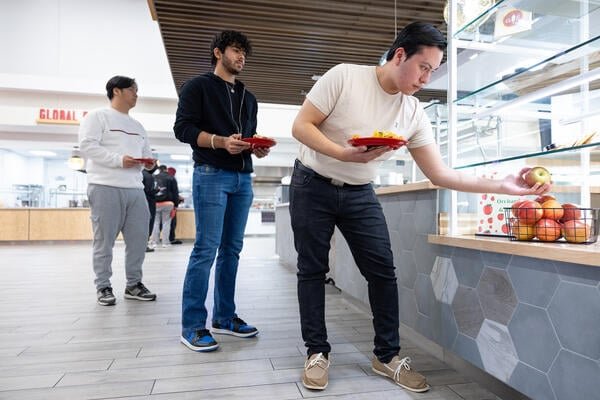
Food insecurity remains a persistent barrier to college completion for many students—particularly those balancing jobs and family responsibilities. A new analysis from the Institute for Higher Education Policy found that during the COVID-19 pandemic, older, working and caregiving students were more likely than their peers to face food insecurity—and less likely to receive institutional emergency aid.
The analysis, using newly released 2020–22 Beginning Postsecondary Students Longitudinal Study data from the National Center for Education Statistics, revealed how the pandemic disrupted students’ food security and educational progress. Roughly 19 percent of older students, 15 percent of primarily working students and 21 percent of caregiving students reported experiencing food insecurity during the pandemic, compared to about 11 percent of their peers in each category.
The report also found that food insecurity was strongly linked to persistence. About 56 percent of older students, 55 percent of primarily working students and 53 percent of caregiving students had either earned a credential or were still enrolled at an institution three years after initial enrollment, compared to roughly 73 percent of their peers.
Marián Vargas, assistant director of research at IHEP, said the analysis cannot definitively link persistence outcomes to the pandemic but highlights a gap between the challenges students reported facing and the support they ultimately received.
“We know from prior research that factors such as food insecurity have a big impact on student persistence and completion,” Vargas said. “During the pandemic, when food insecurity was exacerbated, that likely had an impact on persistence.”
“Disruptions to student persistence—students stopping out—can have a big impact on whether they complete their degrees, especially if the stop-out happens early in a student’s journey,” she added. “Something that may be a temporary disruption, like the devastation of the COVID-19 pandemic, can have very long-term effects on student completion.”
The details: Students experiencing food insecurity were three times more likely to shift their focus from academics toward earning income and more than three times as likely to consider stopping out, the report found.
Vargas said the findings underscore the reality that older, working and caregiving students “have a lot to balance on their plate—and that’s more true for some students than others.”
“These students make up a large share of the undergraduate population, but college hasn’t always been designed to meet their needs,” Vargas said. “It really exposes where we need to do better to make sure these students have the support they need to reach completion and experience the socioeconomic benefits of higher education.”
The report also found that emergency aid didn’t always reach those with the greatest need. Despite experiencing higher rates of food insecurity, older and primarily working students received emergency aid at lower rates than their peers.
About 26 percent of older students, 25 percent of primarily working students and 29 percent of caregiving students reported receiving emergency financial assistance from their institution during the pandemic, compared to roughly 31 percent of their peers.
“Emergency financial aid is usually a need-based program meant to help students through tough financial situations,” Vargas said. “So it’s very concerning that programs designed to help students with the greatest need didn’t achieve that across the board during one of the toughest times.”
She said several factors likely contributed, including complicated application requirements and a lack of awareness that such programs exist.
“If an application is complicated, long or confusing, students with less time may not be able to complete it,” Vargas said. “That’s especially true for students whose time is constrained by caregiving responsibilities or work.”
“There was also a big gap in awareness when it came to emergency financial aid,” she added. Students who spend less time on campus—such as those attending online, working long hours or taking night classes—may be less likely to hear about the programs from peers or see fliers on campus about them. “It shows how students with different experiences may not always be reached through traditional outreach.”
Why this matters: Beyond the findings themselves, Vargas said, the analysis underscores more broadly what’s at risk of being lost under the Trump administration: Insights like these are only possible because of federal data sets like the Beginning Postsecondary Students Longitudinal Study, which now face an uncertain future due to canceled data-collection contracts.
“We won’t know where the gaps are unless we have the data to see them,” Vargas said. “Right now, BPS contracts are canceled, and we don’t know if we’re going to receive important data like this in the future. Policymakers should know how important this is if we want to identify gaps and figure out how to better support students.”
For now, Vargas said, colleges should focus on making sure support programs actually reach the students they are intended to help.
“What I would want colleges to take away from this is that they need to better tailor their support programs to reach the students who need them most,” Vargas said. “It’s great progress that programs like emergency financial aid exist and are targeted to students facing tough financial situations. But there is still work to do to make sure those supports actually reach the students who need them.”
Get more content like this directly to your inbox. Subscribe here.
