

Key events
Show key events only
Please turn on JavaScript to use this feature
Closing summary
Markets have been cheered by news of the two-week ceasefire between the US, Israel and Iran. However, this excludes Lebanon, where Israel has carried out its biggest wave of air strikes today since the war there began on 2 March.
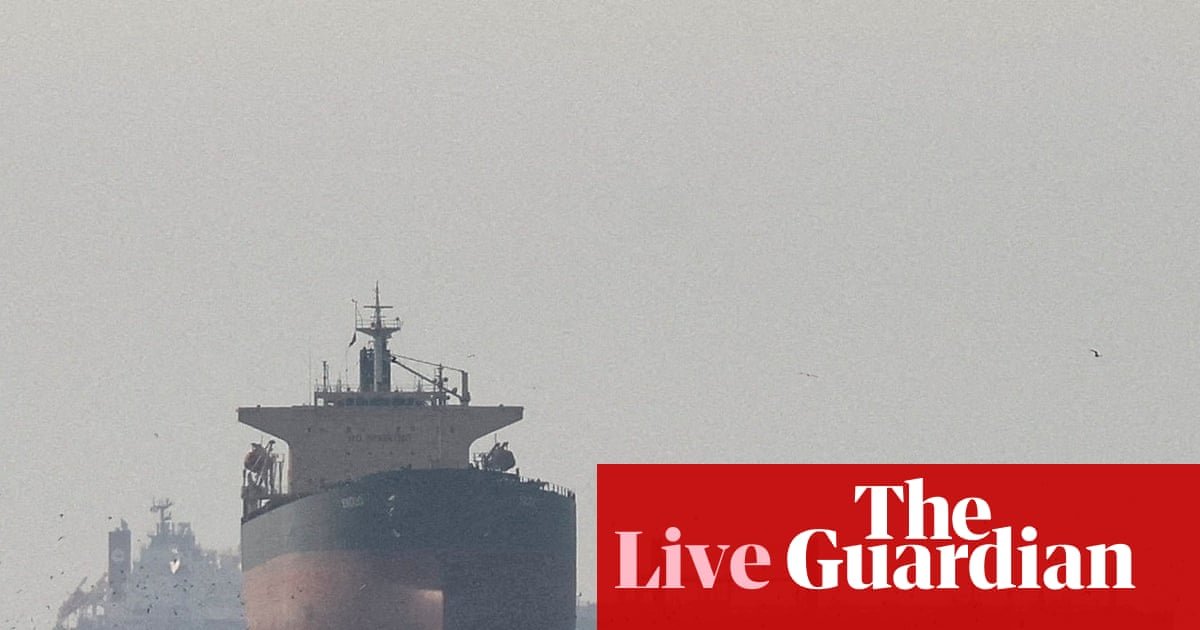
Iran has agreed to reopen the strait of Hormuz, where around 1,000 ships have been trapped. A senior Iranian official told Reuters Tehran could open the key shipping route on Thursday or Friday ahead of peace talks in Islamabad.
Brent crude, the international oil benchmark, has tumbled 15.5% to $92.28 a barrel, down nearly $17. As is stands, it is on track for its biggest daily drop since April 2020, the start of the Covid pandemic, when the price fell 24%.
UK gas prices have tumbled 18%, taking the May delivery contract 24.3p lower to 110.67p per therm.
Stock markets have rallied around the world, starting in Asia where Japan’s Nikkei leapt 5.4% and South Korea’s Kospi soared 7.5%. Over here, the FTSE 100 in London is 275 points, or 2.66% ahead at 10,623. Germany’s Dax jumped 5.2%. On Wall Street, stocks surged to one-month highs. The Dow Jones has gained 2.5% while the S&P 500 has risen 2.2% and the Nasdaq climbed 2.8%.
The dollar is on the backfoot, sliding 1.1% against a basket of currencies. Sterling gained 1.2% to $1.3451.
Government bond yields have plummeted around the world, as traders scaled back bets on interest rate hikes. In the UK, borrowing costs fell the most in three years, measured by the yield (or interest rate) on two-year gilts, as government bonds are known.
Bond yields are sensitive to inflation prospects and have closely tracked oil prices.
Our main stories today:
Thank you for reading. We’ll be back tomorrow. Take care (and enjoy the sunshine!) – JK
Share
Updated at 10.40 EDT
Ceasefire changes little for shipping in strait of Hormuz, experts say
There will be no “mass exodus” of ships through the strait of Hormuz, shipping analysts say, despite a two-week conditional ceasefire being agreed between the US and Iran with provision for the temporary reopening of the crucial maritime channel.
The ceasefire agreement “doesn’t change the situation in the sense that Iran is still in control”, said Richard Meade, the editor-in-chief at the maritime data provider Lloyd’s List Intelligence. “It still requires ships to essentially seek permission, and that’s the key. That means that nothing has changed – no permission, no transit.”
An estimated 2,000 ships and 20,000 seafarers have been trapped in the Gulf since the outbreak of war at the end of February, according to the UN, unable to pass through the strait to continue their journeys.
Share
IMF says ‘economic scars’ of war could take over a decade to recover from
Richard Partington
The International Monetary Fund has said the “economic scars” of war could take more than a decade to recover from, as it warned governments around the world will face hard choices to boost defence spending.
After the news of the Iran ceasefire, and ebullient reaction in financial markets, the IMF has published a timely report that could douse some of that enthusiasm.
Indicating that things could still take quite a while to patch together again, the fund notes the economic costs of war typically exceed those associated with financial crises or severe natural disasters. Economics scars also persist even a decade later.
double quotation markWhen conflict ends and gives way to a durable peace, economic recovery is possible, but it is neither automatic nor rapid.
Publishing a report ahead of its annual spring meetings in Washington next week, the IMF research based on conflicts since 1946 shows that “conflict site” countries – perhaps unsurprisingly – suffer particularly steep economic declines. But other countries can still feel the pain for a lengthy period of time afterwards.
While much of the scarring comes from the damage to infrastructure, human toll, and the financial repair job, the IMF also warns peacetime can be tougher to maintain after periods of conflict, depressing investment intentions amid the cloud of uncertainty.
In pre-released chapters of its World Economic Outlook report, due next week, it says economic output typically rebounds after the last bombs fall, but remains modest relative to wartime losses.
The IMF headquarters building in Washington. Photograph: Yuri Gripas/Reuters
The analysis is about wars generally. But passages of the report highlight the potential consequences of the uncertainty over the situation in the Middle East – which analysts reckon could cast a lasting shadow over the global economy.
double quotation markPersistent political and economic uncertainty despite peace can continue to depress expected returns on investment, sustain capital outflows, and constrain both investment and labor supply.
Meanwhile the fund warns governments face “hard choices” to raise spending on defence. Amid the clamour to do so, there are three choices: higher borrowing, tax hikes, or a “guns versus butter” trade-off involving cuts to social protection, health and education.
For the UK and other Nato members committed to spending 5% of GDP on defence by 2035, it is a sobering reminder that boosting defence spending is not as easy as some make it out to be.
The IMF also cautions that a defence boom does not automatically translate into an economic one. Nations which stimulate their domestic defence manufacturing capacity can benefit. But, typically, buying guns, ammo and associated kit involves boosting imports from places with existing capacity (NB: Mostly the US).
double quotation markNearly half of total arms revenue among the world’s top 100 arms-producing firms is generated in the United States, while Europe accounts for about 14% and China 12%. As a result, most countries import a large share of their military equipment, with this ratio as high as 80% for European Union member countries.
Share
Oil prices are still down 15%, while UK gas prices have tumbled 17%.
Brent crude, the global oil benchmark, slid $16.64 to $92.61 a barrel, at 15.4% drop – the biggest since April 2020, after the Covid-19 outbreak when lockdowns were declared around the world, sharply reducing oil consumption.
The UK’s natural gas contract for May delivery fell 22.95p to 112.05p per therm.
UK gas prices fall 17% UK gas prices fall 17%ShareLisa O’Carroll
While some ships are cautiously on the move in the Gulf making their way towards the Strait of Hormuz, communications on many remain either switched off or jammed, likely by Iran.
AXS Marine intelligence described disruption as “elevated” with “around 43% of vessels in the region are currently either not transmitting or broadcasting unreliable signals, compared to a pre-disruption baseline of around 17%”.
It measures the automatic identification signals that are transmitted by the shipping industry either to transponders on satellites or on shore.
Unreliable signals generally means the signal is being jammed by hostile actors.
Share
Travel shares surge, oil companies slump
Graeme Wearden
Travel stocks are leading the risers on Wall Street.
Cruise operator Carnival is leading the S&P 500 gainers, up almost 14%.
They’re followed by Southwest Airlines (+13.4%) and United Airlines (+13.4%).
But oil company stocks are sliding, following the plunge in crude prices today. Exxon Mobil are down 7.7%, and ConocoPhillips have lost 8.3%.
Share
Updated at 09.37 EDT
Wall Street jumps at the open
Graeme Wearden
The New York has joined the global relief rally, as traders on Wall Street cheer the US-Iran ceasefire.
The Dow Jones Industrial Average has surged by 1,325 points at the start of trading, up 2.85% to 47,909 points.
The broader S&P 500 index is up 2.5%, and the tech-focused Nasdaq 100 is up 3.5%.
Share
Updated at 09.37 EDT
Graeme Wearden
The Iran war will hurt Africa’s growth, and fan inflation across the continent, the World Bank is warning today.
The Washington-based lender cut its 2026 economic growth forecast for the region by 0.3 percentage points to 4.1%, Bloomberg reports. Inflation was seen rising 4.8% versus 3.8% previously expected.
The World Bank also pointed out that oil-importing nations including Kenya and Ethiopia potentially at the greatest risk.
It has also flagged that emerging and developing economies in Europe and Central Asia face a sharp slowdown this year, if the Middle East conflict leads to a large but temporary rise in energy prices.
Growth across the region is expected to slow to 2.1% in 2026, from 2.6% in 2025, and below a previous forecast of 2.2% growth.
Share
RSM: Ceasefire probably comes too late to avoid UK stagflation
Despite the ceasefire, UK inflation could still rise to double the Bank of England’s 2% target by the end of the year.
So warns Thomas Pugh, chief economist at audit, tax and consulting firm RSM UK, who points out that some economic damage has already been done:
double quotation mark“Even in a best case scenario it will take months for energy and other supply chains to return to anything resembling normal. At the same time, an elevated risk premium will remain in energy and commodity prices for a long time, reflecting the greater risk that hostilities restart. That is enough to avoid the worst case scenario of shortages and rationing in Europe, which would have caused a recession. But it still means that even though financial markets have rallied today, the economic damage will persist through this year.
“For the UK, the ceasefire probably comes too late to avoid another bout of stagflation. First, energy prices at current levels are still enough to push inflation to 3% by the end of the year. And the DMP and PMI surveys both suggest that firms are intending to pass on cost increases. If we add in indirect and second round effects from higher shipping and raw material costs, it is easy to get to inflation of around 3.5%-4.0% by the end of the year.
Share
Seafarer in the Gulf: We’ve not moved, and we’re not alone…
Jillian Ambrose
The US-Israeli ceasefire with Iran is unlikely to lead to a swift exit for the hundreds of oil and gas tankers trapped in the Gulf, according to shipping experts.
One seafarer, who is aboard an oil tanker stranded behind the strait of Hormuz, told the Guardian that shipping companies would require more certainty before they attempt to transit the strait.
They said:
double quotation mark“We’re at anchor, near dozens of loaded tankers. No-one has moved an inch.”
The seafarer said that bulk carriers, loaded with dry bulk such as cars and containers, had begun to move towards the Gulf but that major shipping companies would be unlikely to move oil and gas tankers without the go-ahead from insurance companies.
“No reputable company, with any links to EU countries, will risk moving without Lloyds and major insurers saying that they can,” they said.
“Transiting the strait will require more certainty; insurers will need to agree to insure these cargoes and there would need to be a better understanding of how to pay “toll fees” to a country which is still officially sanctioned,” they added.
It will take several days before the impact of the truce on shipping becomes clear, according to Torbjorn Soltvedt, an analyst at risk intelligence company Verisk Maplecroft.
Soltvedt said:
double quotation mark“Before the war, daily transits through the Strait of Hormuz exceeded 100 ships per day and any increase from the trickle of ships currently passing the strait is likely to be gradual.
“Two weeks will not be enough to clear the backlog even if there is a marked increase in traffic.”
ShareGraeme Wearden
Some food commodity prices are falling today, as the US-Iran ceasefire eases fears of further disruption to fertiliser shipments that could lead to lower crop yields.
The most-active wheat contract on the Chicago Board of Trade has fallen 3% to $5.80-1/4 a bushel, Reuters reported.
Corn was down more than 0.8% to $4.45-1/2 a bushel.
A UN report warned last week that food prices rose sharply in March as war in the Middle East drove up energy prices and freight costs around the world.
Share
Trump: 50% tariffs on countries supplying weapons to Iran
Graeme Wearden
Donald Trump is now threatening 50% tariffs on any country supplying weapons to Iran.
In a post on Truth Social, he writes:
double quotation markA Country supplying Military Weapons to Iran will be immediately tariffed, on any and all goods sold to the United States of America, 50%, effective immediately. There will be no exclusions or exemptions! President DJT
Share
