

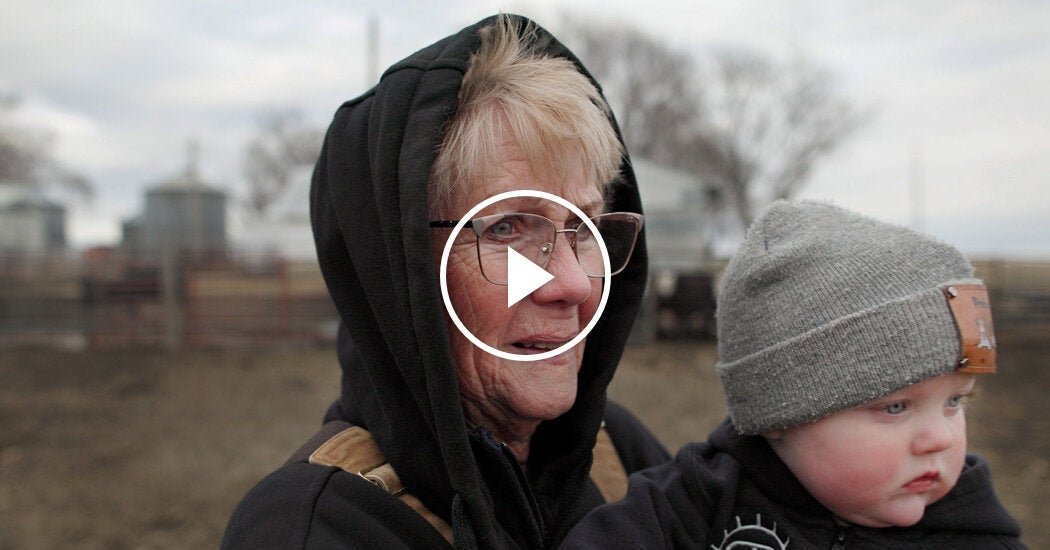
“When I saw the new fertilizer price, I’m like, holy crap. Talk about a kick to the gut.” Spring is here, which means it’s planting season in Iowa. For corn farmers preparing to sow their fields, the war with Iran couldn’t have come at a worse time. “So this is the fertilizer. So how much did the price of it go up after the war in Iran erupted?” “It went up about $250 a ton in my neck of the woods.” Iran’s closure of the Strait of Hormuz, a critical transit point for a third of the world’s fertilizer, sent the price soaring. The cost of two widely used nitrogen fertilizers shot up by 20 and 50 percent in the first few weeks of the war. A decade of inflation, low commodity prices and tariffs have squeezed Jolene Riessen’s profit margins. She’s now facing her toughest year yet as a farmer. “Every year is a risk when you farm. But this has kind of been compounding. Our prices have been low. And yet our input costs continue to ratchet up.” With the price of fertilizer already higher than last year, she put off buying until last month, hoping the price would go down. Then the war started and the opposite happened. With the window to plant closing, she had little choice but to buy at a high price. “For the amount of fertilizer I was going to buy, it had gone up about $13,000 in two days. What pot does that come out of? Fertilizer price, we can’t control. Fuel price, we can’t control. Where is it all going to end up? We don’t know.” “This is like the worst I’ve ever seen it. Gambling what our futures are going to look like.” Farmer Lance Lillibridge has been representing Iowa corn growers for 14 years. “The current conflict in Iran is hurting farmers everywhere in Iowa and across the country. If we’re not able to sustain our land with the nutrients that’s needed to grow a crop, then our yields are going to go down. Eventually going to drive up the price of corn, which is what we use to feed chickens, pigs and cattle, amongst other things. And eventually that is going to go back to the consumer at the grocery store.” While it may take some time for shoppers to see the price increase reflected in their groceries, Jolene’s costs continue to climb higher than what she makes for her corn. “This is the corn that we’ve been talking about.” “Yep.” At today’s price of corn, she could lose roughly $110 per acre across her 530 acres. “We just did the math. And so maybe looking at losing $58,000. So what am I going to do to negate that? I have never lost quite that much before.” Still, she has hoped the price of corn will go up this year to offset at least some of that loss. She keeps a close eye on its every move in the market. “Time to check the markets.” “How many times a day are you checking the prices?” “Sometimes you — Half-dozen times a day. And sometimes that isn’t enough. Now you know that at closing at 2 o’clock, they were, they were up 4 cents and now they’re down 2 cents. Which means that was a 6-cent move in the market. Crazy.” “And today, I’m promising to request additional farm relief for our great patriots in the next funding bill.” Last month, the Trump administration lifted sanctions on fertilizer sales from Belarus and Venezuela to try to ease the price surge and promised more aid to farmers. Still, Jolene is making hard calculations to stay on the farm that has been in her family for 85 years. “Those income sources could very well be selling some equipment. There’s a chance that there could be some ground sold. And then what are you left with? For some farmers, it’s a legacy. That’s my legacy that I’m selling. If it was up to me, the war would be done yesterday.”
Subscribe to Updates
Get the latest creative news from FooBar about art, design and business.
Trump Struck Iran. Now Farmers Are Paying the Price.
Previous Article‘If he’d stayed on the golf course, we’d be in a better place’: experts on Trump’s tariffs, one year on | Tariffs
Next Article Overthinking is rarely an advantage | Letter

Related Posts
Add A Comment