

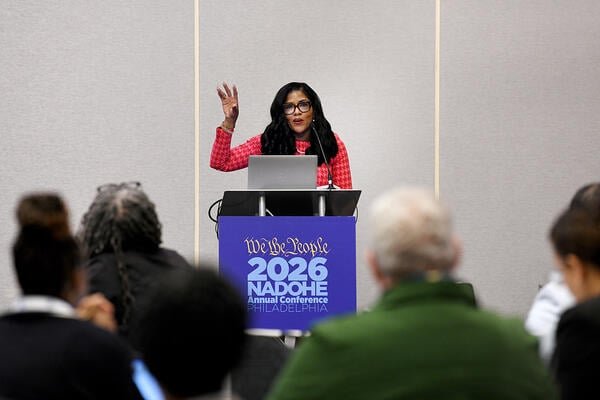
Diversity and leadership consultant Maurice A. Stinnett looked out at a room of 800 diversity, equity and inclusion officers last Thursday and made a hard ask.
“Who is responsible for being courageous in the face of adversity, even at the risk of job loss?” he called out.
“You and me,” the crowd shouted back.
“Who’s responsible for encouraging themselves and saying that I’m still going to carry on and do this work?”
“You and me.”
The impassioned speech kicked off the second day of the National Association of Diversity Officers in Higher Education conference, where diversity officers came together in Philadelphia to grieve and gather steam after a tumultuous year of rebranding and cuts to DEI offices, programs and jobs.
The mood at the event oscillated between mourning and celebration. Some sessions spoke directly to the unique political challenges of the moment, including talks on academic freedom and the “hollowing” of DEI infrastructure and its impact on students of color. Others offered a sense of normalcy, focusing on topics like best practices for campus climate surveys and techniques to support multilingual learners. And some activities aimed to deliver some plain old fun after a long year, including a musical performance by Philadelphia’s Mummers and a dance party on Thursday.
Speakers doubled down on a message of hope, telling beleaguered higher ed diversity officers that their efforts on campuses would continue, despite state bans and anti-DEI executive orders and crackdowns from the Trump administration.
“Political forces, forces that have never believed in the promise we are here to advance, have waged a sustained, coordinated and, at times, devastating campaign against the work and the people who do it,” Caroline Laguerre-Brown, NADOHE’s board chair, told the crowd.
She urged the room full of hundreds of attendees to take a moment of silence “for every colleague who has been forced out, every office that has been shuttered, every program that has been defunded and every student that lost a mentor, every institution that has lost its way,” but she ended it on a rallying cry that “NADOHE is not going anywhere,” to whoops and applause.
Emelyn dela Peña, NADOHE’s new president, struck a similar note, acknowledging that higher ed institutions face a “great deal of uncertainty” as they struggle “to interpret shifting legal guidance” and withstand political pressures. But she stressed that “the underlying goals of diversity work in higher education have not changed.”
“I also feel hope,” she said. “This isn’t the first time higher education and other sectors have faced backlash when expanding access and opportunity. Our field has always evolved in response to external pressures. The question isn’t whether the work continues but how it continues with clarity and integrity.”
NADOHE conference attendees listen to keynote speaker Maurice A. Stinnett.
Stinnett, one of the conference’s keynote speakers, urged continued action even in a political landscape where “progress almost feels impossible.”
“Transformation is possible. Action is not optional,” he told the cheering crowd. “Don’t keep showing up to NADOHE’s conference and go home and do nothing.”
But amid the calls for hope and perseverance, some participants also expressed worry their confidence would flag once back on their campuses.
One attendee said in a question-and-answer session with Stinnett that they felt “a rush of courage and strength” at NADOHE but that it’s harder for DEI officers to keep feeling courageous when they’re sometimes “the only one” bringing up equity issues at a time of heightened scrutiny and hostility.
“People are internalizing that in their body,” they said. “We’re getting breakdown. We’re getting burnout” and suffering from health issues like hypertension due to the stress. “How do we find that courage, where do we find the faith, to keep doing that without our bodies breaking down?”
DEI Evolving
Multiple presenters acknowledged that DEI work on campuses is changing—and would have to change to survive a tumultuous period of dried-up federal funding, shifting legal guidance, pressures to change curriculum and programming, and heightened government scrutiny.
Stinnett argued in his speech that the “language may need to shift slightly” without compromising the mission.
“In this evolving landscape, the cleverness and adaptability of the DEI practitioner will be vital,” he said. “By reframing the conversation and finding innovative ways to engage stakeholders, you can continue to champion diversity and inclusion, ensuring that the principles of equity remain at the forefront of higher education. But you’re going to have to be clever … You know this—I’m preaching to the choir.”
Several sessions touched on how diversity work on campuses might adjust and respond to the moment.
Chloe Poston, vice president of diversity, equity, inclusion and belonging initiatives at Davidson College in North Carolina, gave a talk on how to reframe diversity efforts to broaden support for them. She encouraged diversity officers to reach out to “the middle,” students and staff on campuses who are apathetic to diversity work or don’t understand how it affects their lives.
For example, she described meeting with campus employees, including white, blue-collar workers not especially interested in DEI, to get to know them and ask about their needs. She also said she held focus groups with conservative students after data, disaggregated by race, political affiliation and other characteristics, showed they were reticent to share their views on campus.
“You don’t need to change hearts and minds of your opponents,” Poston said. “You just need to make the work relevant to other people’s experiences.”
She also told diversity officers to emphasize how diversity practices serve values often touted by DEI opponents, like “meritocracy” and “intellectual diversity,” and to challenge critics to be spell out their concerns regarding diversity, equity and inclusion at an institution.
She acknowledged this may be harder in some states, but “I encourage you to push for specificity,” she said. “Ask exactly how your practices are exclusionary. Don’t allow a national narrative to be overlaid onto your campus.”
Other speakers, including Mike Gavin, president and CEO of the Alliance for Higher Education, encouraged similar outreach to those who are “complacent” or “persuadable.” But he also argued that colleges and universities shouldn’t bend on DEI initiatives under pressure from states or the Trump administration. He encouraged diversity officials to continue to put race “at the center” of their work.
He acknowledged that higher education has “work to do internally” but insisted institutions, rather than policymakers, identify the problems and ways to improve. “I’ve been in these meetings, you’ve been in these meetings, in the last five, six years where we start to say, ‘If we could just message it this way …’ No. We have to get out of that. It’s not a messaging problem. It’s an authoritarianism problem.”
