

As students from the City University of New York—the nation’s largest urban public university system—enter an uncertain labor market, a new initiative aims to dramatically expand access to paid internships and better connect college to careers.
CUNY Beyond, a systemwide effort to prioritize career exploration and outcomes, is scaling practices shown to improve students’ employment prospects across CUNY’s 25 campuses. A key piece of the strategy is recruiting professors to serve as career success fellows, who train other faculty members to embed career skills into the classroom, build relationships with employers and help students navigate internships and job pathways.
Jason Hendrickson, CUNY’s co-director of career-connected learning, said the goal is to help faculty understand hiring trends and employer expectations so they can better support students.
“We give faculty opportunities to exchange best practices, update syllabi and build courses that make career connections explicit,” Hendrickson said. “This helps students understand the why behind what they’re learning and how it applies beyond the classroom.”
That, in turn, makes it easier for students to translate those skills into the workplace, he added.
Early signs of impact: Early pilots at Lehman College and LaGuardia Community College offer a glimpse of the initiative’s potential: CUNY students who participate in paid internships are three times more likely to have a job at graduation, according to data from the system. At the same time, internship applications have risen sharply, increasing 59 percent at Lehman and 20 percent at LaGuardia.
Punita Bhansali, CUNY’s co-director of career-connected learning, said the work is often less about adding new content and more about making existing instruction more deliberate.
A lot of our faculty are already doing this work, but there’s a need for greater intentionality. If you’re teaching certain skills, are students even aware of it? Are you asking them to reflect on that? And are you showing them how to articulate those skills in interviews or on their résumé?”
—Punita Bhansali, CUNY’s co-director of career-connected learning
Faculty fellows are translating that approach into practice on their campuses—organizing career fairs, surveying students to gauge their understanding of career readiness and developing courses focused on professional skills, she added.
“We see faculty doing a range of innovative things, both inside and outside the classroom,” Bhansali said. “They’re serving as ambassadors on their campuses and focusing on what matters most in this space.”
Meeting student demand: Hendrickson said the initiative is, in part, a response to students asking for clearer connections between their coursework and careers.
“Students love it, students yearn for it,” Hendrickson said. “We understand the frustration of a student who comes out of a course and says, ‘Why am I taking this?’ And for our students at CUNY, that’s often a financial concern—they’re thinking, ‘This is just another course added to my tuition bill.’”
“It’s incumbent upon faculty to make clear career connections and applicability for their students,” he said.
Bhansali said student surveys back up that demand. Many undergraduates not only value career-connected learning but want more opportunities, including mock interviews and direct engagement with employers.
“Some of them even said, ‘I learned so much about how to solve problems critically, even when my emotions get in the way,’” Bhansali said. “So we’re hearing it impact them in a number of different ways.”
Lauren Andersen, vice chancellor for career engagement and industry partnerships at CUNY, said CUNY Beyond is particularly important given the system’s predominantly first-generation and lower-income student population.
“Students of color do not have as many opportunities—or do not participate at the same rate—in paid internships as their peers, and that is not a CUNY issue, that’s a national issue,” Andersen said. “We recognize that when opportunities are optional or seen as ancillary to the learning experience, it creates a barrier to student participation.”
Andersen added that many CUNY students work full- or part-time, making it difficult for them to leave a steady job to take on an internship, even if it could be a ladder to a more self-sustaining career. That’s why she believes this initiative is so important: It brings career exploration and guidance directly into the classroom, helping students connect their coursework to paid internships and future jobs.
“It became really important that students not view this as something off to the side, but that it be integrated into their education,” Andersen said. “Making it not optional—and designing it to account for the fact that not all students have the same access to opportunities—helps level the playing field.”
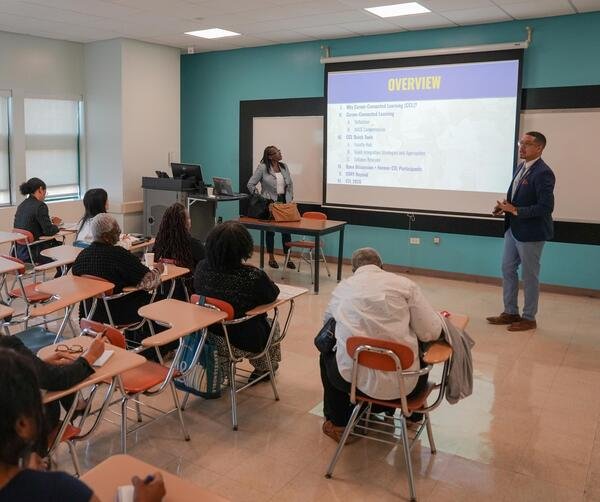
Jason Hendrickson and Punita Bhansali, CUNY’s co-directors of career-connected learning, leading a career success fellows faculty training.
Jermine Hodge/City University of New York
Addressing faculty resistance: Hendrickson said that any faculty apprehension about shifting their curriculum toward career-connected learning is understandable, especially in the current political climate.
“We understand the broader attacks on higher education and the thinly veiled attempts to frame workforce preparation as a threat to the liberal arts,” Hendrickson said. “CUNY Beyond predates the Trump administration, and much of our work has been reframing and reminding faculty that updating our pedagogy in response to the world we aim to improve is something we should be doing anyway.”
“A lot of faculty just need to be reminded that they’re already doing this work—it’s just that [CUNY Beyond] explicitly names and claims it,” he added.
Bhansali agreed, noting that faculty are increasingly seeing students respond positively when career connections are made explicit.
“This is about showing students all the doors that this can open for them, regardless of the discipline they choose,” Bhansali said.
Get more content like this directly to your inbox. Subscribe here.
