

The National Advisory Committee on Institutional Quality and Integrity has one fewer member after the Department of Education removed Joshua Figueira mere months into the role.
While ED did not explain why Figueira wasn’t at Tuesday’s meeting, one member accused the department of ousting him for breaking ranks in a leadership vote. Figueira’s absence was the first sign that partisan politics would seep into the meeting of what is meant to be a politically independent committee. Later in the discussion, members delved into an accreditor’s DEI standards and squabbled over who gets to set the meeting’s agenda.
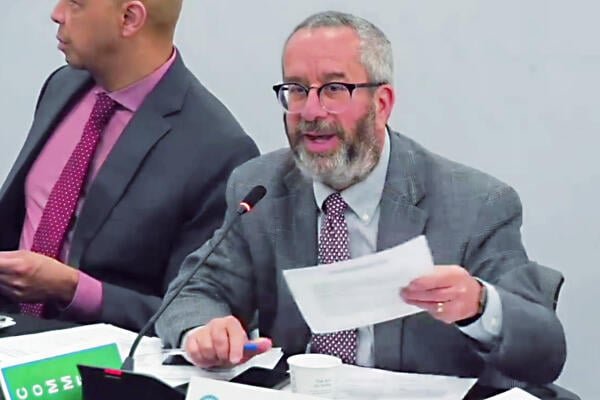
Figueira was appointed to NACIQI by Secretary of Education Linda McMahon in November. His removal from the board came to light at the onset of the meeting when Democratic appointee Bob Shireman accused the department of removing Figueira for voting against the election of current chair Jay Greene, also a McMahon appointee, at December’s meeting.
“It just so happens that the person who is not here is the one who did not vote for you for chair at the last meeting,” Shireman said to Greene at the start of Tuesday’s proceedings. “The Federal Advisory Committee Act says that advisory committee members are supposed to act with independent judgment and not be inappropriately influenced by the appointing authority.”
ED did not offer a public explanation for Figueira’s removal, nor did it deny the accusation that he had been removed for political reasons.
“The [education] secretary has broad discretion that is consistent with statute and long-standing practice across many federal agencies to ensure that NACIQI is positioned to effectively carry out its advisory responsibilities and support the department’s priorities,” David Barker, assistant secretary for postsecondary education, said in response to Shireman’s concerns. “The secretary is committed to assembling a body of members aligned with the urgent need to reform higher education, a system that is too often failing students and taxpayers.”
Shireman then pressed Barker to “assure the Department of Education appointees that they’re not going to be removed because they don’t vote in the way that you or the department want them to.” But Barker demurred and referred Shireman to the statement he had just made.
Department of Education officials did not respond to a request for comment from Inside Higher Ed about why or when Figueira was removed. Based on documents available in the Federal Register, Figueira appears to have been removed from NACIQI sometime between the end of the year and early March.
Figueira, general counsel for Brigham Young University–Idaho, was set to serve through 2031. Contacted by email, Figueira declined to comment.
DEI Examination
Later in the meeting, members turned their attention to a compliance report submitted by the Northwest Commission on Colleges and Universities. The report was initially on the consent agenda, meaning it would have been approved with little to no discussion. Instead, members spent more than 90 minutes on NWCCU, mostly around concerns about diversity, equity and inclusion, which the accreditor does not have as part of its standards.
“It’s been noted, I think correctly, that DEI, by itself, is not necessarily legal or illegal, lawful or unlawful—the devil is in the details,” said Adam Kissel, a Republican appointee who questioned whether a reference to closing racial gaps in completion rates ran afoul of civil rights law.
Kissel pointed to concerns about a requirement in NWCCU’s standards for member institutions to collect student outcomes data “disaggregated by race, ethnicity, age, gender, socioeconomic status, first generation college student, and any other institutionally meaningful categories that may help promote student achievement and close barriers to academic excellence and success (equity gaps).”
He flagged another standard that calls on members to “focus on equity and closure of equity gaps in achievement.” Such standards, he argued, may violate civil rights law by directing where institutions must steer their resources.
Kissel also read a statement from the accreditor about NWCCU’s commitment “to promoting diversity, equity, inclusion, belonging and social justice” within the organization and at its member institutions.
But NWCCU president Selena Grace pushed back. She said all “references to equity gaps are within each institution’s unique institutional mission and context” and members have “flexibility to determine how to disaggregate their data based on their institutional mission and context.” She also noted that the statement on social justice that Kissel referred to was never formal policy and was removed from NWCCU’s website in 2023.
As the conversation stretched on, frustrations became palpable.
Though a noticeably partisan shadow hung over the board meeting, Republican appointee Jennifer Blum raised concerns about the lengthy discussion on NWCCU’s compliance report. Blum noted that the committee had spent more than an hour and a half on a compliance report that ED staff had not raised concerns about and would have otherwise been quickly approved.
“It’s not you that gets to decide a new issue,” Blum said to her fellow committee member Kissel. “It’s the [senior department official] who brings the matter to the staff—the department staff—and the staff refers it to us. Adam, you don’t get to raise a new issue in this meeting—you could raise it with the department ahead of time.”
In response to Blum’s criticism, Kissel accused her of trying to stifle discussion. Pressed by Blum to provide a specific example of noncompliance, Kissel said, “I think we’re talking about systemic issues.”
Despite the lengthy discussion, NACIQI members approved NWCCU’s compliance report. NACIQI also accepted a compliance report for three programmatic accreditors and approved renewals of recognition for the American Board of Funeral Service Education, the Montessori Accreditation Council for Teacher Education and the Association of Institutions of Jewish Studies.
NACIQI meets again today for a policy discussion and to vote on additional renewals.
