

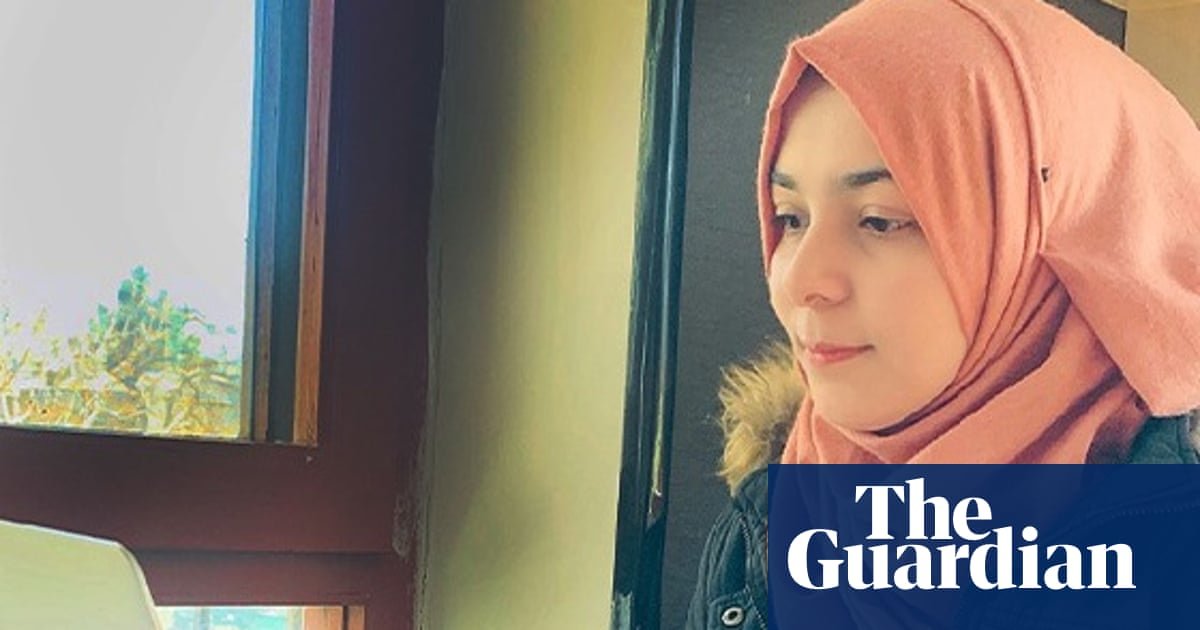
Shahira Sadat was thrilled. She had received an invitation to interview for the prestigious Chevening scholarship. “I cannot describe the joy I felt,” she says. “I was hopeful. I allowed myself to dream.” The scholarships are funded by the UK government, enabling future leaders from all over the world to pursue their studies in the UK – most often a one-year master’s degree – developing skills they can use in their home countries.
In recent years, under Taliban rule, Sadat’s home country of Afghanistan has become increasingly hostile to women and girls, and the mother-of-one’s recent career achievements have happened behind closed doors. She is a software engineer, with an interest in AI and how it might help reduce the education gender gap and the digital exclusion of young people of both genders. Her skills could help generations of Afghan women, including her own daughter.
After receiving three offers from UK universities, she poured everything she had into her scholarship application. “I rewrote my essays again and again. I asked for feedback, reviewed every sentence, refined every idea. I spent sleepless nights thinking about how to best represent my goals and my country.”
On 5 March she received a devastating email. Her Chevening application, including an interview scheduled for 9 March, could no longer be taken forward, due to the visa brake. “I was so shocked,” she says. “I cried and cried for hours and woke up the next morning with a bad headache because I had cried so much.”
The offers were withdrawn because of a surprise announcement earlier that week from the home secretary, Shabana Mahmood. This stated that study visas for students from four countries – Afghanistan, Cameroon, Myanmar and Sudan – are to be suspended. Mahmood considers that there has been abuse of the immigration system by some students from these countries, who have gone on to claim asylum in the UK.
There are other countries whose students come to the UK in much larger numbers – a proportion of whom also claim asylum after completing their studies – that are not facing a similar ban. A Home Office statement noted that asylum claims by students from Cameroon and Sudan “had spiked by more than 330%” before adding that this poses “an unsustainable threat to the UK’s asylum system”. However, while the percentage increase between Covid-era 2021 and 2025 is significant, the actual numbers are small – just a few hundred students. Nonetheless, Mahmood insists this “emergency brake” is necessary to control overall migration.
The women affected by the ban have always regarded the UK and its academic institutions as a beacon. In the world’s worst conflict zones, gifted young women study in hiding, swerving militias, earthquakes, power cuts, internet outages and the threat of starvation. Ironically, they want to study in the UK not to swell the country’s asylum figures, but so they can develop skills to help strengthen the fragile infrastructure back home, which may help reduce the number of people leaving these countries in future.
For Afghan women, says Sadat, “opportunities like Chevening are not just academic programmes – they are lifelines. They are rare doors that allow us to grow, to contribute and to remain connected to the world.”
Afra Elmahdi, a cancer specialist from Sudan.
Afra Elmahdi was floored by Mahmood’s announcement. A Sudanese dentist, she was looking forward to taking up a place at Oxford for an MSc in applied cancer science. Her research focuses on head and neck cancers, with a particular focus on oral cancers, researching saliva as a crucial biomarker for diagnosis and prognosis. As a clinician in Sudan, she has witnessed the human cost of late diagnosis, she says, and wants to address the cancer survival inequalities between developing and developed countries.
“We have applied for these scholarships while being displaced and surviving a war,” she says. “Although we have fulfilled all the universities’ requirements and got a yes, the Home Office is saying a bold, generalised and unjust no.”
Last year, Mariam* graduated from the University of Khartoum, in her home country of Sudan, with first class honours in planning. She was hoping to do her master’s in the field of the built environment, using her skills to help rebuild her war-torn country, and had been offered places at top universities, including University College London, the London School of Economics and the University of Manchester.
“This is the most difficult period Sudan has ever faced,” she says, “and for me, personally, the situation is fragile. We don’t have the resources for education right now and all the infrastructure is collapsing. I don’t have a plan B.
“I spent a long time writing a personal statement, obtaining and authenticating my certificates, and preparing a suitable CV. It took a lot of time and effort, because the internet network in my village is very bad.” She says Mahmood’s decision has “turned my life upside down. Now I will have to go back to square one.”
Sitara* from Afghanistan was entering her fifth year at medical school in Kabul when the Taliban took over and cut off university access for women. “It was like losing a part of my life,” she says. “My father works as a driver and he encouraged me to study medicine. I wanted to make my dad’s dream come true and to help people in my country, particularly women, who would often prefer to be treated by a female doctor, but they can’t, because there are so few.”
She applied to UK universities, hoping to finally qualify as a doctor. Now that dream is over.
“The Taliban don’t want girls to study, but now the UK is saying the same thing as the Taliban. All the doors have closed for us.”
Phyu Nwe Win, an economics student from Myanmar.
Like Sadat, Phyu Nwe Win, a master’s student in economics from Myanmar, had applied for the Chevening scholarship. She studies the relationship between economic development and women’s empowerment.
“Much of my work involves supporting young people,” she says, “particularly girls and adolescents, in areas such as leadership, gender equality, and sexual and reproductive health and rights.” Studying abroad has become one of the few ways young people in Myanmar can continue their education, she says.
Like all the other distraught students from the four banned countries, Sadat is hoping for an 11th-hour reprieve from the home secretary.
“This is not just a simple scholarship to a UK university – it is something life-changing,” she says. “I don’t want to do this just for me, but also for my daughter, to build a better future for her and all the other girls in my country.”
* Some names have been changed
