

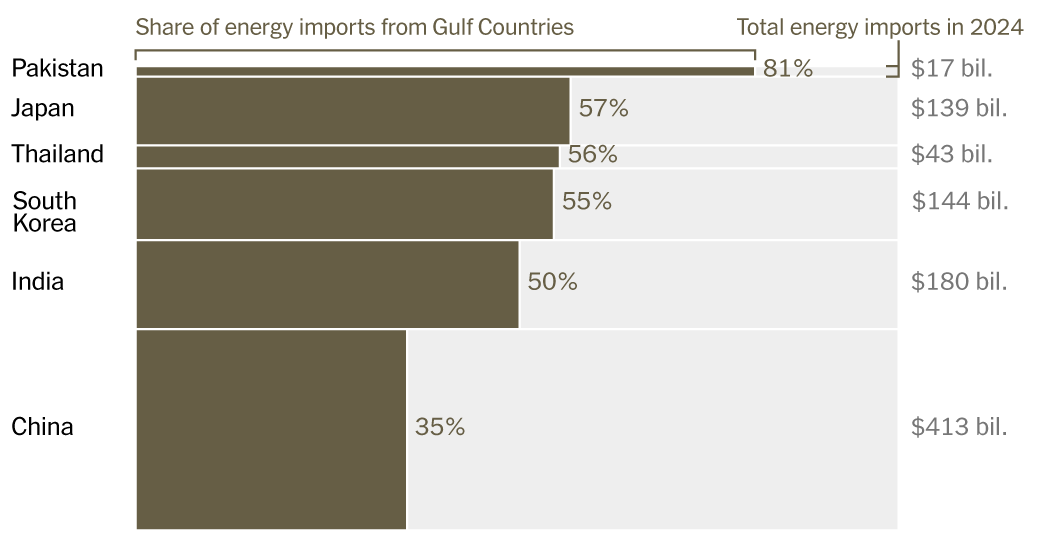
As the war in the Middle East halts most of the oil and gas trade from the region, countries thousands of miles away are feeling the pain of their energy supplies suddenly vanishing. Some are feeling the loss more acutely than others.
Asian countries are the biggest buyers of Persian Gulf energy
Pakistan
Share of energy imports from Gulf Countries
81%
Total energy
imports in 2024Total energy imports in 2024
$17 bil.
Japan
Share of energy imports from Gulf Countries
57%
Total energy imports in 2024
$139 bil.
Thailand
Share of energy imports from Gulf Countries
56%
Total energy imports in 2024
$43 bil.
South Korea
Share of energy imports from Gulf Countries
55%
Total energy imports in 2024
$144 bil.
India
Share of energy imports from Gulf Countries
50%
Total energy imports in 2024
$180 bil.
Maldives
Share of energy imports from Gulf Countries
42%
Total energy imports in 2024
$774.1 mil.
Taiwan
Share of energy imports from Gulf Countries
40%
Total energy imports in 2024
$47 bil.
China
Share of energy imports from Gulf Countries
35%
Total energy imports in 2024
$413 bil.
Sri Lanka
Share of energy imports from Gulf Countries
33%
Total energy imports in 2024
$4 bil.
Malaysia
Share of energy imports from Gulf Countries
29%
Total energy imports in 2024
$44 bil.
Singapore
Share of energy imports from Gulf Countries
27%
Total energy imports in 2024
$86 bil.
Philippines
Share of energy imports from Gulf Countries
26%
Total energy imports in 2024
$16 bil.
Israel
Share of energy imports from Gulf Countries
19%
Total energy imports in 2024
$3 bil.
Brunei
Share of energy imports from Gulf Countries
16%
Total energy imports in 2024
$5 bil.
Myanmar
Share of energy imports from Gulf Countries
16%
Total energy imports in 2024
$5 bil.
Indonesia
Share of energy imports from Gulf Countries
15%
Total energy imports in 2024
$35 bil.
Armenia
Share of energy imports from Gulf Countries
10%
Total energy imports in 2024
$535.9 mil.
Turkey
Share of energy imports from Gulf Countries
7%
Total energy imports in 2024
$26 bil.
Hong Kong
Share of energy imports from Gulf Countries
5%
Total energy imports in 2024
$12 bil.
Uzbekistan
Share of energy imports from Gulf Countries
<1%
Total energy imports in 2024
$2 bil.
Kazakhstan
Share of energy imports from Gulf Countries
<1%
Total energy imports in 2024
$628 mil.
Yemen
Share of energy imports from Gulf Countries
<1%
Total energy imports in 2024
$23.5 mil.
Azerbaijan
Share of energy imports from Gulf Countries
<1%
Total energy imports in 2024
$2 bil.
Kyrgyzstan
Share of energy imports from Gulf Countries
<1%
Total energy imports in 2024
$1 bil.
Jordan
Share of energy imports from Gulf Countries
<1%
Total energy imports in 2024
$641 mil.
Cambodia
Share of energy imports from Gulf Countries
<1%
Total energy imports in 2024
$3 bil.
Syria
Share of energy imports from Gulf Countries
<1%
Total energy imports in 2024
$131.2 mil.
Bangladesh
Share of energy imports from Gulf Countries
<1%
Total energy imports in 2024
$7 bil.
In 2024, nearly 21 million barrels of oil a day crossed through the Strait of Hormuz, the narrow passageway connecting the Persian Gulf to the world. Four-fifths of that supply went to Asia.
China has long been the biggest purchaser of oil and gas from Persian Gulf nations. And with more than a third of its total supply coming from the region, the disruption is significant for Beijing. But other countries are almost entirely reliant on the region for their energy needs.
Pakistan has considered imposing a four-day workweek, and remote school and work, in order to preserve energy stockpiles. A state-led fund in Thailand, to subsidize the cost of fuel when prices surge, plunged into a deficit this month.
In India, where the economy depends on the Middle East for roughly 40 percent of the country’s oil imports and 80 percent of its gas, a shortage of cooking gas is squeezing households. And across Asia, fliers are being stranded because airlines running low on jet fuel have canceled thousands of flights.
Europe has been more insulated, sort of
Greece
Share of energy imports from Gulf Countries
36%
Total energy
imports in 2024Total energy imports in 2024
$19 bil.
Lithuania
Share of energy imports from Gulf Countries
32%
Total energy imports in 2024
$7 bil.
Poland
Share of energy imports from Gulf Countries
30%
Total energy imports in 2024
$28 bil.
Serbia
Share of energy imports from Gulf Countries
29%
Total energy imports in 2024
$2 bil.
Bulgaria
Share of energy imports from Gulf Countries
23%
Total energy imports in 2024
$5 bil.
Slovenia
Share of energy imports from Gulf Countries
23%
Total energy imports in 2024
$4 bil.
Italy
Share of energy imports from Gulf Countries
22%
Total energy imports in 2024
$50 bil.
Albania
Share of energy imports from Gulf Countries
22%
Total energy imports in 2024
$931.9 mil.
France
Share of energy imports from Gulf Countries
18%
Total energy imports in 2024
$73 bil.
Ireland
Share of energy imports from Gulf Countries
14%
Total energy imports in 2024
$6 bil.
Iceland
Share of energy imports from Gulf Countries
13%
Total energy imports in 2024
$1 bil.
U.K.
Share of energy imports from Gulf Countries
11%
Total energy imports in 2024
$62 bil.
Netherlands
Share of energy imports from Gulf Countries
10%
Total energy imports in 2024
$105 bil.
Spain
Share of energy imports from Gulf Countries
9%
Total energy imports in 2024
$53 bil.
Romania
Share of energy imports from Gulf Countries
8%
Total energy imports in 2024
$8 bil.
Denmark
Share of energy imports from Gulf Countries
8%
Total energy imports in 2024
$6 bil.
Ukraine
Share of energy imports from Gulf Countries
7%
Total energy imports in 2024
$8 bil.
Austria
Share of energy imports from Gulf Countries
7%
Total energy imports in 2024
$10 bil.
Germany
Share of energy imports from Gulf Countries
7%
Total energy imports in 2024
$66 bil.
Norway
Share of energy imports from Gulf Countries
5%
Total energy imports in 2024
$5 bil.
Portugal
Share of energy imports from Gulf Countries
5%
Total energy imports in 2024
$10 bil.
Moldova
Share of energy imports from Gulf Countries
4%
Total energy imports in 2024
$1 bil.
Cyprus
Share of energy imports from Gulf Countries
4%
Total energy imports in 2024
$3 bil.
Belgium
Share of energy imports from Gulf Countries
4%
Total energy imports in 2024
$47 bil.
Latvia
Share of energy imports from Gulf Countries
3%
Total energy imports in 2024
$2 bil.
Sweden
Share of energy imports from Gulf Countries
3%
Total energy imports in 2024
$18 bil.
Finland
Share of energy imports from Gulf Countries
3%
Total energy imports in 2024
$10 bil.
Estonia
Share of energy imports from Gulf Countries
2%
Total energy imports in 2024
$1 bil.
North Macedonia
Share of energy imports from Gulf Countries
2%
Total energy imports in 2024
$902.7 mil.
Croatia
Share of energy imports from Gulf Countries
1%
Total energy imports in 2024
$6 bil.
Switzerland
Share of energy imports from Gulf Countries
<1%
Total energy imports in 2024
$8 bil.
Bosnia and Herzegovina
Share of energy imports from Gulf Countries
<1%
Total energy imports in 2024
$1 bil.
Slovakia
Share of energy imports from Gulf Countries
<1%
Total energy imports in 2024
$4 bil.
Europe has traditionally been less reliant on the Gulf than Asia has been. It used to get most of its natural gas from Russia, but in recent years it has relied more on the United States and Norway. But the continent has had to endure one energy crisis after another in recent years, including from Russia’s war with Ukraine and the Western sanctions that followed.
Russia is the world’s third-largest producer of oil and second-largest producer of gas, and the sales of its energy products have been significantly restricted while Moscow continues its invasion of Ukraine.
This current crisis comes as European countries, confronting lackluster economic output, try to rebuild their industrial bases and fend off competition from cheaper Chinese exports.
Confronted with soaring prices since its attack with Israel on Iran, the United States temporarily lifted sanctions on Russian oil that is currently at sea, hoping to ease the global supply and markets in the process. The European Union has not made similar moves.
Parts of Africa will be hit hard
Seychelles
Share of energy imports from Gulf Countries
98%
Total energy
imports in 2024Total energy imports in 2024
$308.6 mil.
Mauritania
Share of energy imports from Gulf Countries
76%
Total energy imports in 2024
$973.5 mil.
Uganda
Share of energy imports from Gulf Countries
61%
Total energy imports in 2024
$2 bil.
Mauritius
Share of energy imports from Gulf Countries
56%
Total energy imports in 2024
$1 bil.
Kenya
Share of energy imports from Gulf Countries
55%
Total energy imports in 2024
$5 bil.
Egypt
Share of energy imports from Gulf Countries
45%
Total energy imports in 2024
$16 bil.
Zambia
Share of energy imports from Gulf Countries
45%
Total energy imports in 2024
$2 bil.
Namibia
Share of energy imports from Gulf Countries
38%
Total energy imports in 2024
$1 bil.
Malawi
Share of energy imports from Gulf Countries
38%
Total energy imports in 2024
$476.1 mil.
South Africa
Share of energy imports from Gulf Countries
33%
Total energy imports in 2024
$18 bil.
Tanzania
Share of energy imports from Gulf Countries
30%
Total energy imports in 2024
$5 bil.
Morocco
Share of energy imports from Gulf Countries
29%
Total energy imports in 2024
$8 bil.
Mozambique
Share of energy imports from Gulf Countries
24%
Total energy imports in 2024
$2 bil.
Madagascar
Share of energy imports from Gulf Countries
19%
Total energy imports in 2024
$841.3 mil.
Zimbabwe
Share of energy imports from Gulf Countries
16%
Total energy imports in 2024
$2 bil.
Senegal
Share of energy imports from Gulf Countries
13%
Total energy imports in 2024
$4 bil.
Nigeria
Share of energy imports from Gulf Countries
12%
Total energy imports in 2024
$13 bil.
Benin
Share of energy imports from Gulf Countries
6%
Total energy imports in 2024
$398.4 mil.
Angola
Share of energy imports from Gulf Countries
4%
Total energy imports in 2024
$2 bil.
Burkina Faso
Share of energy imports from Gulf Countries
4%
Total energy imports in 2024
$2 bil.
Tunisia
Share of energy imports from Gulf Countries
2%
Total energy imports in 2024
$3 bil.
Cote d’Ivoire
Share of energy imports from Gulf Countries
2%
Total energy imports in 2024
$4 bil.
Central African Republic
Share of energy imports from Gulf Countries
1%
Total energy imports in 2024
$196.7 mil.
Gambia
Share of energy imports from Gulf Countries
<1%
Total energy imports in 2024
$206.6 mil.
Niger
Share of energy imports from Gulf Countries
<1%
Total energy imports in 2024
$113.6 mil.
Lesotho
Share of energy imports from Gulf Countries
<1%
Total energy imports in 2024
$214.4 mil.
Cameroon
Share of energy imports from Gulf Countries
<1%
Total energy imports in 2024
$424.4 mil.
Libya
Share of energy imports from Gulf Countries
<1%
Total energy imports in 2024
$4 bil.
African nations, like many other countries in the global south, could feel the disruption unevenly. Seychelles, the island nation off the east coast of Africa, imported almost all of its energy from Gulf states in 2024. Mauritius has had a similar reliance, while Nigeria, an oil-rich state and a member of the OPEC Plus oil cartel, has traditionally imported relatively few fossil fuels from the Middle East.
But as the war continues, the impact is being felt beyond the imports of oil and gas. The Persian Gulf is a dominant source of fertilizer, partly because the region’s abundance of energy has spurred the development of factories that make the raw materials for many types of agricultural chemicals.
A sustained rise in the cost of fertilizer could force governments in South Asia and sub-Saharan Africa to subsidize the cost of growing crops or otherwise watch food prices climb. That could add to debt burdens afflicting many lower-income countries.
The Americas and elsewhere are feeling broader economic shocks
Argentina
Share of energy imports from Gulf Countries
16%
Total energy
imports in 2024Total energy imports in 2024
$3 bil.
Brazil
Share of energy imports from Gulf Countries
13%
Total energy imports in 2024
$28 bil.
United States
Share of energy imports from Gulf Countries
10%
Total energy imports in 2024
$233 bil.
Paraguay
Share of energy imports from Gulf Countries
9%
Total energy imports in 2024
$2 bil.
Canada
Share of energy imports from Gulf Countries
5%
Total energy imports in 2024
$31 bil.
Uruguay
Share of energy imports from Gulf Countries
4%
Total energy imports in 2024
$1 bil.
Australia
Share of energy imports from Gulf Countries
2%
Total energy imports in 2024
$37 bil.
Dominican Republic
Share of energy imports from Gulf Countries
<1%
Total energy imports in 2024
$5 bil.
Guatemala
Share of energy imports from Gulf Countries
<1%
Total energy imports in 2024
$4 bil.
Chile
Share of energy imports from Gulf Countries
<1%
Total energy imports in 2024
$13 bil.
Fiji
Share of energy imports from Gulf Countries
<1%
Total energy imports in 2024
$888.1 mil.
Peru
Share of energy imports from Gulf Countries
<1%
Total energy imports in 2024
$9 bil.
Honduras
Share of energy imports from Gulf Countries
<1%
Total energy imports in 2024
$2 bil.
Ecuador
Share of energy imports from Gulf Countries
<1%
Total energy imports in 2024
$5 bil.
Colombia
Share of energy imports from Gulf Countries
<1%
Total energy imports in 2024
$6 bil.
El Salvador
Share of energy imports from Gulf Countries
<1%
Total energy imports in 2024
$2 bil.
Costa Rica
Share of energy imports from Gulf Countries
<1%
Total energy imports in 2024
$2 bil.
New Zealand
Share of energy imports from Gulf Countries
<1%
Total energy imports in 2024
$6 bil.
Mexico
Share of energy imports from Gulf Countries
<1%
Total energy imports in 2024
$34 bil.
Belize
Share of energy imports from Gulf Countries
<1%
Total energy imports in 2024
$235.5 mil.
Bolivia
Share of energy imports from Gulf Countries
<1%
Total energy imports in 2024
$2 bil.
Nicaragua
Share of energy imports from Gulf Countries
<1%
Total energy imports in 2024
$1 bil.
Barbados
Share of energy imports from Gulf Countries
<1%
Total energy imports in 2024
$552.3 mil.
The United States is the world’s largest producer of oil and gas. That means the impact of halting the energy trade from the Middle East is much less severe.
But the United States and other countries in the region that do not import great quantities from the Gulf are still feeling economic strain. The jump in oil prices – to over $100 a barrel in recent weeks – has already weighed on other major economic factors.
The cost of gasoline has jumped by about a dollar a gallon nationally since the war began. American airlines have begun to cut flights because of fuel costs. Concerns about inflation have pushed mortgage rates to their highest level in three months, just weeks after they fell below 6 percent for the first time since 2022.
If the war drags on, or if oil and gas prices continue to rise, the damage will most likely grow, economists say. It is perhaps one reason why the White House has forcefully insisted that it does not need Middle Eastern oil — and is increasingly trying to use military force to stop Iran’s blockade of it.
Methodology
To calculate total energy imports for each country, The New York Times used 2024 international trade data from the Observatory for Economic Complexity and tallied the value of imports for a subset of energy-related goods. A share of imports from Gulf countries was then calculated from that subset.
The Gulf countries included are: Kuwait, Iraq, Bahrain, Qatar, the United Arab Emirates, Saudi Arabia and Iran.
The categories used were: crude petroleum oils (HS 270900), bituminous petroleum distillates (HS 271000), liquefied natural gas (HS 271111), liquefied propane (HS 271112), liquefied butanes (HS 271113) and liquefied petroleum gases (HS 271119).
