

During his senior seminar at Kalamazoo College, Hollis Masterson was given an assignment to interview someone whose political views sharply differed from his own. For Masterson, a self-described social democrat, the outcome surprised him.
The political science and history major spoke with a classmate’s father, a libertarian who has consistently voted for libertarian presidential candidates. What began as an exercise in disagreement led to something more nuanced: a discussion that covered not only points of contention, but also areas of common ground.
“We had a lot of commonalities about human nature, and I found him to be incredibly realistic,” Masterson said. They disagreed on the value of public versus private education but found agreement on international security and the extent to which the U.S. should play a role on the world stage.
“I’m very rarely pulled towards optimism, and if I am, usually there’s something that quickly shuts that down,” he said. “[This assignment] showed me that many of the individuals in the middle have a lot of agreements, but they’re pulled by people on far opposite sides toward thinking that there’s really not much we have in common.”
The assignment was one of several in the senior seminar course that treats civil discourse as a skill students can actively practice. In the class, students engage in structured conversations around contentious issues, learning techniques for listening closely and navigating disagreement without shutting down dialogue.
Justin Berry, associate professor of political science at Kalamazoo, said many students walk away from the course—particularly after interviewing someone with different political views—rethinking how they engage with opposing viewpoints.
“It really became the backbone of the class,” Berry said. “The conversations that [students] engaged in—I mean, I asked them initially to be 30 minutes to an hour, and some of them ended up being multiple sessions for multiple hours.”
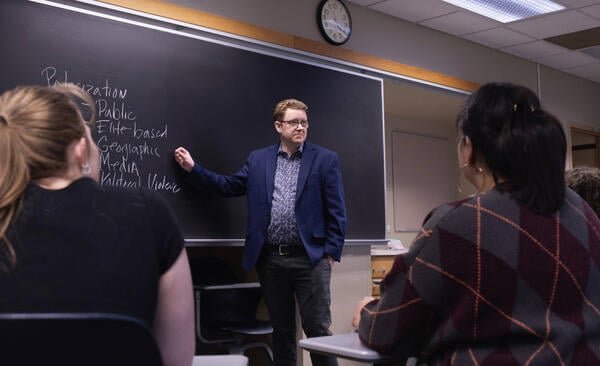
Over the term, Berry asks students to examine the forces driving political polarization in the United States—from widening divides among elected officials and the public to the role social media plays in reinforcing those differences.
“Some scholars talk about the need for civil disagreement, but this course talks about civil agreement,” Berry said. “This generation hasn’t really been taught how to disagree in a way that demonstrates understanding and respect for the person they’re engaging with.”
Civil discourse into practice: As polarization intensifies nationwide, other colleges are also experimenting with ways to help students engage constructively across differences.
At the City University of New York, students, faculty and staff participate in the Constructive Dialogue Initiative, which equips participants with practical skills to lead respectful conversations. The training takes multiple forms, from stand-alone student courses to first-year seminars and faculty development workshops.
Similarly, the University of Denver launched the Compassion Lab, which began as a single course and has since expanded into an opt-in program for faculty and staff. Its lessons now appear across disciplines—from political science and business classes to residential assistant training—emphasizing skills employers increasingly value, including empathy, communication and the ability to navigate conflict.
A key component of the Kalamazoo course involves analyzing the most recent election cycle using a range of sources. Through guided dialogue and interviews, students practice communicating across political divides.
Berry said the assignments often challenge students’ assumptions about people with opposing views.
“I saw in the interviews that students went in with a lot of misperceptions about the people they were interviewing,” Berry said. “There were times when they chose somebody because they thought they would have radically different political beliefs, but in some cases, students actually had to change who they interviewed because they agreed with everything they said.”
“I ultimately feel that, based on how politics operates now and how sorted we are in our media chambers, we’re just not talking to people we disagree with,” he added. “The only way to get at that is to actually practice it.”
Students at Kalamazoo College learn techniques for listening closely and navigating disagreement without shutting down dialogue.
Preparing for a divided world: Berry said the lessons students learn are more than an academic exercise—they help prepare them to navigate a fractured political climate, both nationally and in their own communities.
“There’s a lot of fear among colleges and universities right now, rightfully so, when it comes to getting involved in political conversations,” Berry said. “I understand the risk, but this is exactly the moment when colleges and universities need to be at the forefront of these difficult conversations.”
Masterson noted that engaging in such conversations has helped him become not only a better student but also a more rational person.
“If you want to become a better informed citizen, you have to reckon with the fact that people have different opinions than your own,” he said.
Get more content like this directly to your inbox. Subscribe here.
