

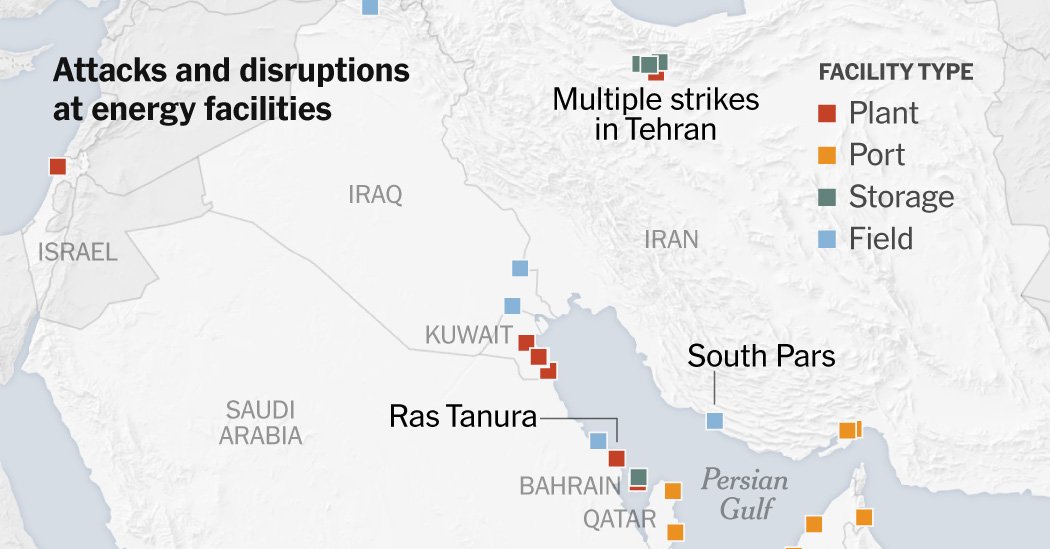
Which sites have been damaged
Multiple strikes
in Tehran
At least 37 energy oil refineries, natural gas fields and other energy sites in nine countries have been damaged since the United States and Israel began bombarding Iran, a New York Times analysis found. Some have been struck by drones. Several have been hit more than once.
As the attacks escalate, both sides increasingly view energy as a potent target — one that is capable of inflicting severe economic pain. Iran depends on oil and natural gas to keep the lights on and its government running, while the United States wants to prevent prices from soaring further and damaging the underpinnings of the global order.
The question is no longer just when Iran’s tight grip on the Strait of Hormuz, a narrow but critical passage on its southern coast, will ease enough for most ships to pass. It is also how long it will take to complete repairs needed to produce and process oil and natural gas in the first place.
“The longer this war goes on, the more likely it is that the two sides are going to play their strongest energy-leverage cards,” said Clayton Seigle, an energy expert at the Center for Strategic and International Studies, a Washington research group. “The attacks on facilities are not easily reversible.”
To count the number of attacks and disruptions at energy facilities in the region, The New York Times reviewed statements from government, state-run and private energy companies. The Times also reviewed lists compiled by ClearView Energy Partners and the Institute for the Study of War, two research firms, and subsequently verified their findings.
Through Friday, The Times had found a total of 45 attacks, though there is no official accounting and more may have occurred. Strikes occur seemingly every day.
Jebel Ali Port. Attacked on March 1.
Ras Tanura Refinery. Attacked multiple times.
Fujairah. Attacked multiple times.
Fardis oil storage facility. Attacked on March 7.
The importance of energy in the war became even clearer after Israel struck facilities tied to Iran’s South Pars gas field on Wednesday. Iran responded by lashing out across the Gulf. At least 10 sites were damaged this week, The Times found, including an energy hub in Qatar, as well as oil refineries in Kuwait, Saudi Arabia and Israel.
The various attacks sent oil and natural gas prices soaring as traders worried that much of the Gulf’s energy could remain effectively landlocked for a while, possibly months. Brent crude, the international oil benchmark, briefly topped $119 a barrel on Thursday morning before retreating. Oil fetched less than $73 a barrel before the war started on Feb. 28, a price that reflected the possibility of a war.
“It’s been the cumulative effect that’s really driven this crisis,” said Raad Alkadiri, a Washington-based political risk analyst who specializes in energy and the Middle East.
While oil has been front and center, analysts are especially concerned about the damage to the world’s largest natural-gas export terminal, called Ras Laffan, on Qatar’s coast.
The sprawling facility, which is operated by the state-owned QatarEnergy company, cools natural gas into liquid that can be loaded onto tankers and shipped. But Qatar said on the third day of the war that it had stopped producing liquefied natural gas, citing military attacks.
This week’s strikes caused further damage, compromising 17 percent of the country’s L.N.G. export capacity, QatarEnergy said on Thursday, adding that repairing the damage could take up to five years.
There is no easy replacement for that fuel, which is used to generate electricity and heat homes. And there is little spare L.N.G. capacity in other countries.
Other points of vulnerability include the oil export terminals where the United Arab Emirates and Saudi Arabia are rerouting oil to avoid the Strait of Hormuz. One of those areas, in the Emirates, was targeted as recently as this week. A refinery near the other, in Saudi Arabia, was also hit by a drone.
“It could become a lot worse if the craziness continues to prevail,” said Charif Souki, a former chief executive of Houston-based Cheniere Energy, a large L.N.G. company. “But there are so many people who have a vested interest in not letting it get too far out of hand.”
Indeed, countries around the world have agreed to release oil from emergency stores to stem rising prices. The U.S. military is also attacking Iranian vessels and drones to try to clear the Strait of Hormuz, and the Trump administration said it would lift sanctions on Iranian oil to nudge prices down.
In many cases, it is hard to know how severe the damage has been to a facility.
As Kevin Book, managing director of ClearView Energy Partners put it, “The last thing they probably want to do is tell Iran, ‘You missed me, try again.’”
Even when companies have been more forthcoming, their disclosures have sometimes only raised more questions.
Mr. Souki said he was surprised to hear that QatarEnergy expected it would take up to five years to repair its L.N.G. facilities. “I think he’s hedging his bets at the moment,” Mr. Souki said, referring to QatarEnergy’s chief executive. “You can always give good news later.”
