

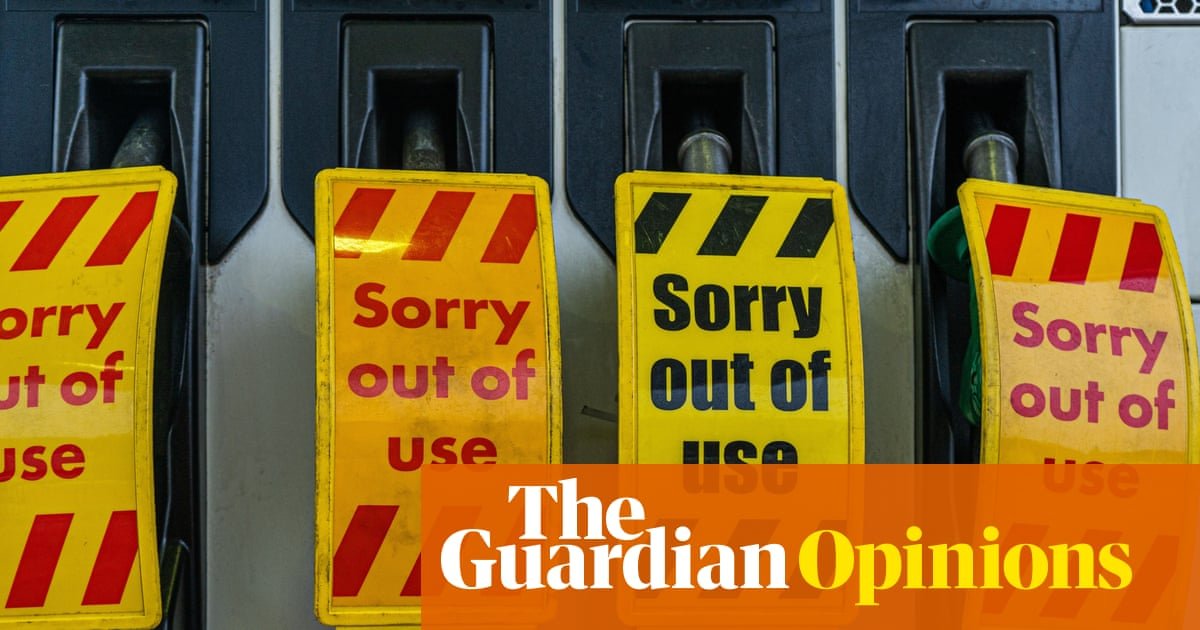
Seventy years ago this winter, the streets of Britain fell eerily quiet. After one last panic buying spree, many garages shut, and traffic even in the heart of London dwindled away. The formal introduction of petrol rationing had begun, limiting drivers to 200 miles’ worth a month – with exceptions for farmers, doctors and vicars – after the Suez crisis blocked fuel supplies from the Gulf.
Ancient history now, of course – or it would be if it weren’t for what looks increasingly like the US’s own version of Suez: a great power starting a war it seemingly doesn’t know how to finish, against an enemy it woefully underestimated. If the strait of Hormuz – the vital shipping lane now rendered unsafe for shipping by Iranian drones and mines – cannot soon be reopened, then Britain could be only weeks away from needing to ration fuel, the former BP executive (and government adviser) Nick Butler warned on Monday morning.
Since nothing guarantees the panic buying of petrol like the fear that other idiots might soon start panic buying petrol, he may not be thanked in Whitehall for mentioning something that hopefully will never come to pass. But Butler was only stating the obvious: if this crisis goes on long enough to create a physical shortage of oil, then critical users like the emergency services would have to be prioritised somehow, and other countries are already being forced into drastic steps. Pakistan has closed schools and put government offices on a four-day week, Vietnam is urging people to work from home, and Bangladesh has stationed soldiers at fuel depots after bringing in rationing for motorcyclists.
That the man who caused this crisis is now demanding Nato members bail him out of it, threatening a “very bad future” for the alliance he has so often rubbished if it doesn’t take on the dangerous task of clearing the strait, elicits open scorn in Europe. “What does Donald Trump expect from a handful of European frigates in the strait of Hormuz that the mighty US navy cannot manage alone?” asked Germany’s defence minister, Boris Pistorius.
But sending our mine-hunting drones to the Gulf probably beats the alternative, if that is global economies grinding to a halt. A sustained energy crisis could push up average British household energy bills by £500, the Resolution Foundation thinktank calculates, while swelling the price of anything – from food to clothes – produced or transported using fossil fuels. And we have all had enough inflationary shocks lately to know what usually comes next: a backlash against incumbents and a shot in the arm for populists, even though we arguably wouldn’t be here had the US not put one in the White House.
Nigel Farage and Kemi Badenoch were both initially gung-ho for this ill-considered war, and shouldn’t be allowed to forget that now Trumpflation is upon us. But it’s not just rightwing parties who are poised to benefit from the feeling that life is just one permanent rolling cost-of-living crisis that nobody seems to know how to fix: the Greens are now in contention too.
Will Iran war make the UK cost of living crisis worse? – The Latest
What matters most is for the government not to look helpless in the face of potentially overwhelming events. Rachel Reeves was commendably quick out of the blocks with help for the 1.7 million mostly rural households reliant on oil for heating and hot water, whose bills doubled almost overnight when the bombs started falling. If petrol prices are still high by autumn, expect her to dump the planned September hike on fuel duty too.
But her warning that financial help is likely to be targeted on lower earners this time, not doled out to both rich and poor as it was when bills spiked after the Ukraine war, nods to harder decisions ahead if the Gulf cannot reopen for business soon.
In a volatile world where shocks just seem to keep on coming, can we really afford to pour millions into subsidising bills every time some big fossil fuel producer yanks our chain? Or is the money better spent going further and faster on net zero, incentivising people to switch to electric cars and heat pumps so that petrostates no longer have us over a barrel? Modelling by the government’s expert Climate Change Committee suggests that if Britain manages to stick to its net zero path, then by 2040 even a substantial Ukraine war-sized oil shock would raise energy bills by a barely noticeable 4%, compared with 59% in a high-carbon world.
Since asking people to change their lives in the middle of a crisis is an infinitely harder sell than offering them free money off the gas bill, that’s not quite the no-brainer it sounds. When Germany tried to wean itself off cheap Russian gas in the aftermath of the Ukraine war, the unexpected winner was the far-right Alternative für Deutschland (AfD), feeding on anger over the resulting rise in heating bills. Reform seems to be attempting something similar here, attacking what Farage calls “lunatic green levies” slapped on utility bills despite studies showing that the cheap clean energy funded by those levies saved us a fortune overall between 2010 and 2023.
But though these are decisions no government wants to rush into, war may end up forcing hands. Britain didn’t want conflict with Iran but it found us anyway, and the same goes for any economic aftershocks. Does Keir Starmer want to prioritise resilience now, cushioning people through frightening times, or the resilience for the future that comes from doubling down on net zero? Is the point of a Labour government to offer shelter from a storm, or try to ride the wind? He may not have long to pick a side.
Gaby Hinsliff is a Guardian columnist
Guardian Newsroom: Can Labour come back from the brink?
On Thursday 30 April, join Gaby Hinsliff, Zoe Williams, Polly Toynbee and Rafael Behr as they discuss how much of a threat Labour faces from the Green party and Reform UK – and whether Keir Starmer can survive as leader.
Book tickets here or at guardian.liveDo you have an opinion on the issues raised in this article? If you would like to submit a response of up to 300 words by email to be considered for publication in our letters section, please click here.
