

March 13, 2026
3 min read
Add Us On GoogleAdd SciAm
AI-designed experiments run by robots hint at a new approach to biology
Researchers at OpenAI and Ginkgo Bioworks showed that an AI model working with an autonomous lab can design and iterate real biology experiments at unprecedented speed
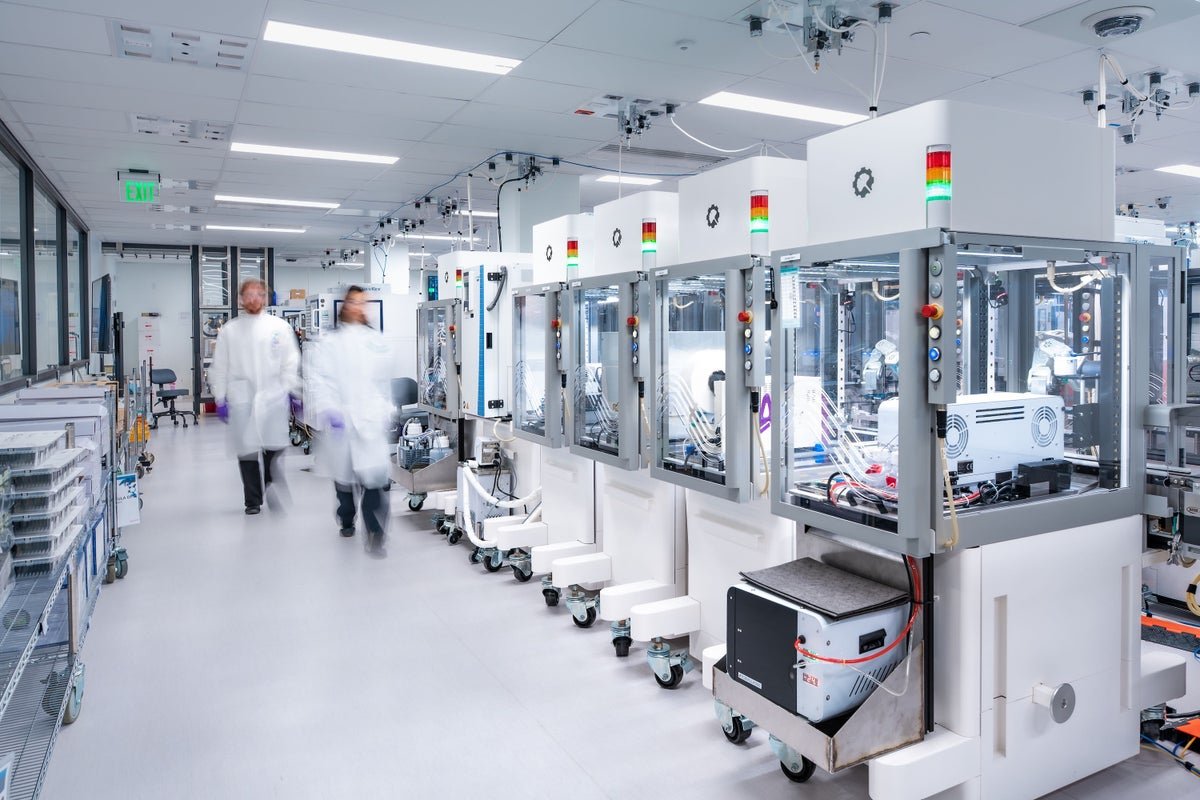
Technicians move through Ginkgo Bioworks’ automated robotics lab, where machines handle high-volume biological research and testing.
OpenAI’s GPT can summarize research papers and make predictions—but can it do science? Can it generate hypotheses, design experiments, interpret results and iterate? Last summer researchers at OpenAI and Ginkgo Bioworks, a company that designs and installs autonomous, robot-run labs, decided to find out.
Though artificial intelligence systems have posted high scores in math, physics and computer science, biology is harder to measure, says Joy Jiao, who leads life sciences research at OpenAI. “For something like ‘design the optimal experiment,’ there’s no right answer. It’s what we call a hard-hard problem: it’s hard to generate a solution, and it’s also really hard to verify.” That led the team to have AI design experiments using superfolder green fluorescent protein (sfGFP), an engineered jellyfish protein that is a common benchmark because it provides a fast, unambiguous signal: it glows green.
While OpenAI’s GPT-5 provided the experimental designs, Ginkgo Bioworks provided what its co-founder and CEO Jason Kelly calls the “Waymo” of biology: an automated lab system where researchers set objective and the AI does the driving. The autonomous robotic lab can rapidly process experiments and operate without constant human oversight.
On supporting science journalism
If you’re enjoying this article, consider supporting our award-winning journalism by subscribing. By purchasing a subscription you are helping to ensure the future of impactful stories about the discoveries and ideas shaping our world today.
The team focused its experiment on cell-free protein synthesis (CFPS), a technique for producing proteins without living cells. Traditional biomanufacturing relies on genetically modifying living cells to produce medicines like insulin. CFPS makes proteins outside of cells by running the cell’s own protein-making machinery in a controlled mixture.
“It is one of the fastest ways to make proteins,” says Reshma Shetty, chief operating officer and co-founder of Ginkgo Bioworks. “You don’t need to clone your DNA, put it into the cell and wait for the cell to grow up.” Improving CFPS could have significant implications for medicine, food and agricultural products.
From OpenAI’s San Francisco, Calif., headquarters, GPT-5 designed experiments and sent them across the country to Ginkgo Bioworks’ robotic systems in Boston. As it iterated, GPT-5 analyzed incoming data and proposed new experiments, which took about an hour per cycle. “In the time it would take for a human to get their coffee, sit down at their computer, log in and get all set up to do work, the model could take in the data, analyze it and propose new experiments,” Shetty says.
“At the beginning of this project, I didn’t know if we could design a single experiment,” Jiao says. “I can remember when the experimental results came back, the reaction from both sides was like, oh, we made a non-zero amount of protein—and that was somewhat surprising.”
After two months and more than 36,000 tests of unique reaction compositions, the AI-driven system reduced the cost of producing the protein by about 40 percent compared with a previously reported benchmark from bioengineer Michael Jewett’s lab at Stanford University. “Honestly, it’s a pretty big deal,” says Jewett, whose lab published its own benchmark paper last week in Nature Communications. “How do we develop medicines faster to get lifesaving therapeutics to patients sooner? I think the integration of artificial intelligence and autonomous labs is one way to do that.”
The OpenAI–Ginkgo Bioworks collaboration also produced one moment of unexpected novelty. When the team gave GPT-5 access to new reagents, “it tried to squeeze in as many as it possibly could,” Jiao says. “So what the model did was set the amount of water to something negative.” Starting an experiment with a negative volume of water isn’t possible. At the lab, when Ginkgo Bioworks’ robot technicians saw the problem, they ran the experiments anyway at a slightly larger overall volume than specified.
The AI-improved reaction composition is now commercially available. More importantly, on March 2, Ginkgo Bioworks launched its Ginkgo Cloud Lab, which allows researchers anywhere to submit experiments to autonomous lab systems starting at just $39 per run. Meanwhile the U.S. Department of Energy is funding a 97-robot autonomous lab at Pacific Northwest National Laboratory in Washington State. The lab will be built by Ginkgo Bioworks and is scheduled to become operational by 2030. “[AI] models alone are not going to cut it,” Shetty says. “You need models paired with labs that can do the experimental validation.”
It’s Time to Stand Up for Science
If you enjoyed this article, I’d like to ask for your support. Scientific American has served as an advocate for science and industry for 180 years, and right now may be the most critical moment in that two-century history.
I’ve been a Scientific American subscriber since I was 12 years old, and it helped shape the way I look at the world. SciAm always educates and delights me, and inspires a sense of awe for our vast, beautiful universe. I hope it does that for you, too.
If you subscribe to Scientific American, you help ensure that our coverage is centered on meaningful research and discovery; that we have the resources to report on the decisions that threaten labs across the U.S.; and that we support both budding and working scientists at a time when the value of science itself too often goes unrecognized.
In return, you get essential news, captivating podcasts, brilliant infographics, can’t-miss newsletters, must-watch videos, challenging games, and the science world’s best writing and reporting. You can even gift someone a subscription.
There has never been a more important time for us to stand up and show why science matters. I hope you’ll support us in that mission.
