

March 11, 2026
4 min read
Add Us On GoogleAdd SciAm
The universe’s brightest supernovae are turbocharged by newborn magnetars
A new study explains how some supernovae are particularly dazzling—the glow from a magnetic, spinning ball of neutrons called a magnetar. An assist from Einstein is what settled the case
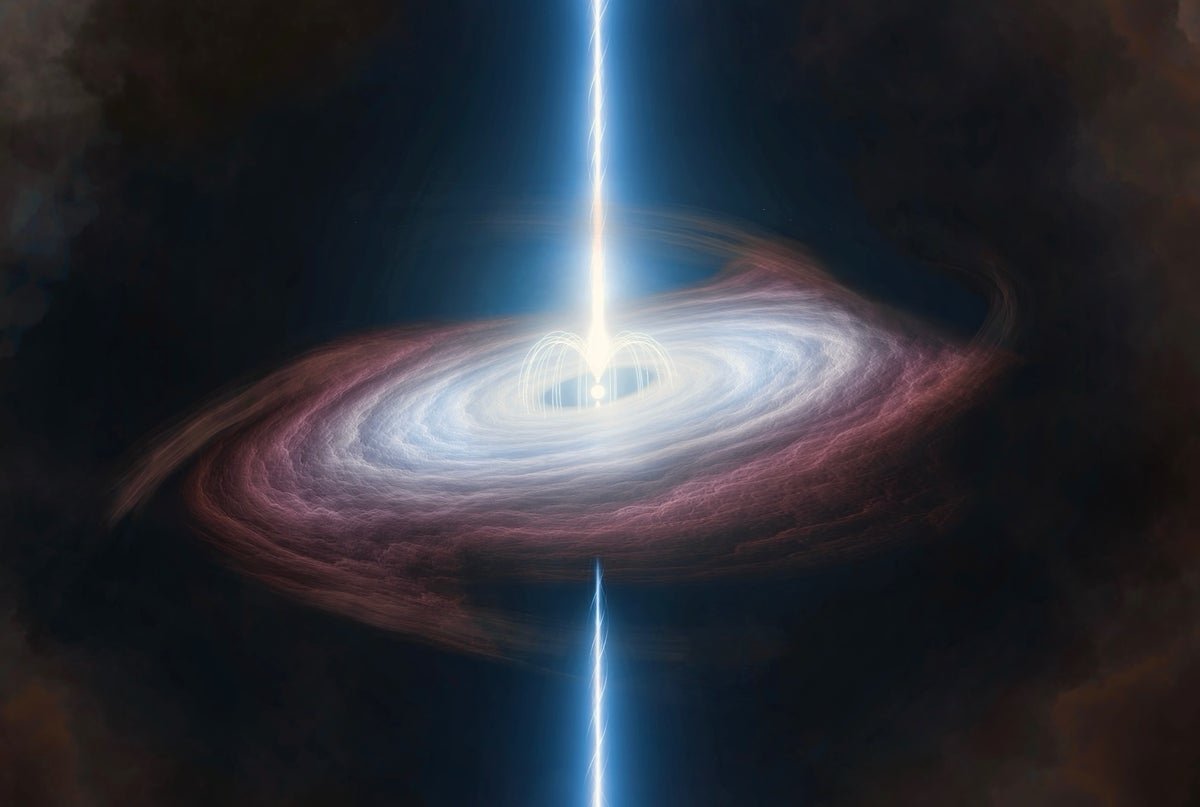
An artist’s conception of a magnetar beaming out radiation. Astronomers found an extra-bright supernova powered by such an engine.
Joseph Farah/Curtis McCully
Every star’s death is dramatic. Superluminous supernovae take the theatrics to another level.
In the early 2000s, scientists first saw these conspicuous cataclysms, which can shine much longer and be more than 10 times brighter than a normal supernova. And ever since, they’ve been wondering what physical process explains such supernovae’s exceptional, lingering glare.
Now they know. In a paper published today in the journal Nature, astrophysicists nailed down a superluminous supernova’s true source: radiation beamed out from a city-sized, freshly formed, highly magnetized, fast-spinning ball of neutrons—a so-called magnetar. Besides solving the puzzle of superluminous supernovae, this also marks the first time scientists have witnessed a magnetar’s birth. And what gave it all away is a strange quirk of Einstein’s general theory of relativity.
On supporting science journalism
If you’re enjoying this article, consider supporting our award-winning journalism by subscribing. By purchasing a subscription you are helping to ensure the future of impactful stories about the discoveries and ideas shaping our world today.
“It’s so remote from anything we’ve ever thought of,” says Joseph Farah, a graduate student affiliated with the at the Las Cumbres Observatory (LCO) and the University of California, Santa Barbara, who led the study. “We know so little about these things.”
What is known is that when a massive star exhausts its fuel, it collapses in on itself and explodes, leaving behind an expanding, slowly cooling cloud of radioactive gas and debris with a tiny stellar remnant at the center. When such a star was some 10 to 25 times the mass of our sun, that remnant is usually a neutron star. These are the weirdest chunks of matter in the cosmos—a teaspoon of their material weighs as much as Mount Everest—making neutron stars the sites of some of the most extreme physics out there.
Neutron stars get especially extreme when they’re rapidly spinning, pulsing out lighthouselike beams of radiation from their poles; astronomers call these objects pulsars. And magnetars are the most extreme of all: most of them are newborn pulsars that possess magnetic fields up to 1,000 times stronger than normal.
Although theorists already had inklings that a magnetar’s tempestuous birth might help explain superluminous supernovae, clinching the case proved difficult. A potential breakthrough came in late 2024 with the eruption of a new superluminous supernova, SN 2024afav, about a billion light-years from Earth. Monitored across 200 days by astronomers at the LCO, SN 2024afav’s brightness periodically dipped, oscillating back and forth, with the time between dips getting shorter and shorter over the course of the measurement.
Farah and his co-authors went to the blackboard in search of explanations for this specific pattern. They landed on only one that could explain it. As a magnetar spins on its axis at nearly the speed of light, its immense magnetic field contorts, coils and twists to pump out powerful radiation. Energy from this astrophysical engine sets the surrounding ejected gas aglow, souping up the supernova’s luminosity and longevity.
But what caused these stellar embers to wax and wane? The answer boils down to how the spinning dead star dragged space and time in its wake.
The magnetar was initially surrounded by a whirling disk of matter, funneling from its inner edge onto the stellar remnant. The disk was slightly tilted from the magnetar’s spin axis, and the violent maelstrom of spacetime it created twirled the disk around it. From afar, this consequence of general relativity, called “Lense-Thirring precession,” made the whole system look like a spinning top wobbling upon a table.
From Earth’s vantage point—right along the faraway magnetar’s equator—the wobbling disk acted like a film projector’s shutter, periodically occluding our view of the dead star supercharging SN 2024afav. As the days went by and the magnetar chomped away at its disk, that torus of material shrank inward. This sped up the shutter effect, making the dips in light more and more frequent until the disk was gone.
This stellar origin story, the authors say, matches the data better than anything else they could come up with. That makes it the surest evidence yet of what’s really going on at the center of a superluminous supernovae. “Other possible energy sources wouldn’t produce such a pattern,” says Daniel Kasen of the University of California, Berkeley, one of the astrophysicists who first proposed the magnetar explanation in 2010 and is acknowledged for providing helpful discussion in the new paper. “A magnetar can act as a powerful engine that lights up the supernova to extraordinary brightness.”
The confirmation opens up magnetars as yet another cosmic laboratory for testing general relativity. “Everything about the system is extreme,” says Adam Ingram, an astrophysicist at Newcastle University in England, who served as a peer reviewer for the study. “The gravitational field is strong enough for the most exotic predictions of general relativity to be large effects.”
Over its lifetime, the newly operational Vera C. Rubin Observatory in Chile will see millions of supernovae, including many more of these rare events. And wherever general relativity is visible in the world, Farah says, there’s an opportunity to better understand it—and perhaps even to find new cracks in the edifice of Einstein’s greatest theory, from which fresh ideas could spring. “It means we can test one of our fundamental theories of reality in one of the most extreme environments in the universe,” he says.
It’s Time to Stand Up for Science
If you enjoyed this article, I’d like to ask for your support. Scientific American has served as an advocate for science and industry for 180 years, and right now may be the most critical moment in that two-century history.
I’ve been a Scientific American subscriber since I was 12 years old, and it helped shape the way I look at the world. SciAm always educates and delights me, and inspires a sense of awe for our vast, beautiful universe. I hope it does that for you, too.
If you subscribe to Scientific American, you help ensure that our coverage is centered on meaningful research and discovery; that we have the resources to report on the decisions that threaten labs across the U.S.; and that we support both budding and working scientists at a time when the value of science itself too often goes unrecognized.
In return, you get essential news, captivating podcasts, brilliant infographics, can’t-miss newsletters, must-watch videos, challenging games, and the science world’s best writing and reporting. You can even gift someone a subscription.
There has never been a more important time for us to stand up and show why science matters. I hope you’ll support us in that mission.
