

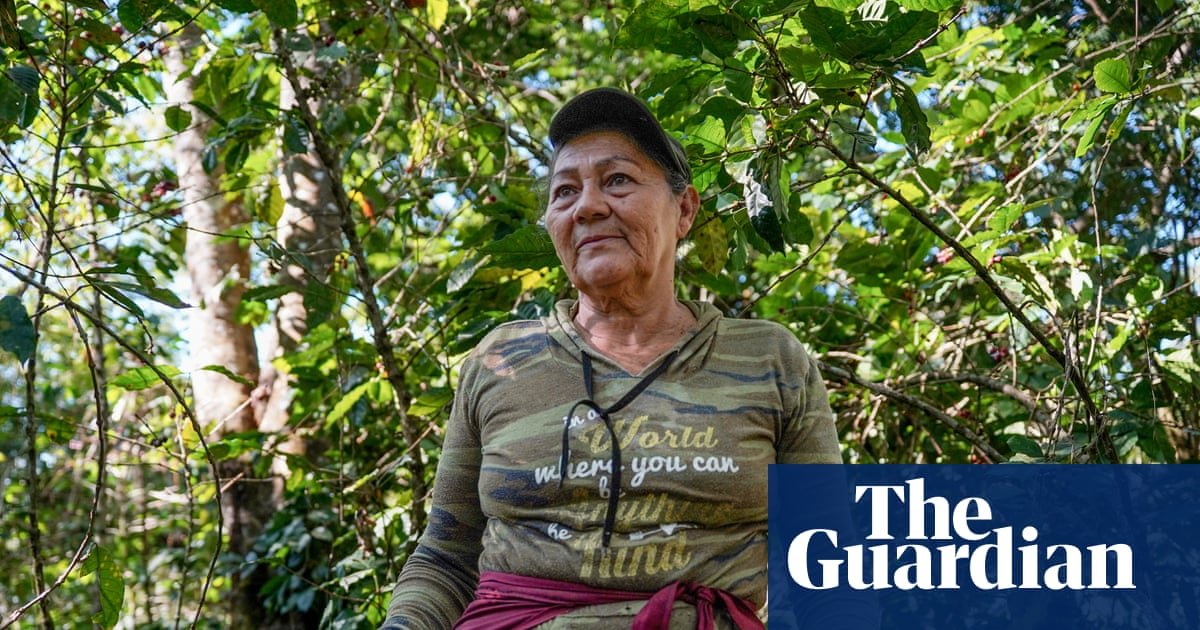
On a steep hillside in western El Salvador, Oscar Leiva watches rainfall in December, a month that once marked the start of the dry season. During this harvest cycle, flowering came early and then stalled. A heatwave followed. What remains of the crop is uneven, lower in quality and more expensive to produce than the last.
For Leiva and his family, coffee has never been just a crop. His mother, Marina Marinero, remembers when the rains arrived on schedule and the harvest could be planned months in advance. Today, the calendar no longer holds. Decisions about pruning, fertilising and hiring labour feel like educated guesses. Each mistake carries a cost the family cannot afford.
Q&A
What is the Coffee crisis series?
Show
As the climate crisis deepens, Latin America’s coffee producers – from the steep hillsides of Central America to the forests of Brazil and the Andean slopes of Colombia – are facing an existential threat.
While global markets still project an image of abundance, small farmers across the region are struggling with rising costs, unpredictable weather and a shrinking workforce, forcing many to question whether coffee farming remains viable.
The climate crisis poses an escalating threat by driving up temperatures in key growing regions. A recent Climate Central analysis found that the world’s five largest producers – Brazil, Vietnam, Colombia, Ethiopia and Indonesia – now face an average of 57 additional days of damaging heat each year.
The problem is evident across much of Latin America, a region that includes leading producers such as Brazil, Colombia, Mexico, Honduras, Guatemala and Peru, and accounts for more than half of global output. According to Climate Central, Brazil, the largest producer, now endures 70 more hot days a year.
“High temperatures place coffee plants under stress, reducing much of their productive potential. This is affecting coffee plantations around the world, as most are located within the same latitudes,” says Celso Vegro, an agronomist and researcher at São Paulo’s state agriculture agency.
According to Vegro, global coffee production has fallen short of expectations since 2021. Countries have been unable to keep pace with growing demand, leading to the depletion of global stocks, which has driven prices higher. “This year, Brazil’s harvest is expected to be large and to replenish supplies. But it will be only a temporary reprieve, as the same climate conditions persist,” he says.
In a new series, Coffee crisis, the Guardian spoke with producers from four Latin American countries to explore the challenges they face.
Thank you for your feedback.
For generations, coffee shaped El Salvador’s rural economy, structuring land use, labour and exports across much of the country. By the mid-1970s, El Salvador ranked among the world’s leading coffee producers, with harvests exceeding 5 million quintales (a quintal is equivalent to about 46kg). Now, national production struggles to reach 1 million quintales. The decline reflects more than market cycles.
Land once planted with shaded coffee is increasingly sold for real estate development
Decades of land restructuring, intensifying climate shocks and rural migration have hollowed out the sector, reshaping livelihoods and the landscapes. Climate volatility has made harvests increasingly unpredictable, disrupting flowering cycles, reducing yields and reducing quality for small farmers who lack the financial buffers to absorb losses.
double quotation markWhen prices keep producers at subsistence level, adaptation becomes impossibleCecibel Romero, coffee researcher
Market signals, meanwhile, point in the opposite direction. After a record rally earlier in 2025, Arabica bean prices are expected to plunge as production rebounds in Colombia, Brazil and other leading exporters. Rabobank forecasts that growing global surpluses over the next two seasons could push prices sharply lower, even as farmers in climate-vulnerable regions face rising costs.
Cecibel Romero, a researcher on coffee production, says the sector faces overlapping problems that go beyond climate alone. “There is a real climate crisis, but there is also a social crisis,” she says, adding that rising temperatures, erratic rainfall and diseases such as coffee rust have exposed longstanding weaknesses in how the commodity has traditionally been produced.
“When prices keep producers at subsistence level,” she says, “adaptation becomes impossible.”
An arabica plant at the Renacer coffee production school, which promotes long-term stability rather than maximum yields, in Juayua, El Salvador
Romero argues that this production model prioritised yields and short-term fixes over soil health, shade management and resilience. After significant rust outbreaks in the early 2010s, many producers replanted with new varieties that promised resistance but often delivered lower quality and limited durability. “Those decisions ended up hitting the system again a few years later,” she says.
As coffee’s economic importance in El Salvador declined, institutional support was reduced. Public support services weakened, renovation programmes fragmented and access to affordable credit became narrowed. Producers were left to navigate climate risk, disease outbreaks and market volatility largely on their own.
Meanwhile, in Honduras, Central America’s largest coffee producer, the pressures are similar even as national output remains higher.
Juan Luis Hernández, a forest engineer who has worked on environmental projects within the Honduran Coffee Institute, says the climate crisis has squeezed the margin for error.
A coffee plant flowers at a Café San Rafael estate in Copan Ruinas, Honduras
“Producers are being asked to adapt,” he says. “But adaptation has a cost.”
Managing shade, soil restoration, water protection and monitoring disease require investment, time and labour, Hernández says, adding that those resources are unevenly distributed.
Gerardo Vásquez
In Copán, Gerardo Vásquez, a small coffee producer, manages an 8-hectare (20-acre) family farm while advising others. He trained with the Honduran Coffee Institute and works on soil analysis, variety selection and agroforestry systems. Even with that background, Vásquez says survival is far from guaranteed. Establishing a single manzana (a traditional Latin American unit of area, equal to about 0.7ha) of coffee now costs about 200,000 lempiras (£5,600) spread over three years.
Fertiliser prices have risen sharply since the pandemic and labour shortages have pushed harvest wages higher. “When you add everything up,” Vásquez says, “harvest, processing, transport, you spend more than 3,000 lempiras (£83) just to get one quintal of parchment coffee.”
Constant rain makes drying difficult, forcing some to sell “cherries” – the fruit on the coffee plant – directly from the field at lower prices. Others rely on intermediaries for cash advances, limiting their ability to negotiate prices later.
Climate pressure is pushing coffee uphill. Forty years ago, coffee struggled above 1,000 metres; now producers are planting higher each decade
“The producer sells because he needs money that day,” Vásquez says. “That producer feels relieved, but he is not earning anything, just recovering part of what he spent.”
double quotation markFifteen or 20 years ago, during the coffee boom, prices were good and all the conditions existed that don’t exist any moreCarlos Guerra, café owner
The climate crisis is also reshaping where coffee can be grown. Vásquez estimates that farms below 1,000m altitude are increasingly vulnerable to heat stress, pests and disease. Yields fall as costs rise, making production harder to sustain.
For most producers, moving uphill or absorbing losses is not an option. But a small number of farms have been able to buy time. Two decades ago, the seasons followed a predictable rhythm. Carlos Guerra, co-owner of Café San Rafael, says flowering is now staggered. “White everywhere, with the smell of jasmine taking over the mountain,” he says, noting that harvests stretch later into the year, increasing costs and reducing returns.
Carlos Guerra, a co-owner of Café San Rafael
Labour has become one of the most acute pressures. Coffee farming is physically demanding, poorly paid and increasingly unstable, driving younger people to leave rural areas.
“Fifteen or 20 years ago, during the coffee boom, prices were good and all the conditions existed that don’t exist any more,” Guerra says. “Back then, people were eager to work. Now, if you are lucky, you find 20 or 30 workers.”
For producers, that shortage limits the extent of adaptation that is even possible. Jesús Guerra says: “With cattle, you can introduce technology. But coffee is different. You cannot mechanise selecting ripe cherries or pruning. That requires human judgment.”
Climate pressure is also pushing coffee uphill. Forty years ago, coffee struggled above 1,000m; now producers are planting higher each decade. “With warmer climates,” Guerra says, “diseases like rust have spread more aggressively.”
Adaptation exists but comes with trade-offs. Producers experiment with shade and soil restoration. “We work with more shade,” Jesús Guerra says. “But that also means lower yields. There is always a balance.”
Carlos Guerra frames the dilemma: “If you move from producing 40 quintales per manzana to five or 10 under shade,” he says, “you have to ask yourself if you accept lower income, or if you intensify production with chemicals.”
Café San Rafael’s roastery allows the operation to compensate for fluctuations in cherry quality
At Café San Rafael, adaptation is treated as a daily concern. On the estate, changes include managing shade, protecting soils and adjusting harvest timing. Post-harvest, tighter control over fermentation and drying helps compensate for uneven cherry quality. The roastery allows the operation to absorb fluctuations.
“We have a window to sell coffee to a differentiated market,” Carlos Guerra says. “Many producers do not have that option.”
Emeric Seguin, director of sourcing and sustainability at Fantôme, a Quebec-based speciality coffee roaster working with smallholders in Central America, says distrust is widespread as farmers feel undervalued, buyers worry about inconsistency and co-operatives are caught between both. “Everyone feels as if they are the one being scammed,” he says.
A barista makes a specialty coffee at Café San Rafael
Speciality coffee is often presented as a solution, offering higher prices and closer relationships. In practice, access is uneven. Certification costs, processing infrastructure and export logistics remain barriers for many producers.
Seguin says the industry’s definition of quality is narrow. “Quality is treated as something objective,” he says. “But it is really a cultural agreement decided in tasting rooms, not on farms.”
Some initiatives are trying to shift that balance. In El Salvador, Renacer, a coffee production school led by agronomists and producers, promotes ecological practices focused on soil health, shade restoration and long-term stability rather than maximum yields.
Sigfredo Corado, one of its lead agronomists, says the goal is not to eliminate risk but to reduce extremes. “You may not harvest 50 quintales one year, but you also will not fall to 10 the next,” he says.
Coffee farming is physically demanding, poorly paid and increasingly unstable, making labour one of the most acute pressures
Rabobank predicts surpluses could lower prices, making coffee less viable for smallholders. As coffee weakens, land once planted with shaded coffee is increasingly converted to sugarcane or sold for development.
Back on the hillside, Leiva walks around his plot, counting the losses. Planning for the next cycle feels premature but unavoidable. Each season now requires decisions made without reliable forecasts. Coffee is adapting across Central America. The question is who can afford to adapt to it – and who will be left behind.
