

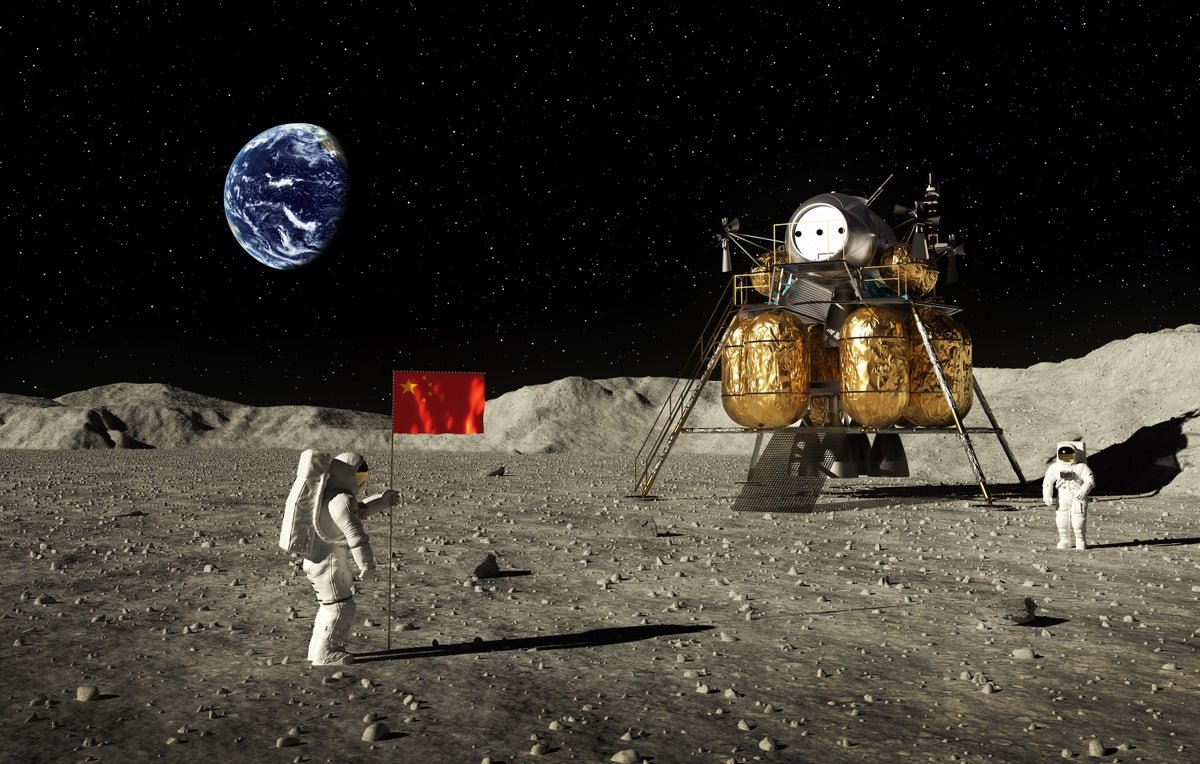
In the two-way race between the U.S. and China to put humans back on the moon, the lunar south pole is widely considered the most prized place to land. The area is relatively resource-rich, pocked with dark craters that harbor water ice and that have near constant exposure to sunlight around their rims—both desirable features for lunar bases. The South Pole-Aitken Basin—the moon’s largest and oldest impact structure—dominates the region. Situated on the moon’s far side, it is shielded from Earth’s radio chatter, making it an ideal site for ultra-sensitive astronomy observations.
But this promise comes with considerable peril: compared to other landing sites, the south pole region is harder to reach, and its craters more treacherous. And without a moon-orbiting relay, the far side is cut off from communicating with Earth.
Still, the U.S. has selected nine candidate sites there for a landing attempt set for 2028 as part of NASA’s Artemis program. But a new paper published yesterday in Nature Astronomy, strengthens the case that China is pursuing an easier initial crewed landing site closer to the equator and on the moon’s near side, with a plan to put boots on the surface by 2030.
On supporting science journalism
If you’re enjoying this article, consider supporting our award-winning journalism by subscribing. By purchasing a subscription you are helping to ensure the future of impactful stories about the discoveries and ideas shaping our world today.
Using data from U.S., Chinese, Indian and Japanese lunar missions as well as archival observations from the ground-based Arecibo radio telescope, the authors argue that Rimae Bode—a relatively flat region north of the equator on the moon’s Earth-facing side—is a top locale for China’s first moonwalking astronauts.
“Rimae Bode is a high-priority ‘sweet spot,’” says Jun Huang, a planetary geologist at the China University of Geosciences in Wuhan and co-lead author of the new study. “Think of it as a prime piece of lunar real estate: its location near the equator provides much flatter, safer terrain for landing, along with constant sunlight for power [during the lunar day] and a direct line-of-sight to Earth for easy communication.”
An animation of flying over the Rimae Bode region (elevation exaggerated). Credit: Maosheng Yang and Jun Huang
Jim Head, an emeritus professor at Brown University who helped select landing sites for NASA’s Apollo moon missions and trained astronauts for geology fieldwork, agrees the region is a top candidate. He regularly collaborates with Chinese scientists developing that nation’s lunar exploration program, but was not part of this study.
“Rimae Bode would be on my ‘lunar human exploration landing site short list,’” Head says, adding that the region was considered as an Apollo mission destination. “More than 50 years after Apollo, the importance of the multiple compelling scientific objectives at Rimae Bode remain!”
Rimae Bode is located between Mare Vaporum—a basin filled with dark, cooled lava—and the lighter-colored, older and more rugged central lunar highlands. “Scientifically, it’s like a geological ‘all-you-can-eat buffet’ that the south pole can’t provide,” Huang says.
He and his team identify five features of interest: a large, dark layer of glassy volcanic ash; a basalt plain called Sinus Aestuum; two basaltic terrains of Rimae Bode proper—one of which is laced with volcanic trenches called rilles—and, finally, the surrounding highlands.
The paper sketches out the region’s complex geology, analyzing its mineralogy and topography, as well as the distribution of craters across the landscape. The ash layer, for instance, probably erupted billions of years ago from the moon’s mantle, offering a unique window into lunar history.
Tiny glass beads in the ash are Rimae Bode’s “crown jewels,” Huang says—these “time capsules” could help reveal the moon’s mysterious interior. “By studying them, we can finally understand what the moon is actually made of, deep inside, and piece together the complete story of how its volcanic activity evolved over time, transforming the moon from a fiery, active world into the quiet neighbor we see today,” he says.
Orbital observations suggest that the ash may also “contain significant water resources,” says Clive Neal, a planetary scientist at the University of Notre Dame who was not involved in the new study. Water is critical for moon mission life support, and for making rocket fuel. “And none of these deposits have been sampled before—another [potential] first for China.”
Water-rich minerals in the ash could mean that the moon’s mantle is wetter than scientists thought, Neal says. “But the bigger thing in this time of human exploration is the resource potential. Could we have an easier-to-get-to human outpost at the equator rather than the poles?”
Based on their analysis, Huang and his co-authors propose four potential landing sites within Rimae Bode; they also plot paths that Chinese astronauts could use to more safely explore and study the surrounding terrain. Huang’s favorite of the four is Landing Site 2 (LS2), a flat patch in Rimae Bode’s north within a few kilometers of multiple science targets. “LS2 is a scientific ‘triple threat,’” he says, giving astronauts access to the volcanic glass beads, a massive lunar trench, and “unique high-thorium materials that are key to understanding the moon’s chemical evolution.”
Obtaining samples from Rimae Bode would allow comparisons with lunar material gathered from other areas, Head says. The Apollo missions collectively brought back nearly 400 kilograms of material scooped up from mid-to-low lunar latitudes on the near side, while China’s Chang’e 5 and Chang’e 6 robotic missions have returned smaller samples from the moon’s near and far sides, respectively.
If China does make a first crewed landing near the equator on the near side, that doesn’t mean its astronauts won’t later explore the lunar south pole or other harder-to-reach spots, Head says. China’s Chang’e 7 spacecraft, launching later this year, is set to land at the south pole at the rim of Shackleton Crater where it will search for water ice. Then, 2029’s Chang’e 8 mission is also designed to target the south pole as a precursor for China’s crewed base called the International Lunar Research Station, which is being planned in partnership with Russia and other countries. The U.S. Apollo missions followed a similar progression, steadily advancing in difficulty and achievement, Head says: “The Chinese are following a safer, sequential path, as was done in Apollo.”
Much work remains to be done before anyone heads for Rimae Bode, of course. Huang and his coauthors are especially eager for higher-resolution images of the region to better characterize its geology and gauge how well astronauts could navigate its terrain—something that could come from a new moon-mapping satellite that China announced last year.
