

Ministers under pressure to bring in cost-of-living support package amid inflation fears
Good morning and welcome to our live coverage of UK politics. The chancellor, Rachel Reeves, and the prime minister, Keir Starmer, indicated yesterday that the government could be prepared to intervene to protect UK households against major cost-of-living shocks to come at the next energy price cap, as Brent crude, the international benchmark, surged as high as $119.50 a barrel on Monday.
Brent then slid back to about $91 when Donald Trump described the US-Israeli war on Iran as “very complete, pretty much” in an interview with CBS News yesterday evening.
His contradictory statements on the timeline for the duration of the war have added to market turbulence, with fears of a prolonged conflict causing governments to consider support packages to protect people from higher prices caused by a predicted surge in inflation.
The British Chambers of Commerce forecast that inflation would remain “firmly above” the Bank of England’s 2% target, noting the “highly uncertain” global situation.
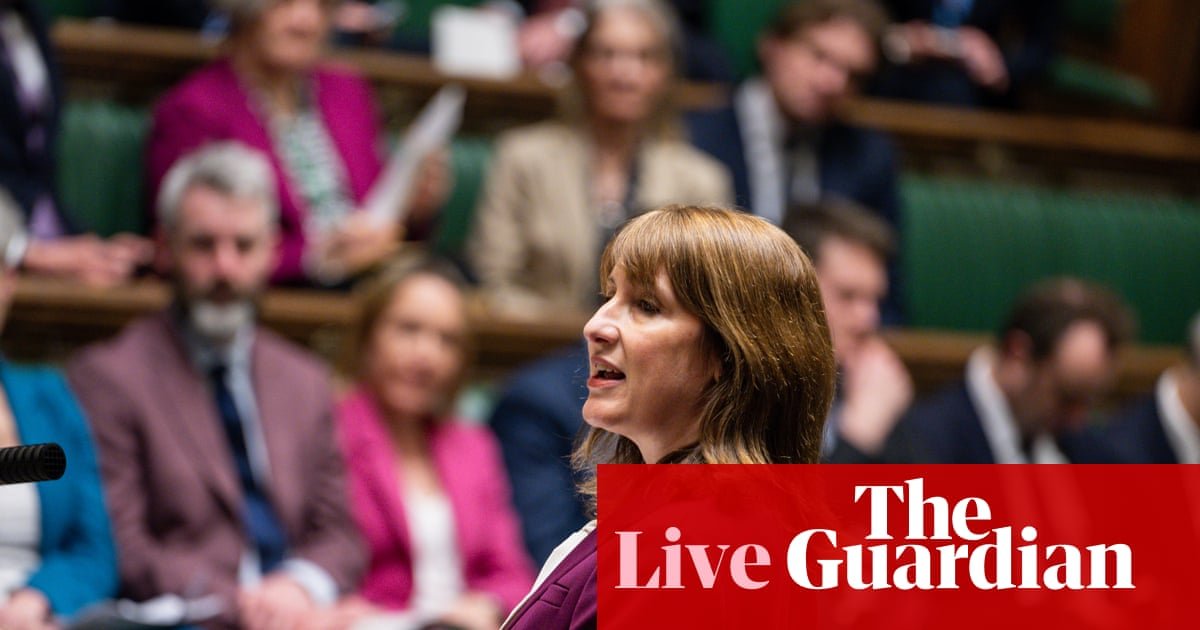
Rachel Reeves said Britain is likely to be hit by rising inflation because of the US war with Iran. Photograph: Simon Dawson/No 10 Downing Street
Following a call with her G7 counterparts on Monday, Reeves said she was ready to support “a coordinated release” of international oil reserves to ease the economic shock of the escalating crisis.
She also called for action to “guarantee the security of vessels” passing through the strait of Hormuz, one of the world’s most important shipping routes. The war has severely reduced sea traffic through the strait which carries about one-fifth of global seaborne crude oil.
Starmer said a prolonged conflict would affect the “lives and households of everybody” but vowed that ministers would seek to “get ahead” in case of that event.
Reeves is due in the Commons for Treasury questions at 11.30am as she faces calls to ditch a planned 5p rise in fuel duty in September and set out an emergency package to shield households from global energy price rises and inflationary pressures.
Share
Key events
Show key events only
Please turn on JavaScript to use this feature
Before taking questions from journalists, Nigel Farage pledged to reverse the government’s planned fuel duty hike by scrapping what he described as “lunatic” net zero levies.
Speaking at Newhaven services on Tuesday, he said: “The way we sneakily do tax in this country means there’s about 6p going on a litre of petrol staged over the course of the next few months. And this is just about the last time this should happen.
“How are we going to pay for not increasing taxes? Well, we’re going to get rid of lunatic green levies. In particular, I’m thinking about heat pump subsidies.”
Nigel Farage and Robert Jenrick at a party press conference at New Haven Services in Derbyshire. Photograph: Jacob King/PAShare
The Ministry of Defence said earlier that landing ship RFA Lyme Bay is being prepared for potential deployment to the eastern Mediterranean. The vessel has aviation and medical facilities.
Meanwhile, Type 45 destroyer HMS Dragon is due to be sent to the eastern Mediterranean to help protect Cyprus and the RAF bases there from further drone or missile attacks.
As my colleague Dan Sabbagh notes in this story, France has already deployed its Charles de Gaulle aircraft carrier into the eastern Mediterranean and the French president, Emmanuel Macron, met Cyprus’s president, Nikos Christodoulides, and Greece’s prime minister, Kyriakos Mitsotakis, on Monday.
Britain has faced criticism from Cyprus about not acting fast enough to protect the country, home to two UK bases.
Equipment is loaded on to HMS Dragon, a Royal Navy destroyer on Monday, in preparation for it sailing to the eastern Mediterranean. Photograph: Neil Hall/EPAShare
Updated at 07.10 EDT
Farage: UK can’t get directly involved in ‘another foreign war’; doesn’t ‘have a navy’
When pressed to clarify Reform’s position, Farage said:
double quotation markWe cannot get involved directly in another foreign war. We don’t have a navy. We can’t even defend our own military base in Cyprus.
Share
Farage says UK doesn’t have ‘capability to offer anything of value’ to the US or Israel
We can bring you some lines from the Reform press conference (see post at 10.10). Sky News’ political editor Beth Rigby asked Nigel Farage about Reform’s inconsistent position over the UK’s policy in regard to the US-Israeli war with Iran. She asks how voters can trust the party’s national security.
“Given that we can’t even send a Royal Naval vessel to defend British sovereign territory and an RAF base, we certainly don’t have the capability to offer anything of any value to the Americans or the Israelis,” Farage said, describing the Royal Navy as a “catastrophe”.
“I think so far the government have had one charter plane, and even that broke down and was 24 hours late,” he added.
Farage said he strongly disagreed with Keir Starmer’s initial refusal to permit the US to use UK bases for its joint offensive with Israel against Iran. He said French President Emmanuel Macron’s “very decisive actions” and intention to help clear the strait of Hormuz shows the “humiliating state that we’ve sunk to today”.
Farage continued: “So there are differing opinions as to whether we should physically join the attacks. I as leader, I’m saying to you, if we can’t even defend Cyprus, let’s not get ourselves involved in another foreign war.”
Reform seems to have been shifting its position on Iran. Farage previously took a harder line than he did this morning, saying the he supported regime change in Iran and said that the RAF and Royal Navy should be deployed to support US strikes on the country. Deputy leader Richard Tice previously said that if Reform were in power “we would be helping the Americans and the Israelis in any way they saw appropriate”. Jenrick, on the other hand, has struck a more cautious tone.
Share
Updated at 07.15 EDT
Thousands of lawyers urge Keir Starmer to rethink plans to cut jury trials
Ben Quinn
Plans to curtail the number of jury trials in England and Wales have been described as “unpopular, untested and poorly evidenced” by thousands of lawyers who have written to the prime minister.
The letter to Keir Starmer, a former director of public prosecutions, from 3,200 lawyers, including 300 senior barristers, comes as his government faces the prospect of one of its most serious backbench revolts since coming to power.
Efforts by David Lammy, the justice secretary, to change the mind of one of the leading Labour figures opposed to the plans, the backbencher Karl Turner, failed after the men met on Monday night.
David Lammy warned opponents of the bill that criminals would walk free if it was blocked. Photograph: James Manning/PA
Turner, who had previously coordinated a letter from 38 Labour MPs urging the prime minister to reverse the plans, said he had “absolutely not” been convinced.
The Conservatives are expected to force a vote to try to block the second reading in parliament on Tuesday. However, the true scale of the Labour rebellion may not yet be evident. You can read the full story here:
Share
The Labour Rural Research Group (made up of over 40 MPs representing “rural” and “semi-rural” constituencies) have a report out today calling on the government to better fund and deliver services for people in rural Britain often neglected in policy formulation in London. It says poverty in the countryside tends to be “undercounted, underfunded and structurally overlooked” and the research group seeks to address these concerns by giving voice to issues affecting rural areas. Here are some of the recommendations in the report:
Rural public transport requires long-term, stable funding, with capped fares covering complete journeys.
Fuel poverty interventions must be targeted at off-grid homes, including extended energy support and social tariffs.
Government should work with the big six supermarkets to introduce a “Rural Basket Delivery Guarantee”, ensuring rural food and retail deserts are covered by delivery services.
The government’s 2026 High Street Strategy must include an explicit rural focus.
In-work support must reflect fluctuating and seasonal incomes common in rural economies.
Share
Updated at 06.39 EDT
UK households that use heating oil face ‘frightening’ surge in bills over Iran war
Hilary Osborne
Rural households that rely on heating oil to warm their homes and provide hot water are facing a “sudden and frightening” surge in their bills, with prices almost trebling since the start of the Iran war.
The cost of heating oil is not covered by Ofgem’s energy price cap and varies between suppliers. In examples seen by the Guardian, customers who were typically paying 62p a litre before the war are now being quoted about £1.73.
The prospect of government help was raised when the chancellor, Rachel Reeves, told parliament she recognised households that used heating oil faced “unique challenges”. She said officials would meet rural and Northern Ireland’s MPs on Wednesday to explore “further action”.
Heating oil is typically a form of kerosene so prices are linked to the cost of jet fuel. Households in the UK say they have orders of deliveries cancelled. Photograph: Wayne HUTCHINSON/Alamy
Across the UK, an estimated 1.7m households rely on heating oil, and in Northern Ireland it is the primary heating source for two-thirds of households.
It is typically a form of kerosene so prices are linked to the cost of jet fuel.
As wholesale prices have risen, some customers have had orders cancelled, leaving them to try to rebuy at a higher price. Others have struggled to find suppliers willing to deliver to them. You can read more here:
Share
This policy paper on the changing fuel duty rates says the following:
double quotation markAlongside other measures announced at Budget 2025 to address the cost of living, this measure continues to support motorists by freezing the current fuel duty rates until the end of August 2026.
Rates will gradually return to March 2022 levels by March 2027, avoiding a 5 ppl increase in March 2026 when the cut was due to expire.
The planned increase in line with inflation for 2026 to 2027 is also being cancelled. This measure will save the average car driver £49 in 2026 to 2027 compared to previous plans.
Share
Reform UK leader, Nigel Farage, and his Treasury spokesperson Robert Jenrick are expected to hold a press conference at a petrol station in Derbyshire shortly and will no doubt be accusing ministers of not doing enough to help motorists.
Writing in The Sun, Farage and Jenrick said:
double quotation markIf Reform were in government, it would never have happened. We will spend the next few months trying to shame Rachel Reeves into cancelling it [the fuel duty rise].
But if she doesn’t – whether because she’s running scared of the Greens or in hock to her far-left backbenchers – then Reform will reverse it in our first budget. Because what she’s doing just isn’t fair.
Nigel Farage and Robert Jenrick will be holding a press conference shortly and will spell out what Reform would do on fuel duty if in government. Photograph: Guy Bell/ShutterstockShare
Updated at 06.14 EDT
You can follow the latest market developments in our business live blog, which is leading on how oil prices are falling and stocks rebounding after Donald Trump said the war would end soon:
Share
The RAC, which represents UK motorists, has said average petrol and diesel prices will likely keep on rising – one of the many examples of how the turmoil in the global energy markets is hitting households already.
The i is reporting that Rachel Reeves could U-turn on the plan to hike fuel duty in September, pointing to a non-committal quote from the prime minister’s spokesperson yesterday. The spokesperson said: “We’re obviously closely monitoring prices in light of the situation in the Middle East. I know there’s been reporting around fuel duty. The chancellor keeps all taxes under review and takes decisions at the budget.”
Share
Updated at 06.00 EDT
Rachel Reeves faces growing calls to cancel planned increase in fuel duty
As we mentioned in the opening post, Rachel Reeves is under pressure to cancel the planned increase in fuel duty due in September which will cause drivers to pay more for petrol and diesel as the government rolls back a temporary cut that was introduced in 2022 in response to Russia’s full-scale invasion of Ukraine.
At her budget last year, Reeves said the 5p cut would be unwound between September 2026 and March 2027, but the Conservatives and Liberal Democrats have called for her to change course in light of the Israeli-US war with Iran. The Tories have promised to bring a vote on reversing the planned increase.
The Conservative party leader, Kemi Badenoch, said:
double quotation markRachel Reeves is planning to hike Fuel Duty for the first time in 15 years at the worst possible moment. Last week at the Spring Statement she knew full well that global instability was pushing oil prices up again.
Instead of helping families and businesses, she chose to pat herself on the back. Now motorists across the country face the double hit of rising petrol prices and higher fuel tax. This is Labour’s instinct: higher taxes and the wrong priorities. Labour must axe the Fuel Tax rise!
Kemi Badenoch has urged the government to commit to cutting fuel duty. Photograph: Stefan Rousseau/PA
The Lib Dem leader, Ed Davey, went further, saying the prime minister should convene the government’s emergency Cobra committee “to personally get a grip on the threat of brutal price shocks facing families, pensioners and businesses”.
Share
Updated at 07.21 EDT
Ministers under pressure to bring in cost-of-living support package amid inflation fears
Good morning and welcome to our live coverage of UK politics. The chancellor, Rachel Reeves, and the prime minister, Keir Starmer, indicated yesterday that the government could be prepared to intervene to protect UK households against major cost-of-living shocks to come at the next energy price cap, as Brent crude, the international benchmark, surged as high as $119.50 a barrel on Monday.
Brent then slid back to about $91 when Donald Trump described the US-Israeli war on Iran as “very complete, pretty much” in an interview with CBS News yesterday evening.
His contradictory statements on the timeline for the duration of the war have added to market turbulence, with fears of a prolonged conflict causing governments to consider support packages to protect people from higher prices caused by a predicted surge in inflation.
The British Chambers of Commerce forecast that inflation would remain “firmly above” the Bank of England’s 2% target, noting the “highly uncertain” global situation.
Rachel Reeves said Britain is likely to be hit by rising inflation because of the US war with Iran. Photograph: Simon Dawson/No 10 Downing Street
Following a call with her G7 counterparts on Monday, Reeves said she was ready to support “a coordinated release” of international oil reserves to ease the economic shock of the escalating crisis.
She also called for action to “guarantee the security of vessels” passing through the strait of Hormuz, one of the world’s most important shipping routes. The war has severely reduced sea traffic through the strait which carries about one-fifth of global seaborne crude oil.
Starmer said a prolonged conflict would affect the “lives and households of everybody” but vowed that ministers would seek to “get ahead” in case of that event.
Reeves is due in the Commons for Treasury questions at 11.30am as she faces calls to ditch a planned 5p rise in fuel duty in September and set out an emergency package to shield households from global energy price rises and inflationary pressures.
Share
