

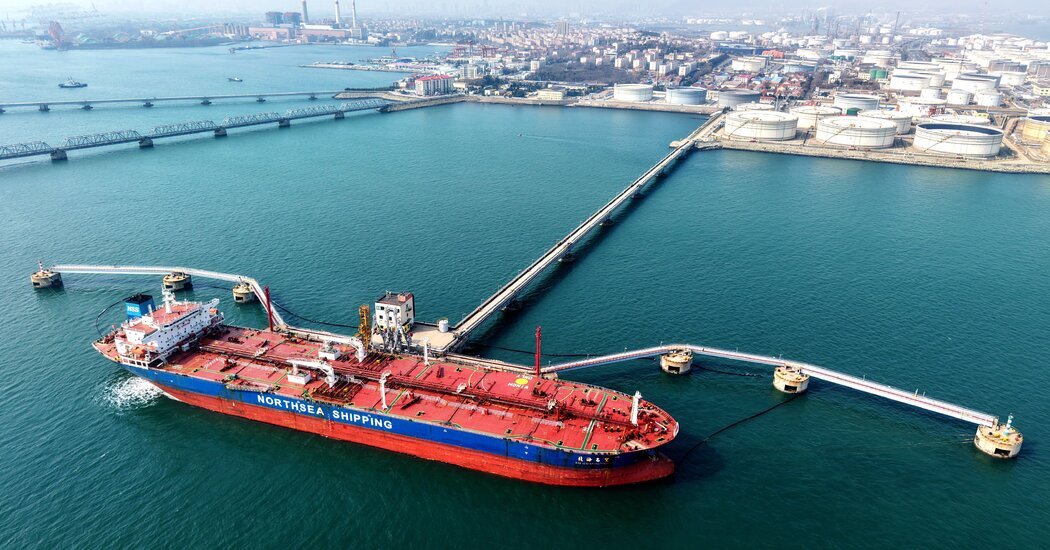
In the first two months of the year, before the outbreak of fighting in the Middle East paralyzed energy supply lines, China ramped up its oil purchases as part of a continued strategy to shield the country from rising geopolitical tensions.
The world’s largest buyer of oil, China imported 15.8 percent more oil in January and February over the same period last year, according to customs data released by China on Tuesday.
Beijing has been building up its strategic stockpile over the past year, even as domestic oil consumption has continued to fall. All that oil is now expected to come in handy.
“Oil stockpiling has been taking place for a while now, and Chinese regulators were already preparing for geopolitical tensions to arise from the Trump administration,” said Cosimo Ries, an energy analyst at Trivium China, a consulting firm. “It was a strategic step which, in hindsight, was pretty wise.”
President Trump has launched attacks on two of China’s cheapest sources of oil, Venezuela and Iran. Venezuela’s leader, Nicolás Maduro, was ousted and brought to the United States, where he is in a federal prison in New York awaiting trial. Iran’s supreme leader, Ayatollah Ali Khamenei, was killed on Feb. 28 during U.S. and Israeli military strikes.
The leadership changes in both countries have thrown into question the lucrative deals that China had secured with the two countries to buy oil sanctioned by the United States. Mr. Trump has said that the United States will take over Venezuela’s oil industry. In Iran, the source of 13 percent of China’s oil imports, the Trump administration’s plans are not yet clear.
Experts said they expected China to continue building up its energy security now, as the war in Iran disrupts traffic in the Strait of Hormuz, a narrow passageway through which one-fifth of the world’s oil supply flows. China imports around half of its seaborne crude oil from the Middle East.
Guo Jiakun, a spokesman for China’s foreign ministry, said on Tuesday that “China will take necessary measures to safeguard its own energy security.”
Muyu Xu, a senior crude oil analyst at Kpler, a market research firm, said the government’s priority is to ensure stable fuel supplies and it may take steps, such as “instructing refiners to halt fuel exports and potentially lending or releasing crude reserves to refiners.”
China has been buying more oil over the past year for its strategic stockpile, which stands at roughly 1.2 billion barrels, or about 115 days of its seaborne crude imports, according to Ms. Xu.
Much of this has been strategic. China significantly increased its purchases of Russian oil this year as India pulled back its own buying amid negotiations with the United States on a trade deal that stipulated it replace its Russian supply.
The surge in oil imports helped to spur China’s robust trade growth in the first two months of the year. Imports surged nearly 20 percent in January and February, a sharp increase after imports remained mostly flat in 2025. Meanwhile, Chinese exports continued to grow rapidly, rising 22 percent in the two-month period and building on last year’s record outpouring of Chinese-made goods abroad.
Murphy Zhao contributed reporting from Hong Kong.
