

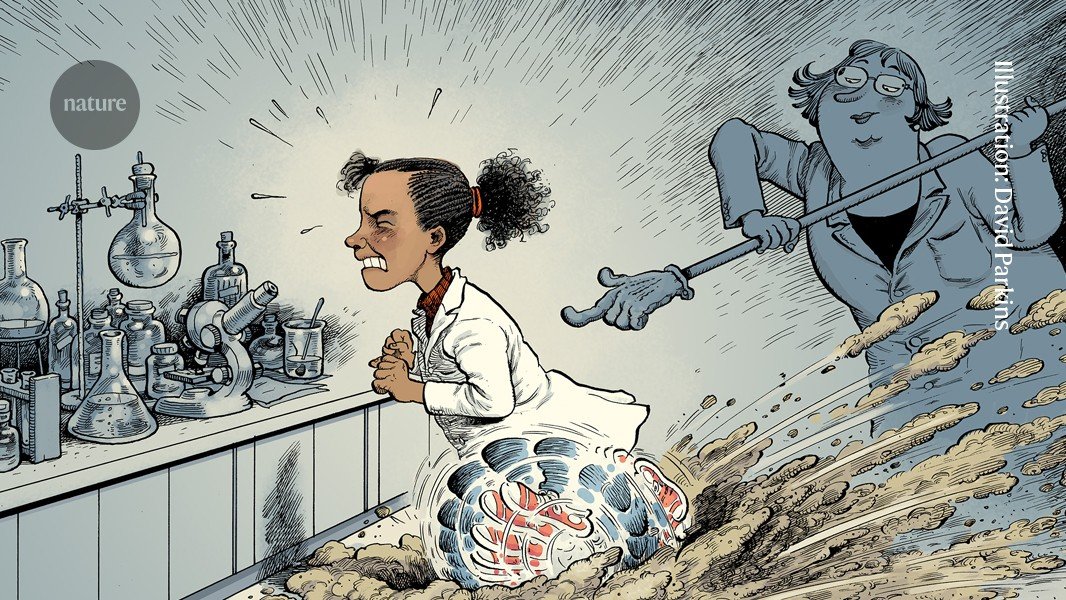
The problem
Dear Nature,
I’m a new principal investigator (PI) with my own laboratory at a prestigious university. The PhD students who make it into our programme have already achieved a lot academically. But, sometimes, that masks their inexperience with the challenges of scientific research, which requires them to be independent decision makers and problem solvers.
From my own graduate work, I know that it’s only when you hit an experimental roadblock that you get to refine your hypothesis and hone your technical skills. But my new graduate students feel like they’ve failed when their first experiments don’t work as planned. It takes a special kind of perseverance to be an independent researcher, and I see this lack of confidence in many of my students.
However, I want to avoid ‘swooping in’ to solve my students’ problems for them. Is there a good recipe for developing the ‘perseverance muscle’ in my PhD students? — A non-helicopter PI
The advice
You’re experiencing a normal phenomenon — one that you clearly remember from your own training. Still, it can be hard to know how to proceed when you’re on the other side of the lab bench.
How to train early-career scientists to weather failure
Studies indicate that up to half of graduate students report feeling anxiety, depression or burnt out during their training years (G. SenthilKumar et al. Am. J. Physiol. Heart Circ. Physiol. 325, H882–H887; 2023). There’s no doubt that frustration with the pace of research or a lack of confidence around dealing with thorny issues — experiments that return unexpected results and even doubts about whether a chosen research question or experimental approach is the right one — can contribute to a student spinning their wheels. To succeed, students must work out how to persevere.
Nature’s Careers team took your problem to four experienced PIs, who explained their best practices.
Build a culture of collaboration
Carlos Menck, a molecular biologist at the University of São Paulo in Brazil, says it shouldn’t be only you who assesses when to help a student and when to step back. He notes that in his country, PIs tend to manage more PhD students than is the case in some other places. That means it’s essential to build teams of people who can act as sounding boards when a PhD student is stumped.
“If you don’t have a team atmosphere, people don’t talk to each other,” says Menck. “If you have people struggling by themselves, then you have a big problem.” Fostering an atmosphere in which colleagues can consult one another is crucial for building self-reliance in new scientists, he says.
Sloan Devlin, a biochemist at Harvard Medical School in Boston, Massachusetts, pairs incoming graduate students with seasoned members of her lab. “Having that new person gain confidence by learning by doing and learning in a safe space where it’s okay to ask the same questions over and over” works well, Devlin says.
Remove the fear of failure
Talented students who enter PhD programmes have often not yet experienced substantial academic failures. But moments of failure can provide the seeds of great successes.
Marie-Emilie Terret, a cell biologist at the Collège de France in Paris, notes that many of her graduate students fear not being good enough when they start. France has a highly competitive academic culture in which many research positions are lifetime civil-service roles, so students might worry about whether they will qualify for these coveted positions. Terret stresses that it is essential to speak frankly with students about the fact that failure and doubt are a part of the profession, not only during training, but also throughout a successful career.
My PI is not offering any support or guidance on my PhD project, what should I do?
“Moments of doubt are inherent to the research profession,” Terret emphasizes. “I would even say they are important for questioning ourselves and moving forward.” But they can be emotionally destabilizing, she stresses. The sooner that students encounter these moments and build the tools to cope with them, the better equipped they will be to handle the same situations throughout their careers. PIs have an important role in guiding their students through these moments, she says, by demonstrating their own resilience and modelling that doubt is normal. This could even mean helping students to learn how to fail effectively, for example by helping them to identify whether an experiment failed owing to a technical error or a larger issue with the experimental design. This mindset helps them to reframe failures as opportunities.
“I knew, through sports and school, from a very young age that doing anything new was going to be incredibly difficult and involve a lot of failure,” says Devlin, who was a sailing champion at Harvard University in Cambridge, Massachusetts, during her undergraduate studies. “But I also learnt later on, after graduate school, that it’s okay to approach a problem from a different direction,” she says.
Set realistic research expectations
Seasoned mentors also say that it’s important to help PhD students set, and sometimes reset, their expectations for how big a project they should set their sights on. PhD students might feel that they need to shoot for the Moon in their first independent research project to compete successfully for faculty positions later on. Menck reminds those who are struggling that it is often more valuable to have realistic goals.
I’ve earned my PhD — what now?
“We call this approach ‘rice and beans’,” Menck says. “If something is not going well, we suggest alternatives” that might be simpler to achieve. That can also lead to unexpected successes. One of Menck’s former students, now a professor at the University of California, San Diego, failed initially in efforts to use antisense RNA to block gene transcription. Trying out alternative methods led the student to develop the lab’s first successful adenovirus vector used for gene transduction.
“It was fantastic and he finished his thesis,” Menck says. “He thought about alternatives to make his experiment work, and in the process, he developed a lot of very interesting ideas.”
Chwee Teck Lim, a biomedical engineer at the National University of Singapore, takes a similar approach. “I never tell my PhD students that they have to publish two or three papers before they graduate, and many of them publish later.” He says that this reduces the pressure on students and prevents them from rushing through their research, something that might lead them to make mistakes.
Devlin builds a culture of partnership among her lab members, so that students know that they can reach out to anyone in the lab for a helping hand: “It’s not a top-down approach.”
